
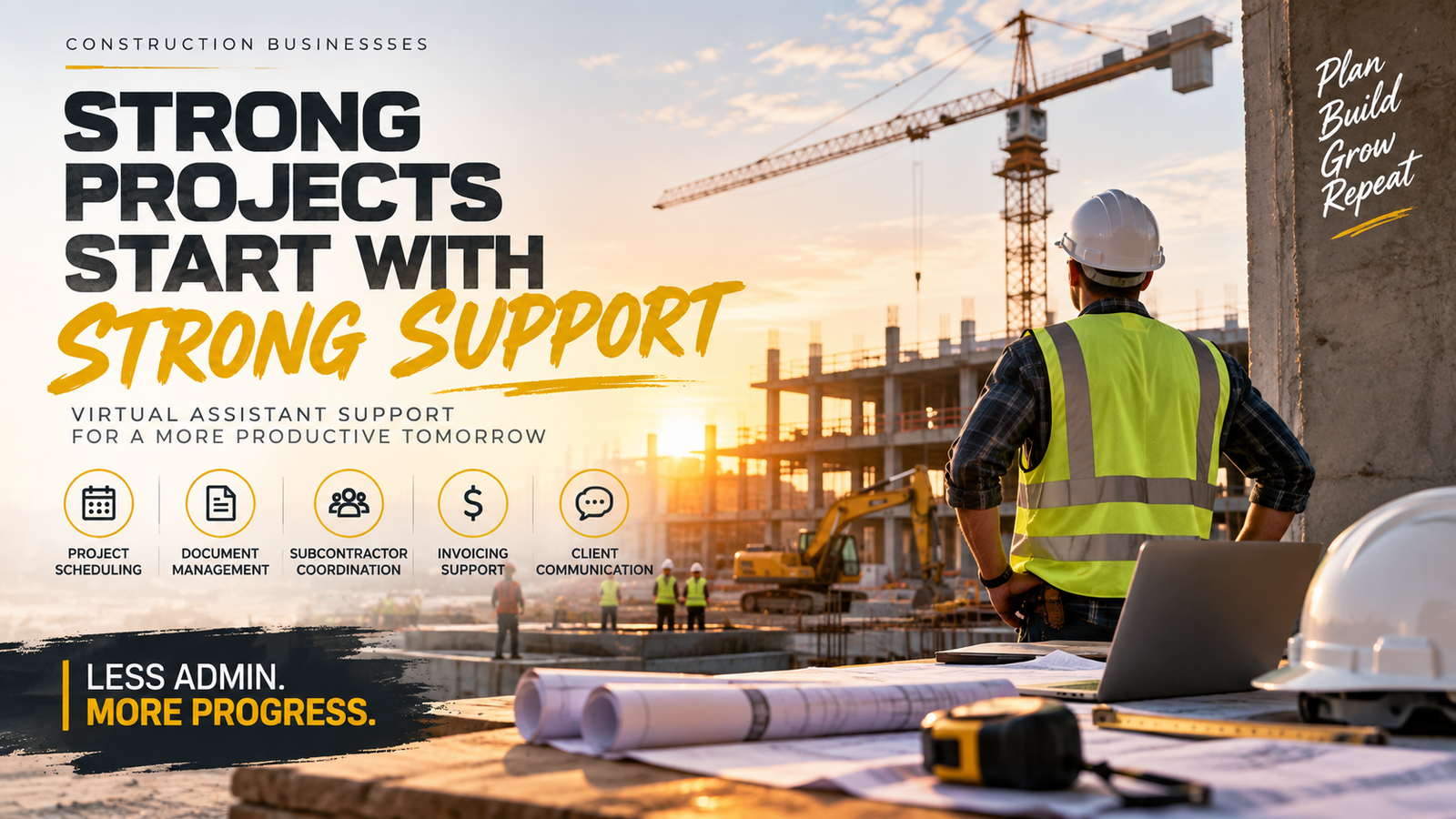
Construction companies do not usually lose productive hours because their teams lack things to do. They lose them because project managers, estimators, office staff, and owners are pulled into too many administrative tasks at once.
Scheduling updates, subcontractor communication, RFIs, document organization, change orders, invoices, client emails, permits, and project records can quickly consume time that should be spent managing projects and growing the business.
A Construction Virtual Assistant can provide dedicated administrative and back-office support, helping contractors organize these workflows while project managers and field teams remain focused on construction.
What Does a Construction Virtual Assistant Do?
A Construction Virtual Assistant provides remote administrative support specifically adapted to construction workflows. Depending on the company's processes, a construction VA can assist with scheduling, documentation, CRM or project-management updates, subcontractor coordination, estimating administration, invoicing follow-ups, customer communication, and other repetitive office responsibilities.
The goal is not to replace construction professionals. It is to take structured administrative work off their workload so they can focus on decisions, field operations, project execution, and client relationships.
Why Construction Companies Are Looking for More Administrative Support
Labor availability remains a major challenge across the construction industry. In September 2026, the Associated General Contractors of America reported that 88% of firms with craft openings said those positions were as hard or harder to fill than a year earlier, while 87% reported the same for salaried openings.
At the same time, construction companies are increasing their use of technology. AGC and Sage reported that 61% of surveyed firms were using AI or planning to increase investment in AI, particularly for office and administrative functions, estimating, and preconstruction.
This creates an opportunity for contractors to rethink how administrative work is handled.
1. Keep Project Documentation Organized
Construction generates a constant flow of information.
A VA can help organize:
-
Project documents
-
Contracts and attachments
-
RFIs
-
Submittals
-
Change orders
-
Photos
-
Inspection records
-
Meeting notes
-
Vendor and subcontractor documents
-
Project correspondence
Instead of allowing information to remain scattered across emails, folders, and spreadsheets, a VA can maintain structured filing and naming procedures based on the company's SOPs.
2. Support Project Scheduling and Coordination
Construction schedules change constantly.
A Construction Virtual Assistant can support the administrative side of scheduling by updating calendars, coordinating meetings, sending reminders, maintaining task lists, and communicating approved schedule changes to the appropriate people.
This can be especially useful for general contractors managing multiple subcontractors and projects simultaneously.
The VA does not make field decisions. Instead, they keep the administrative workflow moving according to established instructions.
3. Reduce the Burden of Subcontractor Follow-Ups
Subcontractor coordination can generate dozens of emails and calls every week.
Administrative support can help track:
-
Required documents
-
Insurance certificates
-
W-9s
-
Project schedules
-
Open requests
-
Outstanding paperwork
-
Meeting confirmations
-
Completion updates
A centralized follow-up process makes it easier for project managers to see what is complete and what still requires attention.
4. Assist With RFIs, Submittals, and Change-Order Administration
RFIs, submittals, and change orders require careful documentation.
A trained construction VA can help maintain logs, organize supporting files, update status information, prepare administrative follow-ups, and ensure documents are routed according to company procedures.
This can reduce the amount of time project managers spend searching through emails and manually updating spreadsheets.
Professional judgment and technical approvals should remain with qualified project personnel.
5. Support Estimates and Preconstruction Administration
Estimating and preconstruction involve substantial administrative work before a project even begins.
A construction VA may assist with:
-
Bid document organization
-
Vendor and subcontractor research
-
Bid invitation tracking
-
Proposal document preparation
-
Spreadsheet updates
-
Estimate data entry
-
Follow-up communication
-
Deadline tracking
This allows estimators and project leaders to spend more time reviewing scope, pricing, risks, and project requirements.
6. Keep Customer Communication Consistent
Clients expect regular updates throughout a construction project.
A virtual assistant can support communication by organizing approved updates, scheduling meetings, tracking unanswered messages, preparing follow-up reminders, and maintaining client records.
For example, a VA can maintain a simple communication tracker showing:
Client → Project → Last Contact → Outstanding Item → Next Follow-Up
That simple workflow can prevent important conversations from being forgotten.
7. Help With Invoicing and Accounts Receivable Follow-Ups
Administrative delays can affect cash flow.
A construction VA can support the administrative side of invoicing by organizing invoice information, updating records, tracking outstanding invoices, sending approved payment reminders, and maintaining follow-up lists.
For companies using accounting software or project-management platforms, the VA can follow established procedures for data entry and status updates.
Financial approvals and other responsibilities requiring authorized personnel should remain with the appropriate team members.
8. Maintain CRM and Construction Software Data
Construction companies often use multiple platforms for project management, accounting, CRM, communication, and documentation.
When information is not updated consistently, employees may end up working from outdated records.
A construction VA can help maintain:
-
Customer records
-
Project statuses
-
Contact information
-
Task lists
-
Follow-up dates
-
Vendor records
-
Project notes
-
Administrative dashboards
Consistent data entry can make information easier for project managers and owners to access.
9. Build Repeatable Administrative Workflows
One of the biggest advantages of dedicated construction administrative support is the ability to turn repetitive work into repeatable processes.
For example:
New Project → Document Setup → Subcontractor Files → Schedule → Client Communication → RFI Tracking → Change Orders → Invoicing → Project Closeout
Each stage can have defined responsibilities, checklists, deadlines, and escalation points.
This creates a more predictable back-office operation as the company takes on additional projects.
What Should Construction Companies Delegate First?
The best starting point is usually work that is repetitive, process-driven, and easy to document.
Good candidates include:
-
Data entry
-
Scheduling
-
Document organization
-
Follow-up tracking
-
CRM updates
-
Subcontractor paperwork
-
Meeting coordination
-
Invoice follow-ups
-
Project administration
-
Customer communication
-
Bid administration
Tasks requiring engineering judgment, contract interpretation, construction-site decisions, safety authority, or final project approval should remain with appropriately qualified professionals.
How to Choose a Construction Virtual Assistant
Look for someone who understands that construction administration is different from generic office administration.
Important qualities include:
Construction workflow knowledge: They should understand projects, contractors, subcontractors, documents, schedules, and common administrative terminology.
Software familiarity: Experience with construction management, CRM, accounting, communication, or document-management systems can shorten the learning curve.
SOP discipline: Construction businesses benefit from assistants who can follow documented processes consistently.
Communication skills: A VA may communicate with clients, vendors, subcontractors, and internal employees, so clear professional communication matters.
Attention to detail: Small administrative errors can create larger project problems when information is missing or outdated.
Frequently Asked Questions
What does a Construction Virtual Assistant do?
A Construction Virtual Assistant provides administrative and back-office support for contractors and construction companies. Common responsibilities include scheduling, documentation, subcontractor follow-ups, CRM updates, project administration, invoicing support, and customer communication.
Can a virtual assistant help a general contractor?
Yes. A VA can support many administrative workflows for general contractors, including subcontractor coordination, document management, scheduling, project updates, bid administration, and follow-ups.
What construction tasks can be outsourced?
Repetitive administrative tasks such as data entry, document organization, scheduling, follow-ups, CRM updates, invoicing administration, and project coordination are common candidates for outsourcing.
Can a construction VA work with construction software?
Yes. Depending on experience and training, a VA can work with construction management platforms, CRMs, accounting systems, communication tools, document-management systems, and other software used by a contractor.
How does a construction VA help project managers?
A VA can reduce the amount of repetitive administrative work handled directly by project managers, allowing them to spend more time on project execution, subcontractor management, client relationships, and higher-level decisions.
Final Thoughts
Construction companies need their skilled people focused on the work that requires construction expertise.
As labor shortages continue to challenge contractors and construction businesses increase their use of technology, administrative workflows deserve more attention. Current industry data shows both pressures clearly: construction firms continue to struggle with staffing, while technology investment is increasingly being directed toward office, administrative, estimating, and preconstruction functions.
A Construction Virtual Assistant can provide the operational support needed to organize documents, maintain project information, coordinate follow-ups, support scheduling, and keep routine administrative work moving.
The result is a more organized back office that allows construction professionals to spend more time where their expertise creates the most value: managing projects, serving clients, and building the business.
If administrative work is taking time away from your construction projects, a dedicated VNS Virtual Assistant can help you build a more organized support system.
Book a 30-minute consultation to discuss the workflows you want to delegate.