
Every minute your billing team spends on hold with insurance or chasing a doctor for a missing signature is a minute your profit is leaking into the void. In 2026, the Durable Medical Equipment (DME) industry is facing a documentation crisis. With CMS tightening regulations and private payers introducing increasingly complex medical necessity criteria, the administrative burden has moved from a "nuisance" to a full-blown business threat. If you are a DME supplier, you know the pain of "Admin Debt", the mounting pile of unsigned CMNs, pending authorizations, and incomplete face-to-face notes that keep your equipment in the warehouse and your cash flow in the gutter.
The cost of inaction is staggering. When an order sits in a "pending" queue for two weeks because a physician's office hasn't returned a call, you aren't just losing that sale; you are losing the trust of the referring clinic and the patient. This is why high-growth DME providers are shifting away from the traditional, expensive in-house model. Why pay $60,000 a year for a local administrative staff member when a specialized Medical Virtual Assistant from Virtual Nexgen Solutions can handle the same volume of prior authorizations, document chasing, and billing cleanup for just $8 per hour?
The Stifling Reality of DME Admin Debt in 2026
The DME landscape in 2026 is no longer about who has the best equipment; it is about who has the most efficient system. We see six major pain points that are currently draining the lifeblood of DME businesses:
- The Prior Authorization Black Hole: Orders enter the system but stall for days or weeks as they wait for insurance approval, often due to minor documentation errors that could have been caught at intake.
- The "Doctor Chasing" Cycle: Your staff spends 40% of their day playing phone tag with medical assistants to get a simple signature or a qualifying test result.
- High Claim Denial Rates: Payers are using more sophisticated algorithms to flag any claim that doesn't perfectly align with their updated 2026 medical necessity guidelines.
- Patient Intake Friction: Slow processing times lead to frustrated patients who call your office daily, further distracting your team from revenue-generating activities.
- Staff Burnout and Turnover: High-quality billing specialists are quitting because they are tired of the repetitive, manual "grunt work" that defines the current DME workflow.
- Revenue Cycle Stagnation: When your Days Sales Outstanding (DSO) climbs above 50 days, your ability to reinvest in new inventory or marketing disappears.
Virtual Nexgen Solutions provides the administrative engine to solve these hurdles. By integrating a dedicated Medical Virtual Assistant into your workflow, you systematize the "boring" parts of your business, allowing your core team to focus on growth and patient care.
Hack 1: The Real-Time Insurance Verification Engine
Most DME suppliers wait until after the patient intake is complete to verify insurance. This is a recipe for disaster. If the coverage is inactive or the equipment isn't a covered benefit, you’ve already wasted hours of labor.
SOP 1: Real-Time Insurance Verification Protocol
- Receive the patient referral via fax or EMR portal.
- Log into the payer portal (e.g., Availity, Waystar, or specific payer sites) within 15 minutes of receipt.
- Confirm active coverage, deductible status, and co-insurance percentages.
- Verify if the specific HCPCS code requires prior authorization for that specific plan.
- Document all findings in the patient notes and flag the order for either "Immediate Processing" or "Documentation Needed."
- Best Practice: Never move an order to the next stage without a "Coverage Confirmed" timestamp.
By having a Medical Virtual Assistant handle this at $8 per hour, you ensure that every order in your pipeline is actually billable.
Hack 2: Proactive Doctor Chasing (The "72-Hour Rule")
Waiting for a doctor's office to return a fax is a passive strategy that kills margins. You need a proactive "chasing" system that treats every missing signature like a lost check.
SOP 2: Proactive Physician Documentation Follow-up
- Identify orders missing a Certificate of Medical Necessity (CMN) or Physician Order.
- Send the initial fax request immediately.
- Schedule a follow-up call 24 hours later if the document is not received.
- On the call, identify the specific person responsible for DME signatures and build a rapport.
- If the document is not received by the 72-hour mark, escalate to a "Direct Physician Outreach" or notify the patient to assist in the request.
- Log every contact attempt with date, time, and the name of the person spoken to.
Hack 3: Pre-Submission Documentation Audits
Payers look for any reason to deny a claim. A specialized Medical Virtual Assistant acts as a human "filter" to ensure every submission is bulletproof.
SOP 3: Medical Necessity Pre-Audit Checklist
- Compare the diagnosis code on the order with the payer’s medical necessity guidelines.
- Verify the face-to-face clinical notes specifically mention the equipment being ordered.
- Check that all test results (e.g., O2 saturation for oxygen, sleep study for CPAP) meet the qualifying thresholds.
- Ensure the physician’s signature is legible and includes the NPI number and date.
- Highlight any discrepancies and resolve them with the referring office before the formal submission.
The ROI of Specialization: A Tale of Two Agencies
To understand the impact of these systems, look at these real-world examples of how Virtual Nexgen Solutions has transformed DME operations.
Case Study: A Mobility Equipment Provider in Texas
This supplier was struggling with a 35% denial rate on complex power wheelchairs. Their in-house team was overwhelmed with the 40+ pages of documentation required for each claim. After onboarding two Medical Virtual Assistants from Virtual Nexgen Solutions at $8/hour, they implemented a strict pre-audit SOP. Within 90 days, their denial rate dropped to 8%, and their average time-to-delivery decreased from 45 days to 28 days. They saved over $90,000 in annual salary costs while increasing their monthly order volume by 20%.
Case Study: A Respiratory Supply Company in Florida
Facing a massive backlog of oxygen re-certifications, this company was at risk of losing thousands in recurring monthly revenue. We deployed a Medical Virtual Assistant specifically to manage the CMN renewal calendar. The VA systematized the outreach to physicians 30 days before the expiration. Result: 100% of their oxygen patients remained compliant, and the company avoided over $12,000 in monthly "profit leakage" from lapsed authorizations.
Hack 4: Payer Portal Mastery & Status Tracking
In 2026, you cannot rely on "waiting for the mail" to know the status of an authorization. Your Medical Virtual Assistant should live in the payer portals.
SOP 4: Daily Authorization Status Monitoring
- Create a master tracking sheet or use a tool like Brightree to monitor all pending authorizations.
- Log into each primary payer portal daily (UnitedHealthcare, BlueCross, Medicare Noridian, etc.).
- Update the status of every "Pending" request to "Approved," "Denied," or "More Info Requested."
- If "More Info" is requested, identify the specific missing element and initiate the fix immediately.
- Notify the warehouse team the moment an "Approved" status is confirmed to schedule delivery.
SOP 5: Managing the Denied Claims Queue
- Pull a daily report of all newly denied claims.
- Categorize the denial reason (e.g., CO-16: Missing info, CO-50: Not medically necessary).
- Draft the appeal letter or gather the missing documentation as specified by the payer.
- Resubmit the corrected claim or appeal within 48 hours of the initial denial.
- Track the appeal status weekly until resolution.
Hack 5: Systematizing the CMN/PAR Lifecycle
The lifecycle of a Certificate of Medical Necessity (CMN) or Prior Authorization Request (PAR) is where most DME providers lose money. It is a game of details.
SOP 6: CMN Expiration Management
- Review the "Upcoming CMN Expiration" report 45 days in advance.
- Contact the patient to confirm they are still using the equipment and have a follow-up appointment scheduled.
- Reach out to the physician's office to request the updated clinical notes and a new order.
- Bundle the documentation and submit the renewal 15 days before the current CMN expires.
SOP 7: Document Indexing and Digital Filing
- Receive incoming faxes and emails in the centralized inbox.
- Review each document and label it according to company naming conventions (e.g., [PatientName]CMN[Date]).
- Upload the document to the correct patient folder in the DME software (e.g., Bonafide or Brightree).
- Link the document to the specific pending order to clear any "Missing Info" flags.
Hack 6: Seamless Patient Intake Coordination
First impressions matter. When a patient gets their equipment quickly, they become a referring source themselves.
SOP 8: Patient Intake and Data Entry
- Receive the initial referral and check for basic completeness (Name, DOB, Insurance, Equipment).
- Create the patient profile in the EMR/DME system.
- Call the patient to verify their address, phone number, and primary physician.
- Explain the next steps of the authorization process to set realistic expectations.
SOP 9: Outbound Patient Satisfaction Calls
- Schedule a call 48 hours after equipment delivery.
- Confirm the equipment is working correctly and the patient knows how to use it.
- Ask for a review on Google or a referral to a friend or family member.
- Log any technical issues and immediately route them to the service technician.
Hack 7: Denial Management & Revenue Recovery
Profit leakage happens when you let "small" denials slide. A $50 supply claim might not seem like much, but 100 of them a month is $60,000 a year in lost revenue.
SOP 10: HCPCS Code and Payer Policy Update
- Review CMS and major payer bulletins monthly for changes in coding or coverage rules.
- Update the internal "cheat sheet" used by the intake and billing teams.
- Flag any current recurring orders that may be affected by the new rules.
SOP 11: Daily Revenue Cycle Reporting
- Generate a daily report showing total orders received, total authorizations submitted, and total claims billed.
- Compare these numbers against the monthly revenue goals.
- Identify any "bottleneck" points where orders are stalling for more than 48 hours.
SOP 12: Updating Managed Care Contracts
- Maintain a digital folder of all current payer contracts and fee schedules.
- Ensure the billing software is updated with the correct allowable amounts for each HCPCS code.
- Flag any payments that are lower than the contracted rate for immediate recovery.
The DME Tech Stack: 6 Essential Tools for 2026
To maximize the efficiency of your Medical Virtual Assistant, you need the right software environment. Our VAs are experts in the industry-leading platforms:
- Brightree: The gold standard for DME business management and billing.
- Bonafide: A comprehensive ERP solution for DME suppliers that streamlines inventory and RCM.
- Waystar: An essential clearinghouse tool for verifying insurance and managing denials.
- RingCentral: A VOIP solution that allows your VA to make and receive calls using your local business number.
- Microsoft 365 / SharePoint: For secure, HIPAA-compliant document storage and internal communication.
- Availity: A critical portal for real-time payer interaction and authorization status.
Stop the Leakage and Scale Your DME Business
The difference between a struggling DME supplier and a market leader is the strength of their administrative engine. You cannot scale a business built on "Admin Debt." By partnering with Virtual Nexgen Solutions, you gain access to a specialized Medical Virtual Assistant who understands the nuances of HCPCS codes, CMNs, and payer portals.
At $8 per hour, you are not just hiring a remote worker; you are implementing a system that recovers lost revenue, speeds up delivery, and eliminates the stress of "doctor chasing."
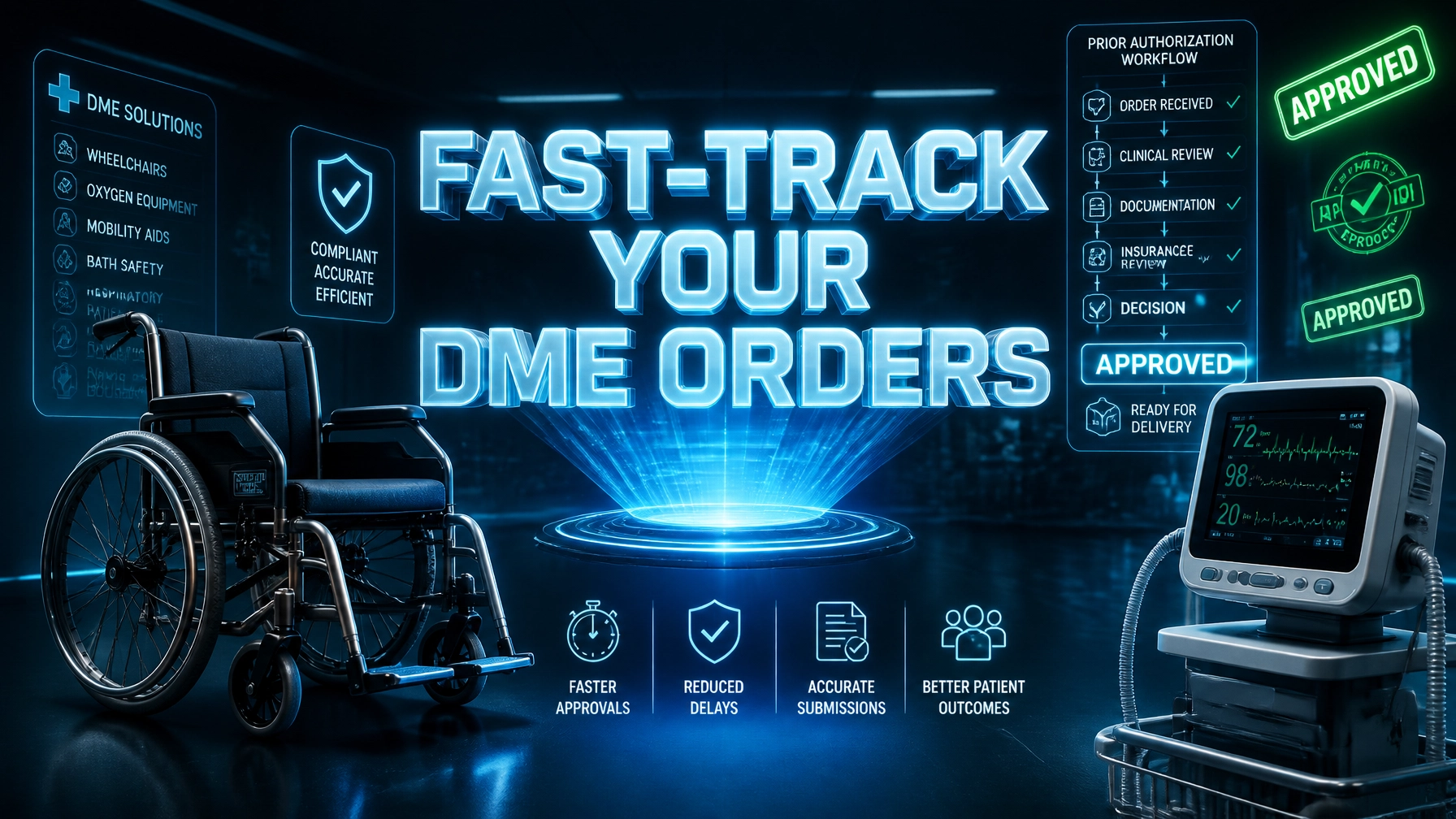
Ready to fast-track your DME orders?
Book a Free 30-Minute Consultation with Virtual Nexgen Solutions
FAQ Section: Common Questions About DME Virtual Assistants
1. Is a Medical Virtual Assistant HIPAA compliant?
Yes. At Virtual Nexgen Solutions, we prioritize security. Our VAs work within your secure, HIPAA-compliant EMR and software systems. We also implement strict data access protocols and use encrypted communication tools to ensure patient PHI is always protected.
2. How do I manage a remote VA for my DME office?
Management is simpler than you think. You assign tasks through your existing DME software (like Brightree) and communicate via tools like Microsoft Teams or Slack. We recommend a 10-minute daily huddle to review the day's priorities and bottlenecks.
3. Can a VA really handle "Doctor Chasing"?
Absolutely. In fact, they are often more successful than in-house staff because they have the dedicated time to follow up relentlessly. They use professional scripts and build relationships with the administrative staff at referring clinics to get signatures faster.
4. What happens if the VA doesn't know a specific payer's rules?
Our VAs are trained to research and document payer-specific medical necessity guidelines. We also provide them with a central knowledge base and SOPs that they update as they learn the specific nuances of your primary payers.
5. How much can I really save by hiring a VA?
The average in-house administrative assistant costs approximately $60,000 per year when you include salary, taxes, benefits, and office space. A Virtual Nexgen Solutions VA costs $8 per hour, which totals about $16,640 per year for a full-time role, a savings of over $43,000 per seat.
6. Do they speak clear English for patient and doctor calls?
Yes. We pre-screen all our Medical Virtual Assistants for high-level English proficiency and professional communication skills. They are trained to handle outbound calls to both medical offices and patients with clarity and empathy.
7. How quickly can a VA be onboarded?
We can typically have a specialized VA integrated into your workflow within 5 to 10 business days. We handle the initial sourcing and basic training, so you only need to provide the specific software access and your unique office protocols.
8. Can they help with billing and collections too?
Yes. Our VAs can handle the entire front-end and back-end of the revenue cycle, including data entry, insurance verification, denial management, and follow-up on outstanding AR.
Ready to Systematize Your Growth?
Don't let another day of admin debt drain your profits. Join the growing list of DME suppliers who have streamlined their operations with Virtual Nexgen Solutions.
Schedule Your Discovery Call Now