

An e-commerce virtual assistant (VA) is a trained remote professional who manages the daily back-office work of an online store. That includes order processing, customer support, product listings, inventory updates, and marketplace operations. U.S. sellers use VAs to cut overhead and respond faster, and they free founders to focus on growth.
Online selling rewards speed. A late shipment, an unanswered message, or an outdated listing costs you sales and reviews. Yet most of the work that protects your store's reputation is repetitive and time-consuming. That is exactly where a dedicated VA adds the most value.
I oversee virtual assistant operations at Virtual Nexgen Solutions (VNS), a San Diego-based virtual assistant and AI automation company serving U.S. businesses since 2016. E-commerce is one of the verticals I see most often, so here is how the work breaks down.
What does an e-commerce virtual assistant actually do?
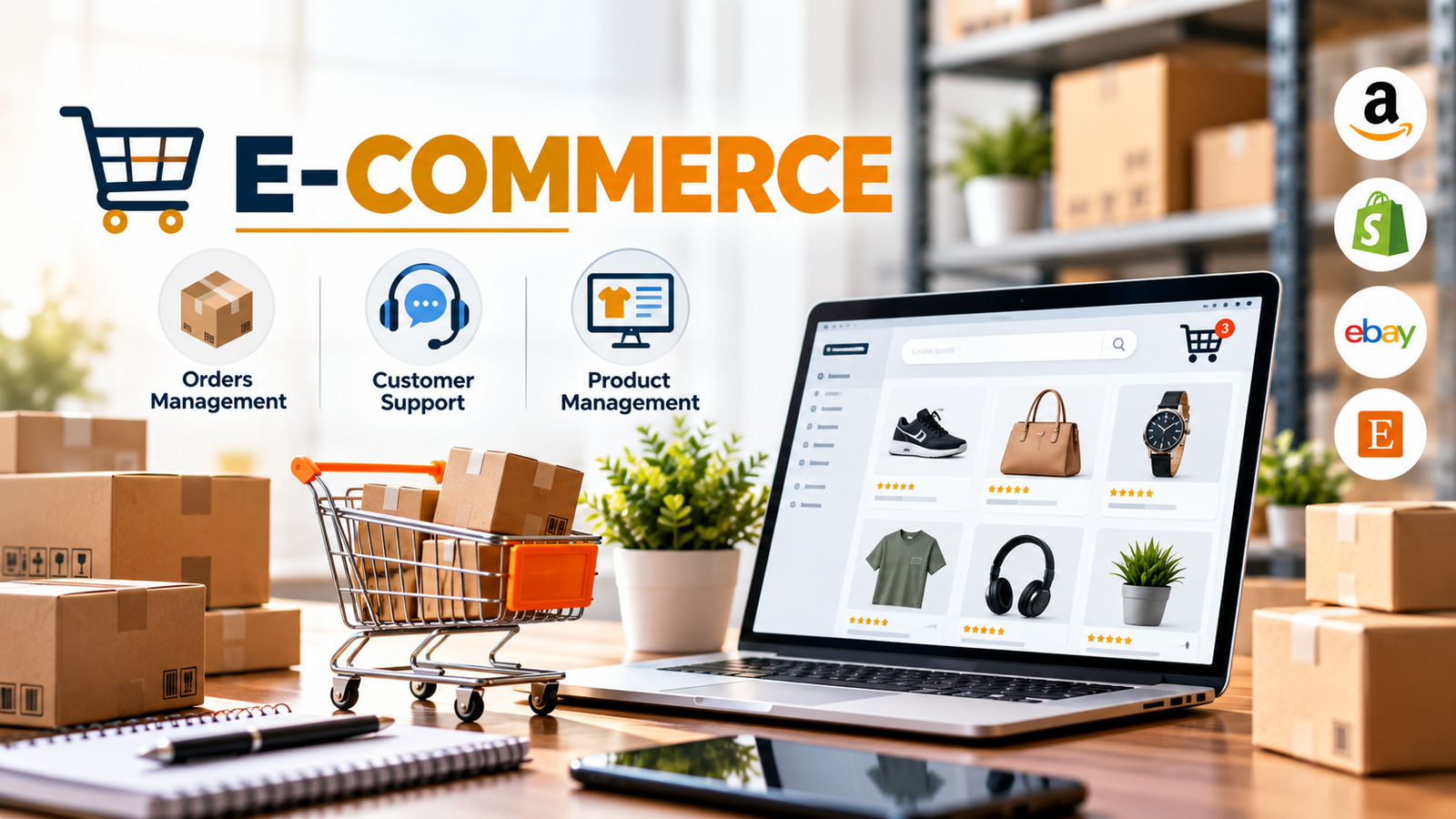
A strong e-commerce VA covers three core areas.
1. Order management
- Monitoring new orders across Amazon, Walmart, Shopify, Temu, and other channels
- Verifying order details and flagging payment or address issues
- Coordinating fulfillment, whether FBA, FBM, or dropshipping suppliers
- Tracking shipments and resolving delays
- Handling cancellations, returns, and refunds according to your policy
2. Customer support
- Answering pre-sale and post-sale questions by email, chat, and marketplace messaging
- Responding within your required service windows
- Managing A-to-Z claims, negative feedback, and review responses
- Escalating complex cases to you with a clear summary
3. Product management
- Creating and optimizing product listings, titles, bullets, and descriptions
- Uploading products in bulk and updating prices
- Monitoring stock levels and flagging low inventory
- Researching competitors and suppliers
- Keeping catalogs consistent across every sales channel
Why are U.S. sellers outsourcing e-commerce operations?
Three reasons come up repeatedly.
Cost control. A full-time in-house hire carries salary, benefits, equipment, and management time. A VA model converts much of that into a flexible monthly cost.
Coverage. Customers expect quick replies. With a VA team, your store can respond outside standard U.S. business hours, which helps protect seller metrics on marketplaces.
Focus. Founders who process orders by hand are working in the business, not on it. Delegating routine tasks gives you time for sourcing, branding, advertising, and strategy.
How do you know which tasks to delegate first?
Start with work that is high-volume, rule-based, and easy to document. A practical order looks like this:
-
Order monitoring and status updates. Clear rules, low risk.
-
Customer messages. Use approved templates and escalation rules.
-
Listing updates and bulk uploads. Easy to check against a standard.
-
Inventory and supplier follow-ups. Valuable once the basics run smoothly.
-
Reporting. Weekly summaries of orders, issues, and refunds.
Keep strategic decisions, such as pricing strategy, supplier negotiation, and brand voice, with the owner until trust is established.
What makes an e-commerce VA engagement succeed?
From experience, the difference between a smooth engagement and a frustrating one comes down to process, not talent.
A written SOP. Document every task module, platform login process, and non-negotiable rule. A VA with a clear SOP performs like a trained team member from week one.
Defined escalation rules. Spell out what the VA can decide alone (a standard refund under a set amount) and what needs your approval.
Consistent communication. A short end-of-day update keeps you informed without constant check-ins.
Quality checks. Review a sample of orders and messages weekly, then tighten the SOP.
Secure access. Use shared password managers and role-based permissions, never shared personal credentials.
How does AI automation fit with a human VA?
Automation handles the predictable parts, such as order notifications, auto-tagging, and first-response messages. A human VA handles judgment: an upset customer, a supplier problem, or a listing that needs a better angle. Pairing the two gives you speed and a human touch. VNS offers both virtual assistants and AI automation so clients can build that combination.
Common mistakes to avoid
- Delegating without documentation
- Giving full account access on day one with no permission levels
- Measuring a VA only by hours instead of outcomes such as response time, order accuracy, and resolved tickets
- Expecting perfection without a feedback loop
Frequently asked questions
How much does an e-commerce virtual assistant cost? Pricing depends on hours, skill level, and scope. Most providers offer part-time or full-time plans, and a dedicated VA usually costs a fraction of a local hire.
Can a VA manage multiple marketplaces? Yes. An experienced VA can work across Amazon, Walmart, Shopify, and dropshipping platforms from one SOP.
Is my store data safe with a remote VA? It can be, with role-based access, password managers, and clear confidentiality terms. Always ask a provider how they handle data security.
How fast can a VA start? With a documented SOP and account access ready, onboarding typically takes days rather than weeks.
Final takeaway
Orders, customer support, and product management are the engine of any online store. Handing them to a trained, well-briefed VA gives you consistency, faster response times, and room to grow. If your day is still filled with order checks and inbox clearing, it is time to delegate.