
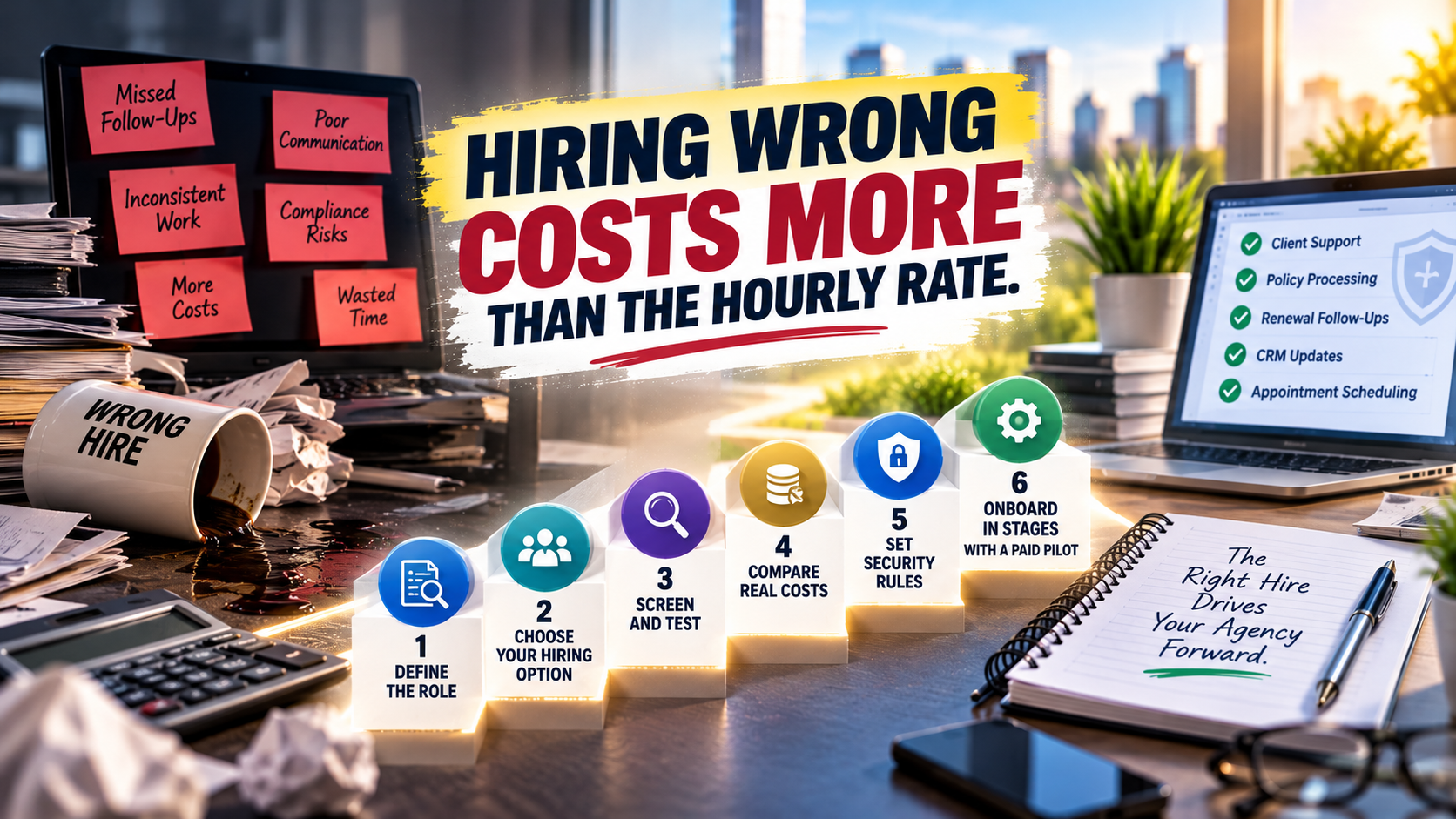
Hiring the wrong support can cost your insurance agency more than the hourly rate. If responsibilities are unclear, systems access is poorly controlled, or the person needs constant correction, you add management work instead of capacity.
To hire a virtual assistant for your insurance agency successfully, start with the workflow you need covered, not a generic job title. Then choose a hiring model, test the candidate against real tasks, set clear boundaries, and ramp up access gradually.
This guide focuses on that hiring decision: where to look, what to assess, how to compare costs, and how to structure onboarding. It is different from a general overview of insurance VA tasks because the goal here is to help you make a sound hiring choice.
1. Define the work before you search
Write down the tasks you want to move off your team’s plate. Include how often each task occurs, the system involved, the expected turnaround time, and who reviews the result.
For example, “help with renewals” is too broad. A useful scope might be: “Review the upcoming-renewal queue each morning, send approved information requests, record responses in the agency management system, and flag incomplete or coverage-sensitive files for the account manager.”
Also define what the role must not do. Depending on your jurisdiction, licensing rules and agency procedures, activities such as recommending coverage, interpreting policy terms, making coverage decisions, or binding insurance may require an appropriately licensed professional. Confirm your boundaries with your compliance lead, carrier, or legal adviser before assigning work.
A clear scope helps you assess candidates fairly and prevents “scope creep”. The gradual addition of duties that were never properly screened or authorized.
2. Choose the right hiring model for your agency
You can hire directly, work with a staffing provider, or recruit a local employee. The best choice depends on your need for control, available management time, coverage hours, and appetite for handling recruiting and continuity yourself.
A direct freelancer can offer flexibility and a lower upfront rate. You’ll usually take responsibility for sourcing, screening, contracts, training, system access, supervision, and finding a replacement if the person leaves. This can suit a small, well-documented workflow if someone on your team has time to manage it.
A specialist staffing provider may handle candidate matching, onboarding coordination, and replacement support. Ask whether the VA is dedicated to your agency, who supervises them, what the fee includes, and whether the provider uses subcontractors. A provider can reduce recruiting and coordination work, but it does not remove your responsibility to set permissions, monitor work, and follow applicable rules.
A local employee may be the better fit when you need in-person collaboration, broader decision-making, or duties that require local licensing or close daily supervision. Factor in the full employment cost and recruitment time, not just the wage.
If you consider a contractor in the United States, don’t rely on the contract label alone to determine worker status. The IRS explains that classification depends on the working relationship and relevant facts. Other countries have their own rules, so seek local advice where needed.
3. Screen for insurance judgment, not just software familiarity
A candidate who has used your agency management system may still need training in your workflows. Look for evidence that they can follow instructions, document actions consistently, communicate professionally, and recognize when to stop and escalate.
Ask candidates to describe how they have handled:
- A request that arrived with missing information.
- A task that did not match the written procedure.
- A client asking a question outside their authority.
- A mistake they found in a record or document.
- A busy queue where several tasks had competing deadlines.
Strong candidates explain how they verify details, record what they did, and ask for guidance when the next step is unclear. Watch for overconfidence. In insurance support, knowing when not to answer can matter as much as speed.
4. Use a paid, practical assessment
A short work sample gives you better evidence than a polished résumé. Keep it paid, limited, and based on fictional or sanitized information, not live client records.
For example, ask the candidate to:
- Organize a mock client folder using your naming rules.
- Draft a neutral reminder requesting missing documents.
- Update a sample task log from a short scenario.
- Identify which questions should be escalated to a licensed team member.
Score accuracy, clarity, process discipline, and escalation judgment. Don’t test someone on confidential production data or ask them to provide unpaid work that your agency might use.
5. Compare the real cost, not just the hourly rate
Published 2026 provider and marketplace estimates vary by location, experience, and what the fee includes. As broad USD examples, some sources place offshore VA support around $8–$15 an hour through a provider, while direct-marketplace support may range more widely. U.S.-based virtual support can cost more. These are indicative figures, not standardized rates or a quote; compare the details behind each price. See, for example, published estimates from XAssure and Stealth Agents.
At $10–$18 an hour, 160 hours of support would be roughly $1,600–$2,880 per month before any provider fees or other costs. A direct freelancer may require more of your team’s time for recruiting, training, supervision, security setup, and coverage planning. A staffing provider may charge more but include some of those services.
Ask for an all-in breakdown: hours, schedule and time-zone overlap, training, equipment, paid leave, management, replacement terms, minimum commitment, and cancellation notice. For agencies in Canada, the UK, or Australia, request a quote in your local currency and confirm the applicable employment, privacy, and insurance rules.
6. Check security and access before sharing client information
Treat access to customer and policy information as a core hiring decision, not an onboarding afterthought. Ask the candidate or provider how they protect data, what devices and networks they use, whether access is shared with subcontractors, and how they report a suspected incident.
Before granting access, agree on confidentiality, permitted systems and uses, incident notification, data return or deletion, and offboarding. Use individual accounts, multifactor authentication, role-based permissions, and only the access needed for the assigned workflow.
If your work involves protected health information in the United States, check whether the arrangement requires a business associate agreement before sharing it. HHS explains when a person or organization handling protected health information on behalf of a covered entity may be a business associate. Privacy and vendor obligations vary by country and situation; confirm the requirements that apply to your agency.
7. Onboard in stages, then review results
A practical onboarding sequence makes expectations visible and limits avoidable risk. Virtual Nexgen Solutions uses a structured five-step onboarding approach: map the workflow, match a dedicated 1-on-1 VA, establish security and access, train against your procedures, and review quality as responsibilities expand.
Start with one defined queue and a supervisor who owns questions and approvals. In the first week, use sample or sandbox work where available, explain your documentation standards and escalation path, and review early tasks closely. Over the following weeks, expand the scope only when quality is consistent.
Set a few measures before work begins:
- Accuracy on reviewed tasks.
- On-time completion and response time.
- Number of items correctly escalated.
- Rework or correction rate.
- Hours of agency-team time freed for higher-priority work.
A short paid pilot can help you assess fit before increasing hours or access. Agree in advance on its length, scope, review dates, and what a successful outcome looks like. At the end, decide whether to continue, adjust the workflow, provide more training, or stop. Remove access promptly if the engagement ends.
When should you hire through Virtual Nexgen Solutions?
If recruiting, screening, and training are the bottleneck, a dedicated insurance-trained VA may be a more practical route than starting from a blank job post. Virtual Nexgen Solutions provides insurance virtual assistant support and insurance policy administration support, with privacy-first workflows and a five-step onboarding process.
The company’s stated service outcomes include reducing administrative workload by up to 60% and increasing operational capacity by up to 3x. Results depend on your task mix, processes, and implementation; agree on measures that make sense for your agency before work begins.
To discuss the workflow you want to delegate, contact Virtual Nexgen Solutions or book a discovery call. Bring a short task list, your preferred coverage hours, and the systems involved. That is enough to begin a focused conversation.
Frequently asked questions
What should I look for when hiring a virtual assistant for an insurance agency?
Look for reliable communication, accurate documentation, relevant insurance workflow experience, respect for privacy, and good escalation judgment. Test these qualities with a paid exercise using fictional or sanitized information.
How much does an insurance agency virtual assistant cost?
Rates vary by location, experience, hours, and whether you hire directly or through a provider. Compare the all-in monthly cost, including training and management, not just the advertised hourly rate.
Can an insurance virtual assistant give coverage advice?
Do not assume so. Licensing rules and permitted duties differ by jurisdiction and task. Keep coverage advice, binding decisions, and other restricted activities with appropriately authorized personnel unless you have confirmed otherwise with qualified advisers.
Should I hire a freelancer or use a staffing provider?
A freelancer may suit a clearly defined workflow if you can manage screening, training, security, and continuity. A provider may be useful when you value dedicated matching, onboarding support, or replacement options. Compare contract terms and responsibilities before deciding.
How should I start onboarding a new insurance VA?
Begin with one documented workflow, a named supervisor, least-privilege system access, and a small set of quality measures. Review work closely at first and expand responsibilities only after the VA demonstrates consistent performance.
Work With Virtual Nexgen Solutions
If your business needs dependable virtual assistant support, Virtual Nexgen Solutions can provide support around your existing workflow. Book a discovery call today.
Get in Touch Now!