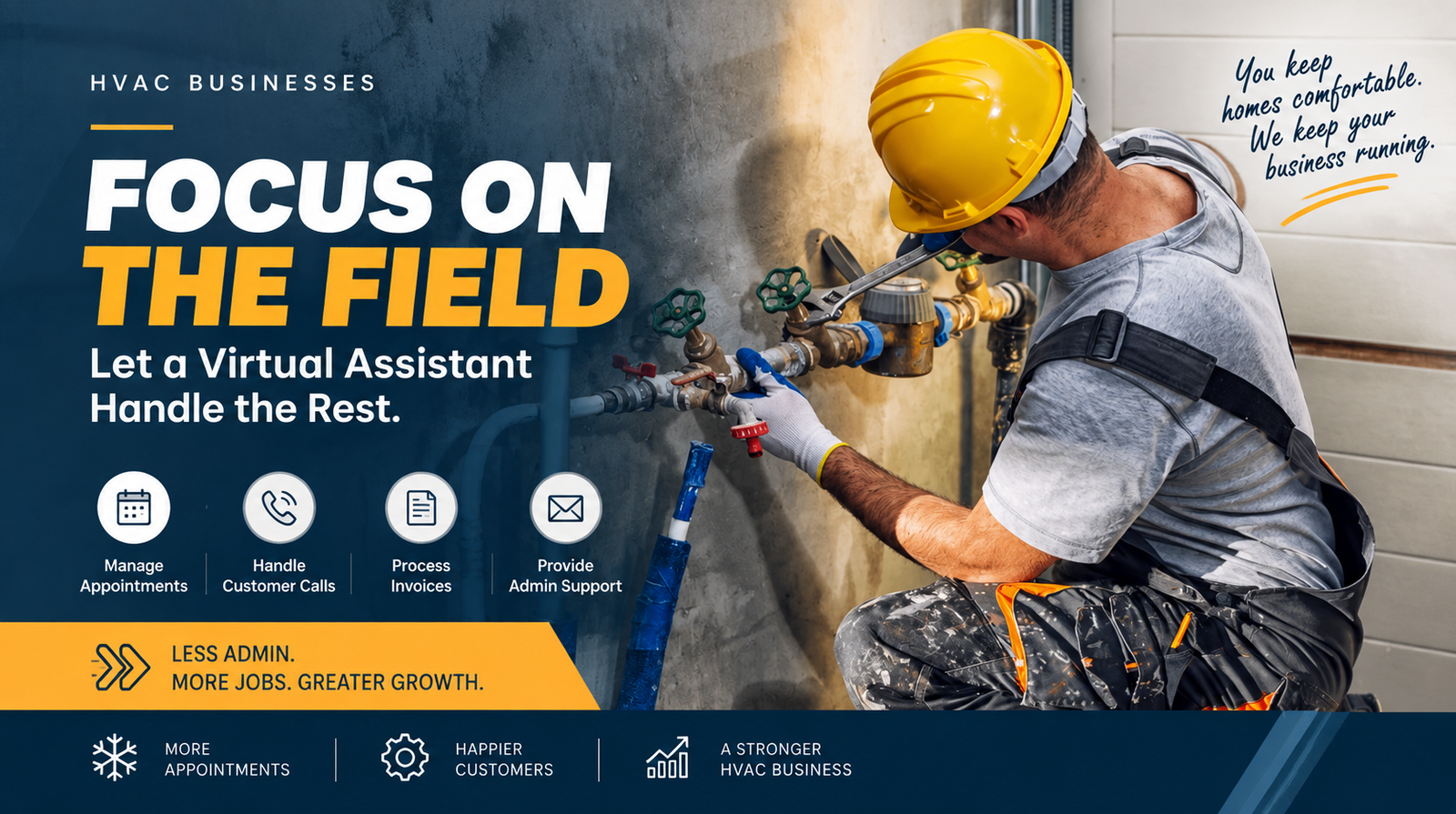


An HVAC company can have skilled technicians, steady demand, and a strong reputation—and still lose revenue because of administrative bottlenecks.A customer calls to schedule a service. A technician needs to be assigned. An estimate needs follow-up. An invoice needs to be processed. A maintenance customer needs a reminder.
When these tasks are not handled quickly and consistently, the problem goes beyond paperwork.
Schedules become harder to manage. Customers wait longer. Technicians lose productive time. Follow-ups get missed.
For growing HVAC service companies, improving administrative operations can be just as important as improving field operations.
This is where HVAC administrative support can help.
Where Does an HVAC Company Lose Time?
The biggest administrative problems are often hidden inside the daily workflow.
A typical service request can involve several steps:
Customer Call → Appointment → Dispatch → Service Visit → Estimate/Invoice → Follow-Up → Customer Record
Every handoff creates an opportunity for delay.
For example, a customer may request an appointment in the morning, but the information may not be entered into the scheduling system immediately. Later, a dispatcher has to verify availability, contact the technician, update the customer, and make sure the appointment is properly recorded.
Multiply this across dozens of service requests, and small delays become a major operational burden.
The Scheduling Bottleneck
Scheduling is one of the most important administrative functions in an HVAC business.
A poorly organized schedule can result in:
- Unnecessary gaps between appointments
- Double-booking risks
- Delayed customer responses
- Excessive back-and-forth communication
- Technicians spending more time waiting or traveling
- Missed opportunities to fill open time slots
Administrative support can help keep appointment information organized, monitor scheduling requests, coordinate approved changes, and ensure that customer information is properly recorded.
The objective is simple:
Keep the right information in front of the right person at the right time.
Technician Coordination Starts Before the Job
Field productivity does not begin when a technician arrives at a customer's property.
It begins with accurate information before the technician leaves.
Administrative teams can help organize:
- Customer details
- Service address
- Appointment information
- Equipment information
- Previous service notes
- Job-related documentation
- Special customer instructions
- Follow-up requirements
When technicians receive organized job information, they spend less time trying to locate missing details.
This creates a smoother connection between the office and the field.
Estimates Should Not Sit Unanswered
Generating an estimate is only one part of the sales process.
The next question is:
What happens after the estimate is sent?
Without a consistent follow-up process, potential revenue can disappear.
An administrative support professional can help maintain an approved follow-up workflow by tracking estimates, identifying pending responses, sending appropriate reminders, updating records, and escalating important opportunities to the responsible team member.
A simple tracking process might look like:
Estimate Sent → Follow-Up Scheduled → Customer Response → Approved / Pending → Next Action
This gives the HVAC team visibility into opportunities that might otherwise get forgotten.
Invoices and Post-Service Administration
The job may be complete, but administrative work often continues.
Service documentation may need to be reviewed and organized. Customer records may need updates. Invoices may need administrative processing. Outstanding items may require follow-up.
When post-service administration is delayed, the entire workflow can slow down.
A virtual assistant can support routine administrative processes such as:
- Organizing service records
- Updating customer information
- Tracking invoice-related tasks
- Maintaining CRM records
- Coordinating follow-ups
- Preparing information for internal review
This allows field technicians and service managers to spend less time dealing with routine paperwork.
Customer Retention Is Also an Administrative Process
Customer retention is not only about providing excellent HVAC service.
It is also about what happens between service appointments.
Customers may need:
- Maintenance reminders
- Seasonal service reminders
- Appointment confirmations
- Follow-up communication
- Estimate reminders
- Service-related updates
If these touchpoints are inconsistent, customers may move to another provider simply because another company communicates better.
A structured administrative workflow helps HVAC businesses stay connected with customers throughout the service lifecycle.
Think Beyond the One-Time Service Call
Instead of viewing a customer interaction as:
Call → Job → Done
HVAC companies can build a longer relationship:
Call → Service → Follow-Up → Maintenance Reminder → Future Service
That shift can create more opportunities for repeat business.
A Better HVAC Administrative Workflow
Growing HVAC companies can improve efficiency by separating field responsibilities from repetitive administrative responsibilities.
Field Team
Technicians and service managers can focus on:
- Diagnosing HVAC issues
- Performing repairs
- Installing equipment
- Communicating technical recommendations
- Completing field service
Administrative Team
Administrative support can focus on:
- Scheduling coordination
- Customer follow-ups
- CRM updates
- Estimate tracking
- Documentation
- Appointment reminders
- Invoice-related administration
- Maintenance follow-up
This creates a cleaner operational structure.
Where a Virtual Assistant Fits
An HVAC virtual assistant can become an extension of the office team.
Instead of expecting dispatchers, service managers, or owners to handle every administrative task, suitable responsibilities can be delegated to a trained virtual professional.
Depending on the company's workflow and systems, support may include:
Scheduling: Organizing appointments and coordinating approved schedule changes.
Customer follow-up: Tracking unanswered calls, estimates, service requests, and other administrative follow-ups.
CRM administration: Keeping customer and job records organized and updated.
Documentation: Organizing service-related information and administrative records.
Maintenance support: Tracking customers who may be due for recurring maintenance communication.
The exact responsibilities should be based on the HVAC company's existing processes and approval requirements.
Can HVAC Software and AI Reduce These Bottlenecks?
Technology can make administrative workflows more efficient, but software alone does not guarantee that tasks will be completed properly.
Many HVAC businesses use platforms for scheduling, dispatching, CRM, customer communication, and field service management.
AI automation can further assist with suitable repetitive workflows such as:
- Task creation
- Reminder generation
- Information extraction
- Follow-up notifications
- Data organization
- Workflow routing
- Administrative reporting
A stronger model combines technology with human oversight:
HVAC Software + AI Automation + Virtual Administrative Support
Software provides the system.
AI helps automate repetitive processes.
A virtual professional monitors and manages administrative workflows.
Your HVAC team focuses on delivering the service.
A Practical 5-Step Improvement Plan
HVAC companies don't need to transform every process at once.
Start with the areas creating the biggest operational delays.
1. Identify Repetitive Tasks
List everything office employees repeatedly do throughout the week.
2. Find the Bottlenecks
Look for tasks that frequently remain incomplete or require repeated follow-up.
3. Create Standard Workflows
Document how scheduling, estimates, customer follow-ups, and administrative tasks should be handled.
4. Delegate Suitable Responsibilities
Move repetitive administrative work away from technicians, owners, and overloaded service managers.
5. Add Automation Where It Makes Sense
Use existing HVAC software and AI tools to reduce unnecessary manual steps while keeping human oversight where required.
Frequently Asked Questions
What is HVAC administrative support?
HVAC administrative support involves handling routine office and operational tasks such as scheduling coordination, CRM updates, customer follow-ups, documentation, estimate tracking, and other administrative workflows.
How can administrative support improve HVAC scheduling?
Administrative support can help organize appointment requests, maintain accurate scheduling information, coordinate approved changes, and reduce delays in customer communication.
Can an HVAC virtual assistant follow up on estimates?
Yes. A trained virtual assistant can track estimates and support approved follow-up processes, helping the HVAC company avoid losing opportunities because of missed administrative follow-ups.
How does administrative support help customer retention?
Consistent appointment reminders, maintenance follow-ups, estimate communication, and customer record management can help HVAC companies maintain stronger ongoing customer relationships.
Can AI automate HVAC administrative work?
AI can assist with suitable repetitive processes such as reminders, task management, information processing, workflow notifications, and administrative reporting. Human oversight remains important for customer-facing and business-critical decisions.
Final Takeaway
For an HVAC service company, administrative efficiency directly affects the customer experience.
A missed follow-up can mean a lost sale.
A scheduling delay can frustrate a customer.
An incomplete record can slow down a technician.
An unanswered estimate can become lost revenue.
The solution is not necessarily to make your existing team work harder.
It is to create a better system for managing the work.
With HVAC administrative support, virtual assistants, and AI automation, service companies can reduce repetitive workloads, improve scheduling coordination, strengthen customer follow-up, and create more capacity for growth.
The goal is simple:
Let your technicians focus on HVAC. Let your administrative systems keep the business moving.
Ready to Improve Your HVAC Operations?
Virtual NexGen Solutions provides virtual assistant and AI automation solutions designed to help service businesses streamline administrative workflows and operate more efficiently.
Book a 30-minute Discovery Call: https://calendly.com/virtualnexgen-info/30min
Learn more: https://virtualnexgen.com/