

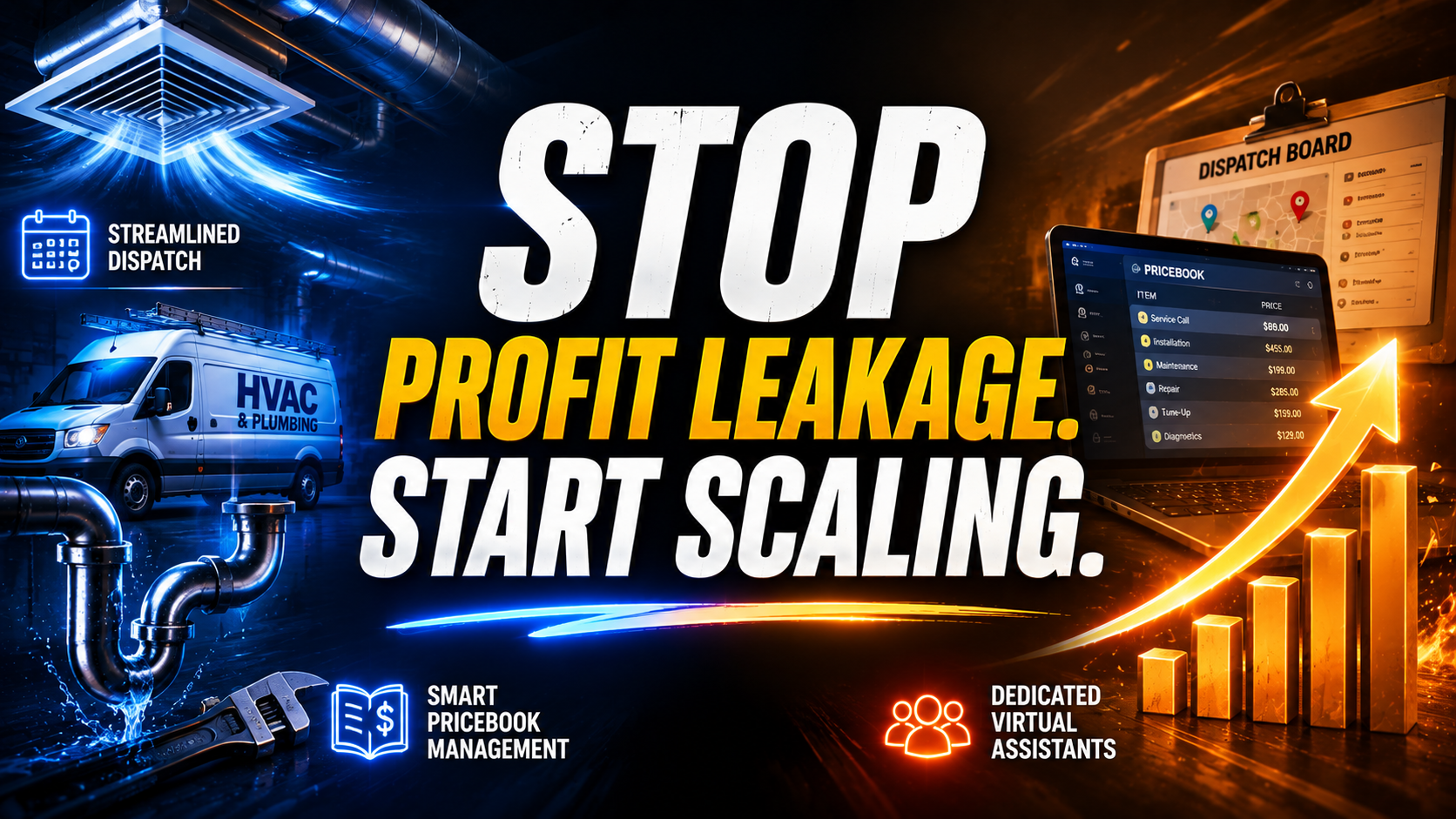
You are likely staring at your dispatch board right now, watching a 3-ton compressor changeout get delayed because your lead technician is spending twenty minutes on the phone sorting out a parts warranty, while three emergency calls ring unanswered on the main line. You built your HVAC or plumbing business to master your trade, to deliver exceptional comfort to homeowners, and to build a generational asset that provides financial freedom for your family. Yet, here you are, sitting at your kitchen table at 9:00 PM, thumbing through invoices, updating pricebook categories, and trying to figure out why your net profit margin is hovering at eight percent despite record summer revenue. You are caught in the daily grind of operational friction, feeling the crushing weight of administrative overhead every single time you want to add a new truck to your fleet.
Understanding Admin Debt in Modern Contracting
In the contracting industry, we talk endlessly about equipment costs, copper prices, refrigerant taxes, and technician retention. But very few business owners calculate the true toll of Admin Debt. Admin debt is the silent accumulator of unhandled paperwork, delayed estimate follow-ups, messy dispatch routing, unstructured pricebooks, and unindexed customer records. Every time you skip entering equipment serial numbers into your field service software because your hands are dirty, you take on admin debt. Every time an incoming service inquiry sits in your voicemail for forty-five minutes because your lone office manager is handling a billing dispute, you add interest to that debt. Over months and years, this debt compounds into severe profit leakage. Your technicians burn precious billable hours sitting in traffic because your routing was slapped together in a rush. Your callbacks increase because job notes are incomplete. Worst of all, your homeowners drift toward your competitors who answer the phone on the second ring and dispatch a technician within a two-hour window. Admin debt does not show up on your balance sheet as a distinct liability, but it drains your bank account through missed upsells, delayed collections, and exorbitant local payroll expenses.
The Half-Day Problem and the Trap of Local Hiring
When your business reaches the three-to-five truck threshold, you face a pivotal fork in the road. You can no longer manage the phones, the scheduling, the parts ordering, and the invoicing yourself while running service calls or estimating jobs. You need back-office support. The conventional advice you receive from local peer groups is to post an ad on Indeed for a full-time, in-house customer service representative or dispatcher. You interview candidates, you offer twenty-two dollars an hour to compete with local retail and medical offices, you pony up for healthcare benefits, workers compensation, and payroll taxes, and suddenly you have added a fixed overhead burden of sixty thousand dollars a year. But here is what nobody tells you about the Half-Day Problem. In a growing contracting business, office workflow is rarely distributed evenly across forty hours. Monday morning brings a tsunami of emergency no-heat and broken-pipe calls that overwhelms a single dispatcher. By Wednesday afternoon, call volume drops off sharply, leaving your expensive local hire with hours of downtime while you are still paying full freight. Furthermore, when that employee calls in sick or quits after six months, you are right back at square one, juggling phones while trying to train a replacement. Hiring local full-time staff locks growing trade companies into rigid cost structures that erode profitability during seasonal shoulder months.
The ROI: $8/Hour vs. The $60,000 Salary Trap
To understand true operational leverage, let's examine the mathematical reality of scaling your back office. A traditional in-house dispatcher or customer service representative in most US markets demands between twenty and twenty-five dollars per hour, plus payroll taxes, unemployment insurance, workers compensation, sick leave, and onboarding costs. That easily translates to fifty-five to sixty-five thousand dollars annually in fully loaded employment expenses. For an independent HVAC or plumbing company running five to ten trucks, that fixed overhead eats a massive chunk of gross operating margin. Now, contrast that with partnering with Virtual Nexgen Solutions to deploy a specialized virtual assistant at an all-inclusive rate of eight dollars per hour. At eight dollars an hour, a dedicated forty-hour-per-week professional costs approximately sixteen thousand six hundred dollars annually: saving you over forty-three thousand dollars every single year in direct payroll overhead. But the real return on investment goes far beyond wage arbitrage. When you free up your internal team from repetitive data entry and manual dispatching, you unlock billable capacity. If your virtual assistant saves your lead technicians just five hours per week in transit and scheduling inefficiencies, that translates to dozens of additional completed service calls every month. At an average ticket size of three hundred fifty dollars for plumbing maintenance or twelve hundred dollars for HVAC diagnostic and repair work, those reclaimed hours generate tens of thousands of dollars in new top-line revenue. You are trading a rigid, high-risk fixed cost for an agile, high-performance operational asset that scales precisely with your seasonal demand.
Technical Mastery: Optimizing ServiceTitan and Housecall Pro
Modern contracting businesses live and die by their field service management software. Whether your operation runs on ServiceTitan, Housecall Pro, Jobber, Service Fusion, or FieldEdge, your software is only as good as the data flowing into it. Most contractors utilize only a fraction of their platform's capabilities because setting up advanced routing modules, cleaning pricebook flat-rate assemblies, and configuring automated customer follow-up sequences requires dedicated administrative focus that field owners simply do not have. Virtual Nexgen Solutions provides virtual assistants who are deeply certified and experienced in navigating these complex platforms. In ServiceTitan, our virtual assistants master Dispatch Pro configuration, ensuring that incoming jobs are automatically matched with the technician who possesses the precise skill set, certification, and proximity to minimize drive time and maximize first-time fix rates. They audit your Pricebook Pro modules, scrubbing obsolete materials, updating tiered good-better-best flat-rate pricing assemblies, and ensuring that every labor matrix accounts for current local overhead and markup targets. In Housecall Pro, our virtual assistants manage customer database segmentation, trigger automated review request sequences immediately upon job completion, and monitor real-time job status boards to ensure no estimate sits in pending status for more than twenty-four hours. By keeping your software pristine, your dispatchers focused, and your pricebooks updated, your entire operation runs with institutional precision.
Licensed vs. Unlicensed: What Can a Virtual Assistant Actually Do?
One of the most common questions contractors ask when considering remote support is where the regulatory and practical boundaries lie. Let's be entirely clear about what a virtual assistant can and cannot do in your HVAC or plumbing business.
- Customer Intake & Emergency Triaging: VAs answer incoming calls, live chats, and web leads, collecting customer name, equipment type, symptom description, and service address, and entering them directly into your dispatch software.
- Dispatch & Route Optimization: VAs monitor live GPS tracking and job statuses in ServiceTitan or Housecall Pro, assigning jobs to the closest available technician to minimize windshield time.
- Estimate & Invoice Follow-ups: VAs review open estimates older than 48 hours, calling or emailing homeowners to address objections, answer questions, and secure approvals.
- Pricebook & Inventory Maintenance: VAs update material costs, add new equipment models and manufacturer SKUs, and organize flat-rate pricing tables.
- Parts & Distributor Coordination: VAs call local supply houses to check part availability, place hold orders for technicians, and verify warranty statuses.
- Review & Reputation Management: VAs send automated and personalized follow-up sequences to collect Google reviews from satisfied homeowners immediately post-service.
- Preventive Maintenance Scheduling: VAs comb through your customer database to book seasonal tune-up appointments during your shoulder months, keeping your trucks rolling year-round.
What a virtual assistant cannot do is perform physical diagnostic work, turn wrenches in a crawlspace, solder copper lines, recover refrigerant, or pull municipal permits that require a licensed master plumber or HVAC contractor signature. They are your digital command center, handling every single back-office touchpoint so your licensed field technicians can focus one hundred percent of their energy on diagnosing equipment, educating homeowners, and closing high-ticket replacements.
Three Real-World Case Studies: Transforming Field Operations
To understand the tangible impact of specialized remote operations, let's examine three anonymized case studies of contractors who partnered with Virtual Nexgen Solutions to overcome severe admin debt and scale their truck fleets.
Case Study One: Residential HVAC Contractor in Dallas, Texas
A growing residential HVAC company running eight installation and service trucks was drowning in dispatch chaos. The owner was spending four hours every morning manually sorting routing sheets, while his part-time receptionist struggled to keep up with incoming summer repair calls. Pricebook assemblies had not been updated in two years, leading to underpriced capacitor and motor replacements that squeezed margins. Partnering with Virtual Nexgen Solutions, the owner integrated a dedicated ServiceTitan virtual assistant at eight dollars per hour to handle Dispatch Pro oversight and pricebook maintenance. Within ninety days, average transit time between jobs dropped by thirty-one percent, allowing each technician to complete an average of one additional service call per day. Furthermore, updating the pricebook flat-rate matrix boosted average ticket size by fourteen percent. The company scaled from eight to twelve trucks within six months without adding a single local administrative hire.
Case Study Two: Commercial and Residential Plumbing Firm in Atlanta, Georgia
A bustling plumbing contractor handling both emergency service dispatch and multi-family repiping projects was suffering from severe leaky funnel syndrome. Over forty percent of high-value replacement estimates were sitting in pending status because the office team lacked the bandwidth to follow up with property managers and homeowners. The company engaged Virtual Nexgen Solutions to deploy a virtual assistant specializing in estimate follow-up, customer communication, and warranty processing through Housecall Pro. The virtual assistant implemented a rigid seventy-two-hour follow-up cadence, instituted automated review requests, and organized all material supplier invoices. Within four months, estimate closing rates increased by twenty-two percent, capturing over eighty-five thousand dollars in previously abandoned revenue. Administrative overhead remained completely flat while monthly net operating profit surged by nineteen percent.
Case Study Three: Multi-Service HVAC and Plumbing Company in Denver, Colorado
An established heating and plumbing shop with twelve service vehicles faced severe seasonal cash flow crunches during autumn shoulder months due to delayed invoicing and lax preventive maintenance booking. The owner hired two Virtual Nexgen Solutions assistants: one dedicated to dispatch and warranty processing, and the second focused exclusively on outbound preventive maintenance scheduling and accounts receivable follow-up. The administrative team systematically scrubbed the customer database, launching targeted tune-up campaigns and ensuring all completed jobs were invoiced within two hours of technician sign-off. As a result, days sales outstanding dropped from forty-eight days to fourteen days, and over three hundred winter tune-up memberships were booked before the first freeze. The business achieved record winter profitability and eliminated the need for seasonal credit lines.
Tactical SOP: How to Delegate Dispatch and Pricebook Management in 5 Steps
To successfully integrate a Virtual Nexgen Solutions assistant into your HVAC or plumbing workflow, you must follow a disciplined operational framework. Do not simply hand over login credentials and hope for the best. Implement this five-step Standard Operating Procedure within your first fourteen days of onboarding.
Step One: Audit Your Current Communication Channels. Map out every inbound touchpoint: phone calls, missed calls, web forms, emergency voicemails, and email inquiries. Document your average response time and identify where prospective customers are dropping off. Provide your new virtual assistant with a standardized scripting document for emergency versus routine service calls.
Step Two: Configure Software Permissions and User Roles. Set up your virtual assistant inside ServiceTitan, Housecall Pro, or your preferred FSM platform with appropriate role-based permissions. Ensure they have access to the dispatch board, customer records, pricebook catalog, and invoicing modules while restricting sensitive financial settings.
Step Three: Establish Daily Dispatch Protocols. Schedule a mandatory ten-minute morning huddle every day at 7:30 AM between your field supervisor and your virtual assistant. Review the day's board, verify technician certifications against incoming job requirements, and establish optimal geographic clustering to minimize transit times.
Step Four: Implement the 48-Hour Estimate Follow-Up Rule. Set up a dedicated dashboard filter for all estimates that have been sent to homeowners but remain unapproved after forty-eight hours. Instruct your virtual assistant to execute a polite multi-touch follow-up sequence via phone, text, and email, addressing common objections regarding financing options and equipment warranties.
Step Five: Conduct Weekly Pricebook and Inventory Audits. Dedicate Friday afternoons to pricebook maintenance. Have your virtual assistant review supplier price sheets, update material cost increases, verify tax rates, and ensure flat-rate pricing assemblies reflect your required gross margin targets before Monday morning dispatching.
Why Virtual Nexgen Solutions?
In an industry crowded with generic overseas outsourcing agencies that treat contracting businesses like commodity call centers, Virtual Nexgen Solutions stands apart through deep vertical expertise and uncompromising reliability. Founded on the principle that small and mid-sized trade companies deserve enterprise-grade operational support without enterprise-level overhead, we have spent years refining our recruitment, vetting, and training pipelines. Our virtual assistants are not generalists; they undergo rigorous training in field service management platforms, customer psychology, trade terminology, and dispatch logic before they ever touch your accounts. We understand the high-stakes reality of a homeowner sitting in a freezing house in January or dealing with a flooded basement in July. When you partner with Virtual Nexgen Solutions, you gain a dedicated administrative engine that operates twenty-four hours a day, seven days a week, ensuring your phones are answered, your schedules are optimized, your pricebooks are profitable, and your business is positioned for aggressive, sustainable growth.
Frequently Asked Questions
What does a virtual assistant for an HVAC or plumbing company actually do on a daily basis?
Our virtual assistants handle inbound customer intake, emergency triaging, dispatch board management, route optimization in software like ServiceTitan and Housecall Pro, estimate follow-ups, pricebook and inventory maintenance, parts ordering coordination, and review generation.
How does hiring a virtual assistant at eight dollars an hour compare to hiring an in-house employee?
A traditional full-time local dispatcher costs between fifty-five and sixty-five thousand dollars annually when factoring in wages, taxes, benefits, and overhead. A dedicated Virtual Nexgen Solutions assistant at eight dollars an hour provides forty hours per week of specialized support for approximately sixteen thousand six hundred dollars annually, saving you over forty-three thousand dollars a year.
Can a virtual assistant take emergency calls late at night?
Yes. Virtual Nexgen Solutions offers twenty-four-hour availability, ensuring that after-hours emergency calls for no-heat or burst pipes are answered promptly, triaged correctly, and dispatched to your on-call technicians according to your exact escalation rules.
Will a virtual assistant know how to use our specific field service software?
Our virtual assistants are extensively trained in major trade platforms including ServiceTitan, Housecall Pro, Jobber, Service Fusion, FieldEdge, and AccuLynx, ensuring a seamless plug-and-play integration with your existing workflows.
How long does it take to onboard a virtual assistant?
Most contractors are fully operational within three to five business days. We handle initial vetting, skills assessment, and software familiarity before pairing them with your specific company processes.
Is my customer data secure when working with a remote assistant?
We enforce strict enterprise-grade security protocols, secure encrypted VPN connections, role-based software permissions, and comprehensive confidentiality agreements to protect all customer and business data.
Can a virtual assistant help us increase our average ticket size?
Yes. By systematically following up on pending estimates, presenting maintenance agreements, and keeping your flat-rate pricebook updated with correct pricing assemblies, our VAs directly contribute to higher conversion rates and larger average invoice totals.
What happens if my assigned virtual assistant falls sick or takes vacation time?
Virtual Nexgen Solutions maintains robust coverage protocols. In the rare event that your primary assistant is unavailable, a fully briefed backup professional steps in immediately to ensure zero disruption to your daily dispatch operations.
How do I communicate with my virtual assistant during the workday?
You maintain direct, real-time communication through your preferred channels including Slack, Microsoft Teams, WhatsApp, phone calls, and direct video huddles, operating exactly as you would with an in-house employee sitting in your office.
Do I need to provide computer equipment and software licenses for the virtual assistant?
No. Our virtual assistants operate from fully equipped professional remote work environments with high-speed redundant internet, professional headsets, and dual-monitor workstations. You only need to provide standard user login licenses for your field service software.
Can a virtual assistant help with our accounts receivable and collections?
Yes. Your VA can monitor aging invoice reports, send automated payment reminders, call commercial and residential accounts regarding overdue balances, and update payment statuses in your accounting software.
What industries do Virtual Nexgen Solutions specialize in beyond HVAC and plumbing?
We provide specialized virtual assistant solutions across multiple high-demand sectors including electrical contracting, roofing, construction, pest control, legal practices, real estate brokerages, medical clinics, and independent insurance agencies.
How do I measure the performance and ROI of my virtual assistant?
We help you track key performance indicators including call answer rates, first-time dispatch accuracy, estimate conversion percentages, review generation volume, and weekly billable hours recovered for your field technicians.
Are there any long-term contracts required to start?
We offer flexible engagement models designed to scale with your business growth, allowing you to adjust your support levels as your truck fleet and operational needs expand.
What is the difference between a general virtual assistant and a Virtual Nexgen Solutions trade assistant?
General virtual assistants lack industry vocabulary, do not understand trade software workflows, and require extensive hand-holding. Our trade assistants understand equipment terminology, warranty processing, dispatch logic, and flat-rate pricing from day one.
Can a virtual assistant help us book preventive maintenance agreements?
Yes. During your shoulder seasons, your VA can conduct outbound calling and email campaigns targeting your existing customer database to book seasonal tune-ups and sell recurring maintenance memberships.
How do we handle parts ordering and distributor coordination remotely?
Your VA can call local supply houses to check inventory availability, place hold orders for your technicians to pick up, and track warranty part credits, saving your field crew hours of wasted time on hold.
Can our virtual assistant manage our Google Business Profile and customer reviews?
Yes. Your VA can monitor incoming reviews, respond professionally within minutes, and execute automated post-service review request sequences to boost your local search rankings.
What happens if we need to scale up our support during peak summer or winter weather spikes?
Because our staffing model is completely agile, you can easily scale your hours or add additional virtual assistants during extreme weather surges without any long-term hiring headaches.
How do we get started with Virtual Nexgen Solutions?
You can book a free thirty-minute operational strategy consultation directly through our website or call our team to analyze your current admin bottlenecks and map out a custom support plan.
Ready to Scale Without Hiring In-House?
Virtual Nexgen Solutions provides Specialized Virtual Assistants for businesses across the United States. Whether you need help with: Scheduling, Dispatching, Operations, Customer Support, Industry Specific Software, Administrative Tasks, Revenue Generating Activities.