

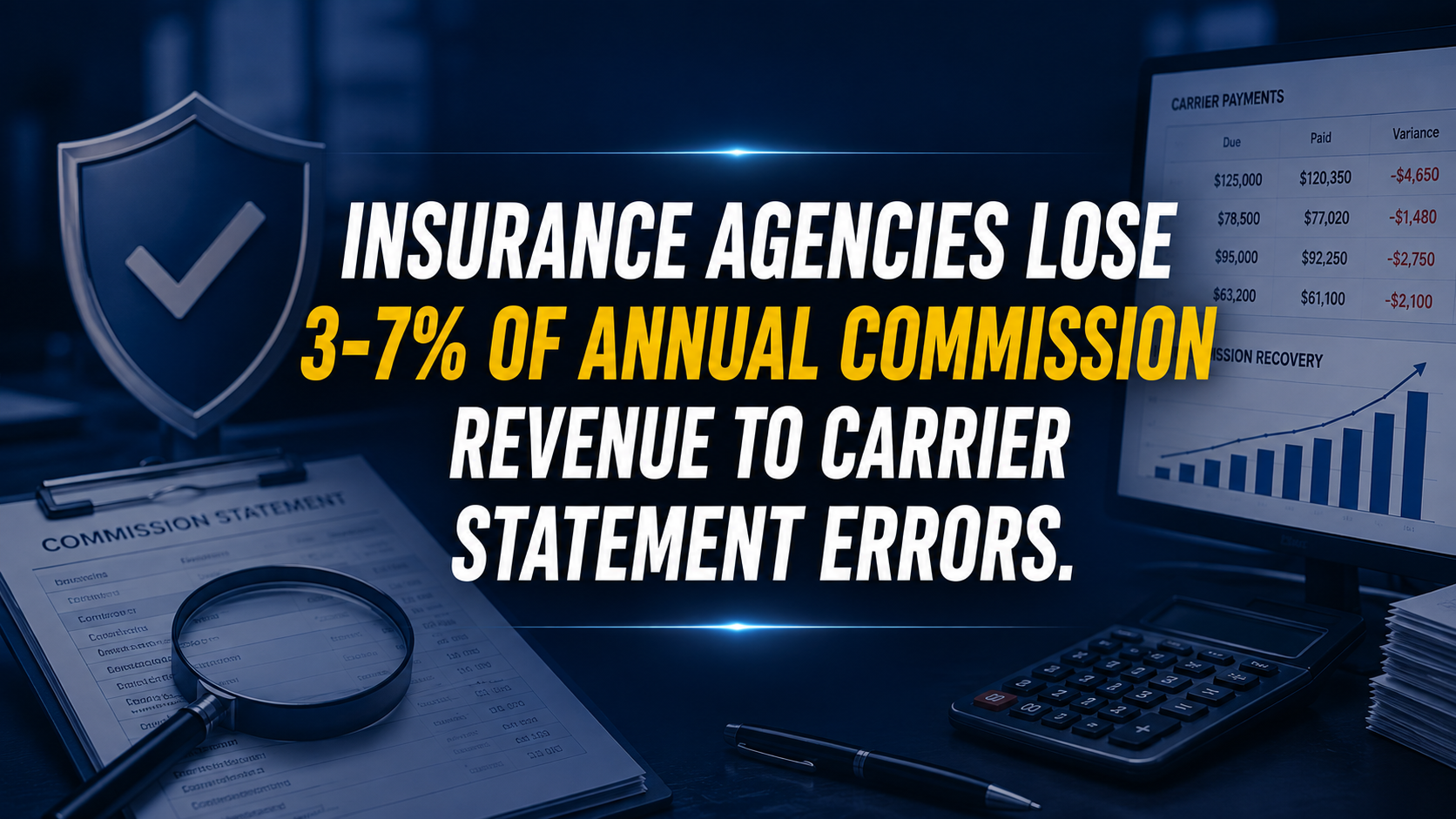
Independent insurance agencies across the United States are currently leaking between 3% and 7% of their total annual commission revenue directly into carrier margins. In an industry operating on razor-thin margins where every producer point matters, this uncollected revenue isn't just a minor bookkeeping annoyance, it represents thousands of dollars in lost profit per year. Carrier statement errors, unapplied endorsement splits, orphan producer codes, and stale Agent of Record (AOR) records create a massive financial blind spot for busy agency principals.
When agency owners and account managers spend 80% of their day putting out fires, handling certificate requests, and wrestling with ACORD forms, meticulous financial reconciliation falls by the wayside. Commission statements arrive monthly from dozens of carriers in wildly inconsistent formats, some as clean CSV exports, others as complex multi-page PDFs, and many buried inside carrier portals. Manually checking hundreds of policy lines against your Agency Management System (AMS) has a documented human error rate of 10% to 15%.
Recovering this lost revenue requires rigorous, repeatable technical processes. By deploying a specialized insurance virtual assistant from Virtual Nexgen Solutions at just $8 per hour, your agency can implement ironclad standard operating procedures (SOPs) that automatically catch discrepancies, track carrier receivables, and protect your bottom line.
10 Core Tasks an Insurance Virtual Assistant Handles Daily
To understand how commission reconciliation fits into daily agency workflows, it helps to look at the full operational scope of a trained insurance virtual assistant. Beyond financial auditing, your VA absorbs the administrative burden across multiple fronts:
- Carrier Statement Ingestion: Downloading, organizing, and archiving monthly commission statements from all carrier portals into secure cloud storage.
- Policy-Level Matching: Reconciling individual statement lines against active policy records inside Applied Epic, AMS360, HawkSoft, or EZLynx.
- Discrepancy Logging: Recording premium mismatches, rate variances, and missing payments into a centralized commission tracking ledger.
- Dispute Preparation: Assembling carrier dispute packets with policy numbers, effective dates, and contract commission schedules.
- Certificate of Insurance (COI) Issuance: Processing standard COI requests for commercial lines clients within 15 minutes of submission.
- Policy Renewal Tracking: Running upcoming renewal reports 60 days out and flagging policies requiring carrier underwriting reviews.
- Endorsement Processing: Entering mid-term policy changes, driver additions, and location updates directly into your AMS.
- ACORD Form Preparation: Pre-filling ACORD 25, 125, 126, and 140 applications for producer review prior to carrier submission.
- Orphan Policy Assignment: Identifying unassigned policies in suspense files and re-attributing them to active producers.
- Client Billing Inquiry Triage: Resolving direct-bill vs. agency-bill discrepancies and answering billing status queries from insureds.
The Technical Fixer: 7 SOPs to Recover Lost Commissions
Implementing structured operational controls transforms commission reconciliation from an impossible chore into a reliable profit center. Below are seven technical standard operating procedures executed by Virtual Nexgen Solutions virtual assistants to eliminate carrier leakage.
SOP 1: Monthly Carrier Statement Ingestion & PDF/CSV Parsing
- Goal: Centralize and normalize raw commission data from all active carrier portals within 48 hours of statement release.
- Steps:
-
- Set up calendar triggers for the 1st through the 10th of every month to check carrier portals (The Hartford, Travelers, Liberty Mutual, Progressive, etc.).
- Download all available commission statements in CSV format where available, or PDF format as a secondary option.
- Rename downloaded files using the standardized naming convention:
YYYY-MM-[CarrierName]-CommissionStatement. - Upload all files into the agency’s secure master commission folder on Google Drive or SharePoint with restricted access permissions.
- For PDF-only statements, run Optical Character Recognition (OCR) or structured data extraction tools to convert line items into tabular spreadsheets.
- Notify the lead accountant or agency principal via Slack or Microsoft Teams that all ingestion tasks for the monthly batch are complete.
SOP 2: Policy-Level Matching & Variance Flagging
- Goal: Match every single line item on carrier statements against active policy records in your AMS to identify payment anomalies.
- Steps:
-
- Export active policy records, premium amounts, and expected commission percentages from your AMS (e.g., Applied Epic or AMS360) for the matching statement period.
- Import the carrier statement spreadsheet and the AMS export into your master monthly reconciliation workbook.
- Execute an automated VLOOKUP or INDEX/MATCH formula matching records primarily by Policy Number, using insured name and effective date as secondary fuzzy-match parameters.
- Filter the matched dataset to isolate line items where the actual paid commission differs from the expected commission by more than $0.05.
- Tag each unmatched line item into one of three categories: Unmatched Statement Line, Unmatched AMS Policy, or Amount Variance.
- Compile a summary report of total expected versus total actual commissions received for the carrier batch.
SOP 3: Identifying & Logging Missing Commissions (Unpaid Bindings)
- Goal: Detect bound policies that exist in your AMS but generated zero commission on the carrier statement within 30 to 45 days of effective date.
- Steps:
-
- Review all policies with effective dates falling within the prior statement cycle that returned a zero-dollar or blank commission entry on the carrier report.
- Cross-reference the policy status in the AMS to ensure the policy is active and premium financing or direct payment has been acknowledged by the carrier.
- Check carrier portals directly to verify whether the policy has been processed on their end or is stuck in underwriting suspense.
- Log every confirmed missing commission into the Master Commission Discrepancy Register with columns for: Policy Number, Insured Name, Effective Date, Written Premium, Commission %, Expected Amount, and Carrier Contact.
- Generate an automated inquiry ticket or email draft addressed to the carrier’s commission department requesting status and payment retroaction.
SOP 4: Commission Rate & Tier Discrepancy Auditing
- Goal: Verify that carriers apply contracted commission percentages rather than standard base rates, capturing tiered volume bonuses and override differentials.
- Steps:
-
- Maintain a digital repository of all active carrier commission schedules and overriding agreements.
- Extract the commission percentage paid on every line item from the reconciled statement workbook.
- Compare the paid percentage against the contracted rate schedule for the specific line of business (e.g., Commercial General Liability, Workers' Compensation, BOP).
- Isolate any policy where the paid percentage is lower than the contracted rate.
- Check whether premium adjustments, endorsements, or retro-rated audits triggered a rate recalculation on the carrier side.
- Flag systemic rate discrepancies affecting entire writing classes for immediate escalation to agency management and carrier reps.
SOP 5: Endorsement, Cancellation & Mid-Term Clawback Reconciliation
- Goal: Accurately reconcile mid-term endorsements, partial cancellations, and negative commission adjustments (clawbacks) to prevent accounting discrepancies.
- Steps:
-
- Filter monthly statements for negative dollar amounts and credit line items.
- Pull the corresponding endorsement Dec page or cancellation notice from the AMS document archive.
- Verify the mathematical accuracy of the commission clawback based on the unearned premium calculation and the contracted commission rate.
- Identify any retroactive clawbacks appearing more than 90 days after a policy change, as these frequently violate carrier agreement windows.
- Update the accounting ledger to reflect negative commission entries in the correct financial period, avoiding distorted month-end revenue figures.
- Notify producers of any significant commission chargebacks affecting their monthly compensation draws.
SOP 6: Producer Split Verification & Commission Attribution Audit
- Goal: Ensure every reconciled commission dollar is credited to the correct writing producer, house account, or referral partner.
- Steps:
-
- Cross-reference the producer code listed on the carrier statement against the internal split schedule in your AMS.
- Identify discrepancies where a producer's commission was misattributed to a "House" account or an incorrect agent code due to carrier onboarding errors.
- Review house account thresholds to confirm whether residual accounts are correctly routing according to agency partnership agreements.
- Generate a pre-payout producer commission verification report for management review prior to monthly payroll runs.
- Document all split corrections in the audit log to maintain transparent internal accounting records.
SOP 7: Carrier Dispute Submission & Commission Receivable Tracking
- Goal: Submit formal payment disputes within carrier-mandated deadlines and track outstanding discrepancies until cash is collected.
- Steps:
-
- Compile dispute packages for all validated discrepancies, attaching: agency NPN, policy number, effective date, statement copy, contract schedule, and specific error description.
- Submit disputes via carrier portals or designated accounting email channels within 15 days of statement receipt.
- Enter each submitted dispute into the Commission Receivable Aging Tracker with assigned follow-up dates (15, 30, and 45 days post-submission).
- Send automated follow-up inquiries to carrier accounting reps for any dispute remaining unresolved after 30 days.
- Upon receipt of adjustment payments, reconcile the supplementary deposit against the open receivable log and close the ticket.
Industry Software Mastered by Our Virtual Assistants
A specialized virtual assistant from Virtual Nexgen Solutions arrives fully trained on the industry-standard Agency Management Systems (AMS), CRM platforms, and carrier portals used by independent agencies across the United States. They hit the ground running without requiring technical onboarding on core software stacks:
- Agency Management Systems: Applied Epic, AMS360, HawkSoft, EZLynx, Vertafore, and AgencyMatrix.
- Accounting & Reconciliation Tools: QuickBooks Online, Xero, Excel advanced macros, and specialized carrier reconciliation plugins.
- Carrier Portals & Rating Tools: Ivans Download, Bold Penguin, State Auto, Travelers Agent Portal, The Hartford E-Business, and Progressive Agent.
- Client Communication & CRM: HubSpot, Salesforce Financial Services Cloud, RingCentral, and Agency Zoom.
Why Independent Agencies Choose Virtual Nexgen Solutions
Running an independent insurance agency in today’s competitive market requires freeing your licensed producers from administrative gridlock. While hiring a full-time in-house administrative assistant in the US costs upwards of $60,000 per year plus benefits, payroll taxes, and overhead, Virtual Nexgen Solutions provides elite, rigorously vetted virtual assistants starting at just $8 per hour.
Since 2016, we have specialized in supporting independent agencies, MGAs, risk management firms, and insurance brokers. Our virtual assistants are trained in insurance workflows, data security compliance, and precise financial reconciliation. We handle the recruitment, screening, and ongoing quality assurance so you can scale your agency operations seamlessly without inflating your fixed overhead.
Frequently Asked Questions
1. What is commission reconciliation for an independent insurance agency?
Commission reconciliation is the monthly process of matching line items from carrier commission statements against active policy records in your Agency Management System (AMS) to verify correct premium amounts, commission rates, and producer splits.
2. Why do independent agencies lose 3% to 7% of their commission revenue?
Agencies lose revenue due to unbilled carrier statements, unapplied endorsement splits, incorrect commission percentages applied by carriers, orphan producer codes, and missed clawback verifications that go unnoticed during manual reviews.
3. How does a virtual assistant handle monthly carrier statements?
A virtual assistant downloads statements from all carrier portals, converts PDFs/CSVs into structured workbooks, performs automated matching against AMS records, and flags any financial discrepancies for review.
4. Can an insurance virtual assistant work directly inside Applied Epic or AMS360?
Yes. Virtual Nexgen Solutions virtual assistants are experienced in navigating major Agency Management Systems including Applied Epic, AMS360, HawkSoft, and EZLynx with secure credential handling.
5. How much does an insurance virtual assistant cost with Virtual Nexgen Solutions?
Our specialized insurance virtual assistants start at just $8 per hour, providing a cost-effective alternative to hiring full-time, local administrative staff.
6. What happens when a missing commission payment is discovered?
The virtual assistant logs the missing payment in a centralized tracking register, assembles supporting documentation (policy dec page, contract schedule), and submits a formal carrier dispute within required deadlines.
7. How do virtual assistants help with producer compensation splits?
They cross-reference carrier statement producer codes against internal agency split schedules, ensuring commission payouts match actual policy ownership and eliminating manual calculation errors.
8. How quickly can a virtual assistant start reconciling our commission statements?
Onboarding is streamlined; after analyzing your agency’s specific carrier mix and AMS setup, your dedicated virtual assistant can begin structured monthly reconciliation within days.