
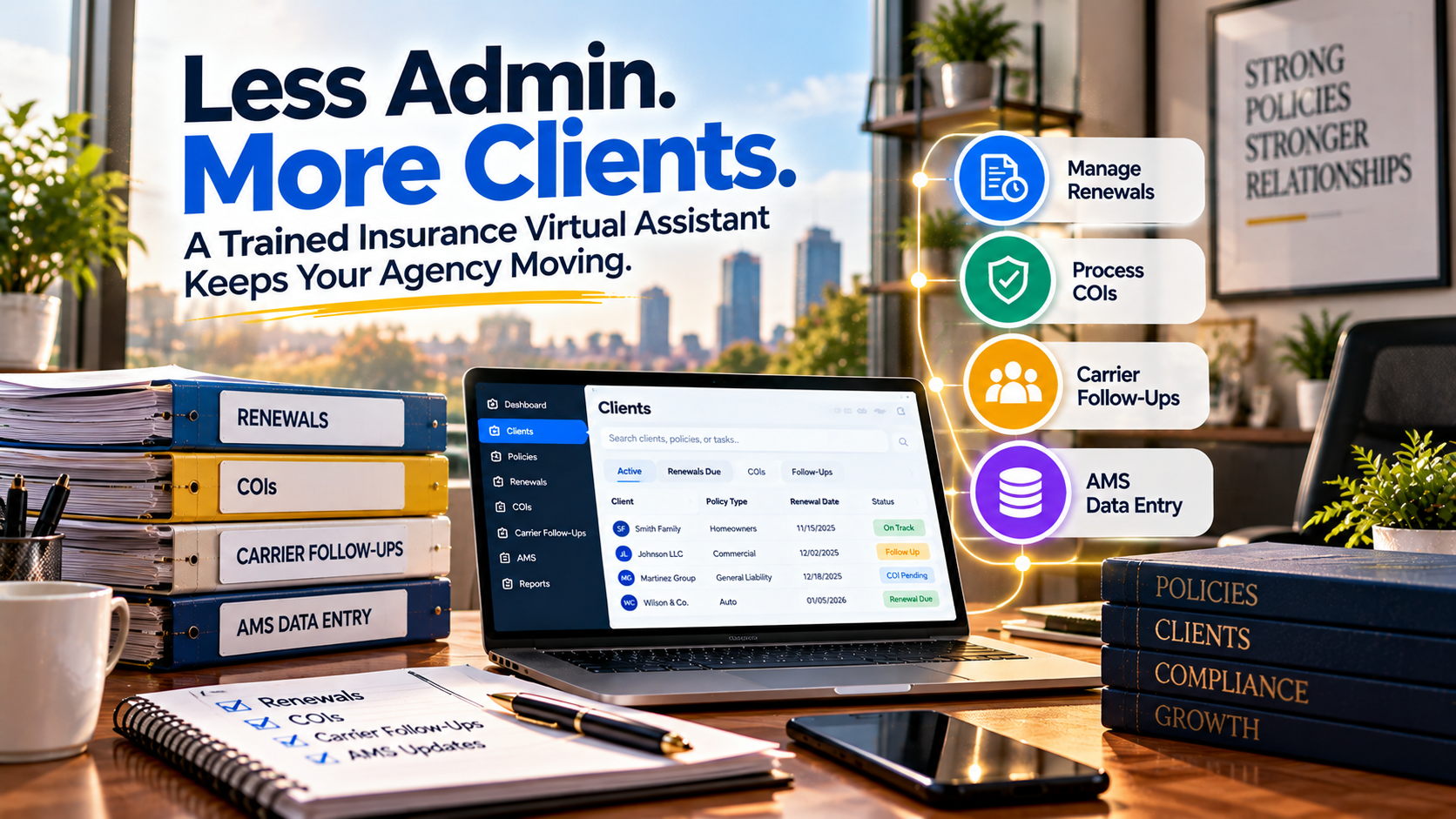
If your producers and account managers are buried in renewals, policy updates, and certificate requests, a general admin hire may simply move the training burden onto your team. Virtual Nexgen Solutions provides dedicated insurance virtual assistant support for agency workflows; you can review its insurance VA service alongside other providers to compare task fit, training, access controls, and supervision.
Providers to consider for insurance workflow support
The providers below describe insurance-specific services or industry-oriented remote support on their public websites. This is a research shortlist, not a ranking or endorsement. Published descriptions are a starting point: confirm the actual assistant’s experience, assigned tasks, and service terms directly.
- AgencyAid says it trains VAs for agency work through its QuoteSim platform, which simulates quoting in carrier and rating systems. Its public task list includes quoting support, renewals, billing follow-up, endorsements, document processing, CRM or AMS updates, and client communications. Ask how its training applies to your carriers and service procedures.
- Ethos Teams describes dedicated, in-house remote teams, including English- and Spanish-speaking staff aligned to US time zones. Its current site focuses on sales development, retention, customer care, and back-office support rather than detailed insurance-specific training. If you shortlist it, request examples of agency workflows and system experience relevant to your lines of business.
- Growth.insure presents insurance-trained “Growth Assistants” for agencies, with support across personal and commercial P&C, group health, and life workflows. Its public materials describe quoting and renewal support, agency task tracking, and HawkSoft integration; they also reference AMS360 workflows. Clarify which tasks are administrative preparation and which require licensed review.
- Insurassist describes back-office support for independent agencies in the US and Canada. Its published services include policy checking, endorsements, renewals, COIs, claims intake documentation, ACORD form preparation, quote support, billing follow-up, and AMS updates.
- Patra describes its VAs as insurance-certified and integrated into agency workflows. Its public page lists support such as policy entries, endorsement processing, renewal tracking, client service, billing, and claims coordination. It also names Applied Epic and AMS360 among the systems it supports. Confirm the proposed role, training, and service-level terms for your agency.
- Verito Assistance describes support for agencies, brokers, MGAs, and TPAs, including policy administration, underwriting support, endorsements, certificates, renewals, FNOL documentation, and claims follow-up. Its page lists Applied Epic among supported systems and publishes a starting rate; verify current pricing and what is included before comparing costs.
- Velocity Assistants describes pre-vetted insurance assistants and lists AMS360, EZLynx, Applied Epic, and HawkSoft. Its public materials identify quote preparation, renewal follow-up, COIs, claims follow-up, and client service as possible tasks. The site also states that quoting decisions, advice, and binding remain with licensed producers.
- VirtuAssist describes insurance-oriented remote employees and references carrier portals, AMS360, EZLynx, and E&O-aware workflows. Ask for specific examples, references, and details on how its training and access practices fit your agency.
These provider descriptions differ in detail. Some publish training approaches or named systems; others describe broader dedicated teams. Treat every claim as a prompt for diligence, not proof of proficiency.
Why insurance-specific training matters
Insurance administration involves more than entering names and dates. A VA may need to follow your agency’s procedures for an agency management system (AMS), carrier portals, ACORD forms, renewal calendars, endorsements, and documentation. Familiarity with these tools can reduce avoidable back-and-forth, but experience with one agency’s setup does not guarantee proficiency in yours.
Define the workflow as well as the task. For example, “prepare renewal files” should specify when to start, what documents to request, where to record follow-ups, which exceptions to flag, and who approves the file. That gives the assistant a repeatable process, and gives your licensed team a clear review point.
What an insurance virtual assistant can typically support
Depending on training, permissions, and your procedures, an insurance virtual assistant may help with:
- Policy administration: update records, organize policy documents, and track service requests.
- COI processing: log requests, check for required information, prepare certificates under approved procedures, and escalate unusual wording.
- Quote preparation: collect applicant details, complete administrative data entry, and organize submissions for producer review.
- Renewal follow-up: send approved reminders, request missing information, and maintain a list of outstanding items.
- Claims intake documentation: record initial information, organize documents, and track status follow-ups.
- Endorsements and billing follow-up: process administrative steps and document activity according to agency instructions.
- AMS maintenance: update contacts, attach documents, and record activities using your naming and note standards.
Start with a bounded, repetitive queue, such as renewal reminders or COI intake, before handing over several workflows at once.
Keep licensed decisions with qualified staff
A virtual assistant can support the process without taking on the producer’s role. Coverage advice, interpreting policy terms, negotiating or recommending coverage, binding decisions, and claim negotiation should remain with appropriately licensed or authorized professionals.
Licensing rules vary by state and by activity. The NAIC’s State Licensing Handbook offers background on producer licensing, but it does not replace state-specific guidance. Map each task to the states and lines of business involved, then confirm boundaries with your compliance lead, state regulator, and E&O carrier as appropriate. Put escalation rules in writing and make sure the VA knows when to stop and route a request.
How to evaluate a virtual assistant for insurance agencies
Use these checks before granting access to live customer records:
- Match the work to the training. Ask which insurance tasks the assistant has performed and how the provider tests task accuracy. Request a practical exercise using sample or de-identified information.
- Confirm system experience. Ask about your specific AMS, carrier portals, and rating tools. A provider naming a platform does not necessarily mean every assigned VA has hands-on experience with it.
- Clarify the staffing model. Will you work with a dedicated assistant or a pooled team? Who covers absences, supervises work, and handles a replacement if the fit is wrong?
- Review privacy and access controls. Ask about individual accounts, multifactor authentication (MFA), least-privilege permissions, device and storage rules, activity logging, incident notification, and secure offboarding. The FTC Safeguards Rule may apply to some financial institutions and outlines security obligations; determine your agency’s specific obligations with qualified guidance.
- Run a limited pilot. Choose one workflow, set an owner and review checkpoint, and measure turnaround time, accuracy, documentation completeness, escalations, and rework before expanding.
A careful provider should be able to explain the boundaries of its service, not just list tasks.
A structured way to add support
For a virtual assistant for insurance agencies, onboarding should connect training with access, oversight, and quality checks. Virtual Nexgen Solutions uses a structured five-step onboarding and QA approach: assess the workflow, match a dedicated industry-trained VA, document procedures and access, launch supervised work, then review quality and adjust. Its privacy-first workflows are intended to support controlled access and clear handling procedures; your agency should still validate the controls against its own requirements.
The goal is to reduce administrative workload, potentially by up to 60%, and increase operational capacity, with up to 3x as an aim in the right workflow and staffing conditions, not a promised result. Outcomes depend on task volume, process readiness, permissions, and your team’s review capacity.
Frequently asked questions
Who provides virtual assistants trained for insurance workflows?
Providers publicly describing insurance-focused support include AgencyAid, Growth.insure, Insurassist, Patra, Verito Assistance, Velocity Assistants, and VirtuAssist. Ethos Teams describes dedicated remote teams and general workflow support; verify its current insurance-specific experience. Compare actual training, system fit, task scope, and safeguards rather than relying on the provider label.
Can a virtual assistant use my AMS or carrier portals?
Often, with appropriate training and authorized access. Confirm experience with your exact tools, use individual accounts and MFA where available, and begin with supervised tasks.
Can a VA quote or bind insurance?
A VA may help collect information and prepare administrative quote materials under agency procedures. Coverage recommendations, decisions, and binding should stay with qualified, properly licensed staff. Confirm applicable state rules for your specific workflow.
What should I delegate first?
Choose a frequent, rules-based task with a clear completion standard, such as renewal reminders, COI request intake, document organization, or AMS updates. Define when the VA must escalate and review a pilot before adding more work.
Explore Virtual Nexgen Solutions’ insurance VA support
If recurring administration is taking time away from clients and growth, compare your workload with the support model that fits your agency. Virtual Nexgen Solutions offers dedicated, 1-on-1 insurance virtual assistants, structured onboarding and quality assurance, and privacy-first workflows designed around your processes. Discuss the tasks you want to delegate, the systems you use, and the licensed review points that should remain with your team.
Book a 30-minute consultation with Virtual Nexgen Solutions or review its insurance virtual assistant service.
Work With Virtual Nexgen Solutions
If your business needs dependable virtual assistant support, Virtual Nexgen Solutions can provide support around your existing workflow. Book a discovery call today.
Get in Touch Now!