

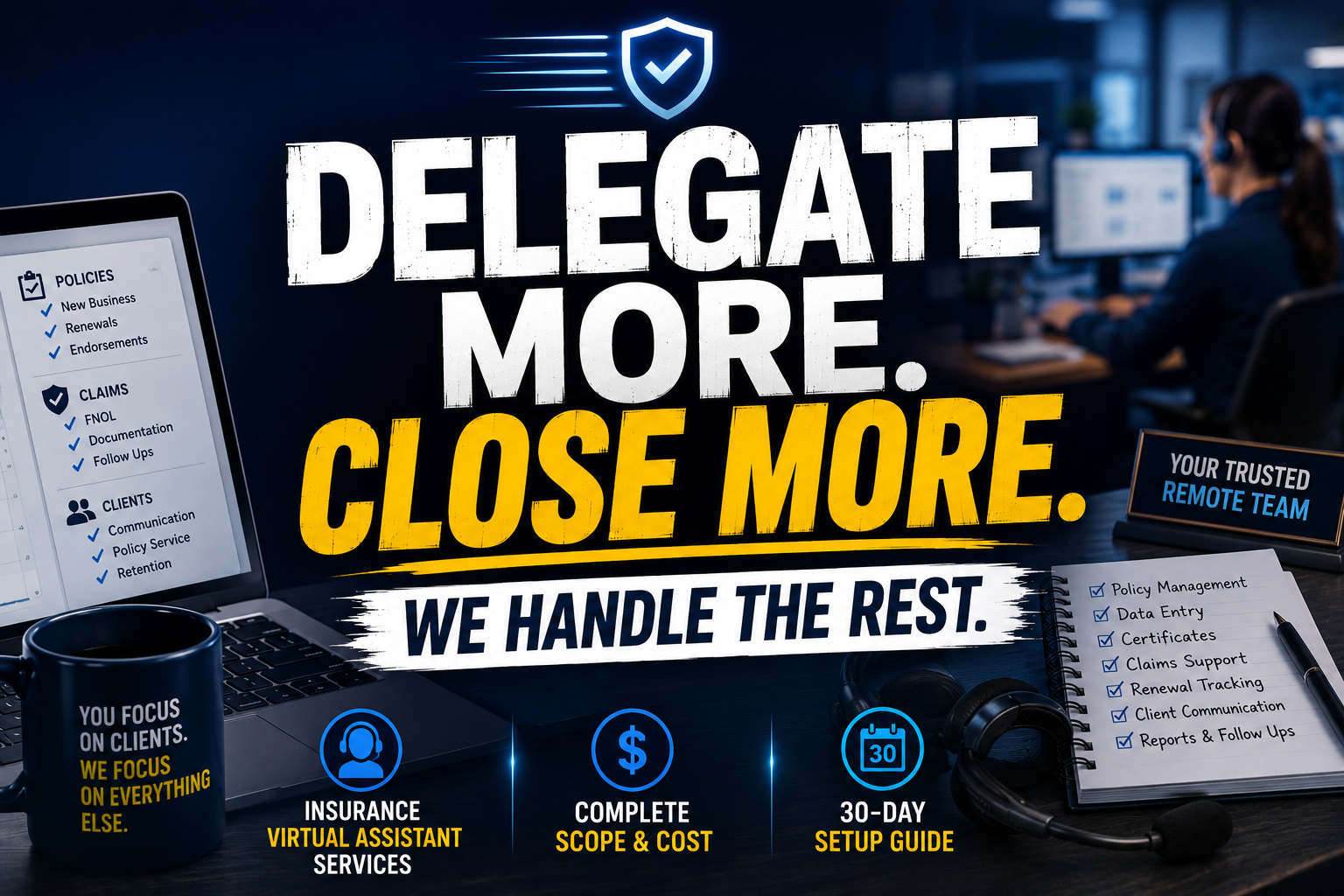
Insurance virtual assistant services are not one generic task. They are a group of specialized service lines that support independent insurance agencies, P&C brokers, MGAs, wholesalers, risk management firms, and insurance companies.
You can assign policy servicing, COI processing, renewal preparation, claims documentation, new-business support, AMS data hygiene, customer follow-up, and review or referral support. Define the queue first. Then assign the right permissions, training, and escalation rules.
Start with Virtual Nexgen Solutions’ insurance support services when you need a tailored support plan rather than a general administrative resource.
Task-by-Task Scope, With Turnaround Expectations
Set expectations around volume and complexity. The following examples are illustrative service targets, not guarantees:
- COI processing: one to two business days after complete information is received.
- Renewal preparation: organize the renewal file at least five business days before the internal deadline.
- Document indexing: complete within 24–48 hours of receipt.
- FNOL documentation: record and route the first notice of loss the same business day.
- AMS cleanup: review records on a monthly cadence.
- Email triage: categorize and route messages within four business hours.
A VA can prepare documents, update records, request missing information, and flag exceptions. A licensed producer, CSR, or manager must make coverage, binding, premium, and settlement decisions.
For practical delegation ideas, review this insurance agency VA guide before building your task list
What Insurance VA Services Are Not: The Licensed Boundary
Set the boundary in writing. Unless properly licensed and specifically authorized, a VA must not:
- Bind or cancel coverage.
- Give coverage advice or interpret policy language.
- Approve premium changes.
- Settle claims.
- Sign compliance attestations.
- Make underwriting decisions.
- Represent a recommendation as professional advice.
Use role-based permissions, unique logins, documented approvals, and escalation notes. Check your state Department of Insurance requirements and consult your compliance leader. The NAIC state insurance department directory can help you locate the applicable regulator.
The Service Line Breakdown
Policy Servicing Support
Assign policy data updates, endorsement requests, ID card preparation, policy document delivery, and follow-up with carriers. Route unusual wording or coverage changes to licensed staff.
COI and Certificate Processing
Have the VA collect request details, verify available policy information, prepare certificates using agency procedures, track holders, and escalate additional-insured or non-standard wording.
Renewal Preparation and Follow-Up
Use the VA to create renewal checklists, request loss runs, collect updated exposures, organize carrier correspondence, and track unanswered client requests.
Claims Intake Documentation
Assign FNOL data capture, document naming, chronology preparation, contact logging, and follow-up reminders. Send coverage or settlement questions to the claims professional.
New Business Submission Support
Delegate ACORD form preparation, document collection, submission checklists, quote comparison formatting, and follow-up with prospects or carriers.
AMS Data Hygiene
Maintain contacts, activities, attachments, expiration dates, producer assignments, and task statuses. Schedule recurring reviews for duplicate or incomplete records.
Inbox and Customer Follow-Up
Create categories for urgent service requests, renewals, claims, billing, and new business. Draft responses from approved templates and escalate sensitive issues.
Review and Referral Support
Track post-service review requests, referral opportunities, thank-you messages, and approved social content. Keep all communications aligned with agency policy.
AMS and Carrier Portal Integration
An insurance VA can work inside Applied Epic, AMS360, HawkSoft, and EZLynx when you provide controlled access and clear procedures. Training should use sample records first, followed by supervised live work.
Document your naming convention, activity-note format, attachment rules, carrier portal process, and escalation path. For Farmers Insurance agencies, follow approved Apex and eAgent procedures. Do not share passwords or allow unauthorized policy changes.
Use the administrative support service for adjacent work such as email management, scheduling, data entry, and reporting.
Pricing by Scope: What Insurance VA Services Cost
Virtual Nexgen Solutions prices insurance VA support at $8 per hour. Using 4.33 weeks per month, 10 hours per week equals approximately $346.40 per month. Twenty hours equals $692.80, while 40 hours equals $1,385.60 before any plan-specific terms or additional requirements.
Compare the full scope, not only the rate. VA Masters publishes ranges around $6.50–$14 per hour. 7VAS has published plans beginning around $899 per month, while Virtustant has published insurance staffing from about $7 per hour. Pricing can change, so verify current terms directly.
Evaluate AMS training, supervision, security, backup coverage, time tracking, and compliance processes. The cheapest hourly rate can become expensive when work requires repeated correction.
The True Cost of an In-House Insurance CSR
The Bureau of Labor Statistics insurance claims and policy processing category provides a useful wage reference for back-office insurance roles. Your actual internal cost also includes payroll taxes, benefits, recruiting, training, equipment, office space, management time, and coverage during absence.
A $60,000 annual employee cost is a useful planning comparison, not a universal benchmark. SHRM’s workforce resources also show why cost-per-hire and time-to-productivity should be included in staffing decisions. Compare the full employment cost with the hours and service queues you actually need.
How to Choose an Insurance VA Services Provider
Check these eight points before signing:
- Confirm experience with insurance agencies, brokers, MGAs, or wholesalers.
- Verify Applied Epic, AMS360, HawkSoft, or EZLynx training.
- Require a written licensing and escalation boundary.
- Review security controls, access procedures, and device standards.
- Sign an NDA and define data-handling responsibilities.
- Ask who supervises complex tasks.
- Request a limited pilot or clearly defined starting scope.
- Require weekly reporting with hours, completed work, exceptions, and pending items.
Choose managed support when you need supervision and backup coverage. Choose flexible hourly support when your queues vary week to week.
Red Flags to Avoid
Avoid providers that promise guaranteed lead volume, retention, or revenue. Reject vendors that provide no NDA, rely on shared logins, claim to “handle everything,” or cannot explain licensing boundaries.
Also question vague pricing, missing time records, unclear supervision, and no process for correcting AMS errors. A professional provider should explain what the VA handles and what must remain with your licensed team.
How to Measure Success
Track COI turnaround, renewal files ready before deadline, AMS record completeness, claims documentation accuracy, new-business packets completed, producer hours reclaimed, and escalation accuracy.
Review performance at 30, 60, and 90 days. Do not judge the service only by hours worked. Judge it by queue quality, reduced rework, visibility, and the amount of producer time redirected to clients and growth.
Scenario 1: A Texas P&C agency receives 25 COI requests weekly. Assigning intake, document checks, tracking, and approved certificate preparation to a VA could create a 10-hour weekly workstream, or about $346.40 monthly at $8 per hour. Treat this as a planning model, not a reported client result.
Scenario 2: A Midwest MGA manages 40 monthly submissions. A 20-hour weekly support scope could cover document checklists, AMS updates, carrier follow-up, and exception logs at approximately $692.80 monthly. Measure actual completion time and accuracy during the pilot.
A 30-Day Implementation Plan
- Days 1–5: Define scope, map queues, sign the NDA, create user access, and approve escalation rules.
- Days 6–12: Train on sample records in Applied Epic, AMS360, HawkSoft, or EZLynx. Review notes and document naming.
- Days 13–20: Run a live pilot on one queue, such as COIs, renewal follow-up, or AMS cleanup.
- Days 21–30: Review quality, backlog, response times, and exceptions. Expand only after the manager approves the results.
Keep the first scope narrow. A focused pilot reveals process gaps faster than a broad handoff.
Frequently Asked Questions
What services does an insurance virtual assistant provide?
An insurance VA can support policy servicing, COIs, renewals, claims documentation, new-business submissions, AMS updates, inbox triage, and client follow-up.
Can an insurance virtual assistant use Applied Epic or AMS360?
Yes. An insurance VA can work in Applied Epic or AMS360 after system training, supervised practice, and role-based access are established.
Can an insurance virtual assistant issue certificates of insurance?
A VA may prepare or process COIs under your approved procedures. A licensed or authorized agency professional must handle exceptions and decisions requiring judgment.
Does an insurance virtual assistant need a license?
Licensing requirements vary by state and task. Keep unlicensed support administrative, and confirm boundaries with your compliance leader and state regulator.
How much do insurance virtual assistant services cost?
Virtual Nexgen Solutions’ rate is $8 per hour. Monthly cost depends on hours, complexity, supervision, systems, and the selected service scope.
Is an hourly or managed insurance VA better?
Hourly support suits variable queues. Managed support suits agencies that need structured supervision, reporting, backup coverage, and ongoing process oversight.
Can an insurance VA help with claims?
Yes. A VA can document FNOL information, organize files, log communications, and track follow-ups. Claims decisions and settlements must remain with authorized professionals.
How fast can an insurance VA start?
A focused engagement can begin after scope approval, access setup, and training. A practical rollout often uses a 30-day staged implementation.
Why Choose Virtual Nexgen Solutions?
Virtual Nexgen Solutions has served businesses since 2016. Its insurance-trained virtual assistants support policy administration, COIs, renewals, claims documentation, data entry, email management, and customer follow-up.
You receive a tailored scope at $8 per hour, with support designed around your systems, queue volume, permissions, and escalation rules. Begin with one service line, measure the work, and expand when the process is stable.
Reduce the service backlog without handing licensed decisions to the wrong role. Book a 30-minute consultation with Virtual Nexgen Solutions to discuss your insurance VA scope, AMS environment, hours, and 30-day implementation plan.