

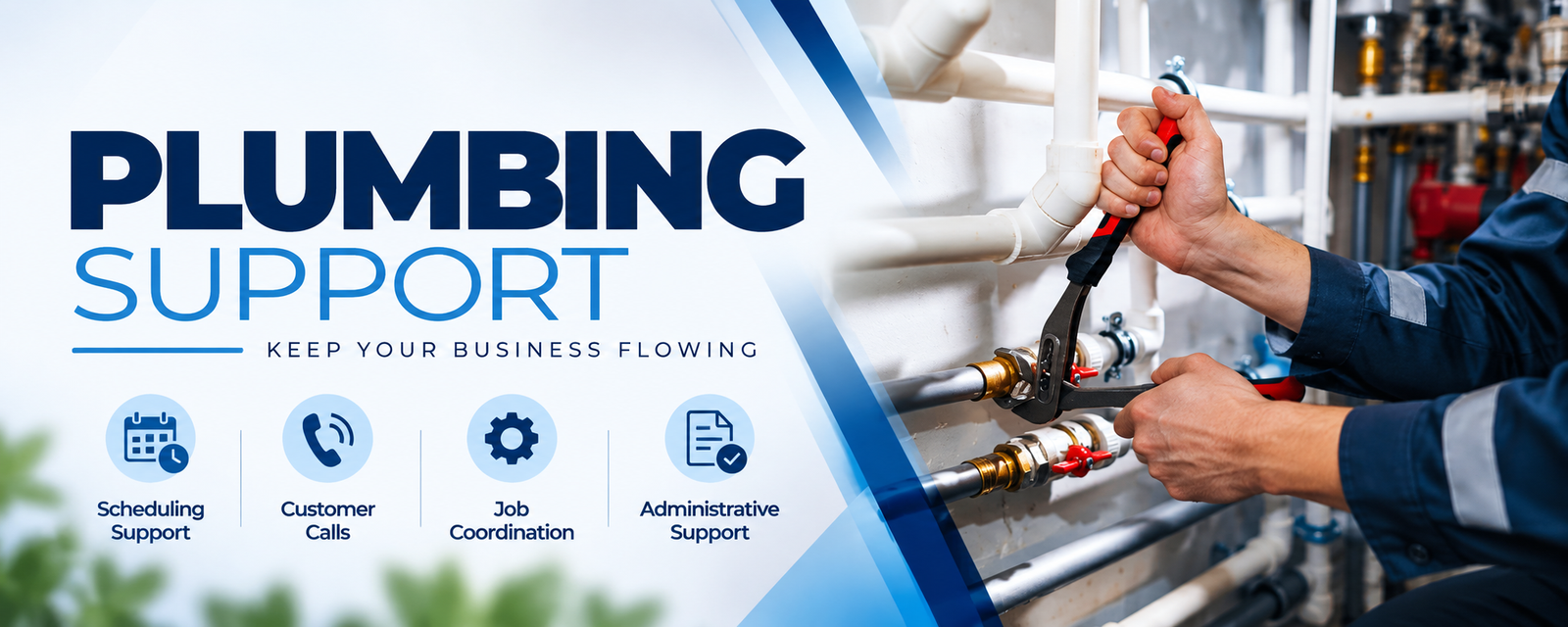
A plumbing emergency rarely happens at a convenient time.A homeowner discovers water under the kitchen sink. A pipe bursts overnight. A water heater stops working. A property manager receives a tenant complaint about a leak.
The first thing the customer usually does is pick up the phone.
What happens next can determine whether that caller becomes a customer.
For plumbing companies, the challenge isn't always generating demand. In many U.S. markets, there is already plenty of demand. The bigger challenge is managing that demand efficiently once it arrives.
Calls need to be answered. Customer information needs to be captured. Appointments need to be coordinated. Technicians need the right information. Estimates need follow-up. Customers need updates.
When these activities aren't organized, opportunities can disappear between the first phone call and the completed plumbing job.
A dedicated Virtual Assistant for plumbing companies can help create the administrative structure needed to keep those opportunities moving.
The Five-Minute Window
Imagine a homeowner has a leaking water heater.
They search for a local plumber and call the first company.
The phone rings.
Nobody answers.
They call the next company.
That second company answers, understands the situation, provides an appointment window, and confirms the visit.
The first company may have better technicians or competitive pricing, but it never got the opportunity.
This is why responsiveness matters so much in plumbing.
A Virtual Assistant can become part of the first-response process, helping ensure incoming inquiries are handled according to the company's procedures.
The objective isn't simply to answer a phone.
It is to move the customer from inquiry toward the appropriate next step.
The Job Doesn't Start When the Technician Arrives
Getting an appointment booked is only the beginning.
Once a job enters the schedule, several things may need to happen.
Customer information needs to be recorded. The appointment needs confirmation. The technician needs relevant information. The customer may need an update. The schedule may change. A completed job may require additional follow-up.
Without a clear administrative process, these details can become scattered across phone calls, emails, notes, and conversations.
A dedicated VA can help keep the administrative side of the job organized from the initial inquiry through post-service communication.
A simple workflow might look like:
New inquiry → Customer information → Service request → Appointment → Confirmation → Technician coordination → Service → Follow-up
The VA doesn't perform the plumbing work.
The VA helps make sure the administrative process surrounding the plumbing work keeps moving.
Connecting the Office With the Field
A plumbing company essentially has two operating environments.
The field team diagnoses problems, performs repairs, installs equipment, and serves customers.
The office team manages the information surrounding those jobs.
When communication between these two sides breaks down, problems appear.
A technician may arrive without enough customer information.
A customer may not know when the technician is expected.
The office may not know whether a job has been completed.
A lead may go without follow-up because everyone assumed someone else was handling it.
These aren't necessarily major failures.
They're communication gaps.
But repeated communication gaps can become expensive.
A Virtual Assistant can help act as the administrative bridge between customers, technicians, office staff, and management.
Not Every Lead Books Immediately
A plumbing inquiry doesn't always become an appointment during the first conversation.
A customer may be comparing companies.
A property manager may need approval.
A homeowner may need time to consider an estimate.
A commercial customer may need additional information.
Without a consistent follow-up process, those opportunities can disappear.
A plumbing VA can help maintain an appropriate follow-up workflow:
Inquiry → Initial response → Information provided → Follow-up scheduled → Customer contacted → Appointment booked or status updated
The exact process depends on the company's sales strategy.
The important thing is that someone owns the follow-up.
Estimates Need Follow-Up Too
Consider a customer who receives an estimate for a water heater replacement.
The customer says they need a few days to think about it.
The technician leaves for the next appointment.
The office becomes busy.
Three days become three weeks.
Eventually, the customer chooses another company.
A structured follow-up process could have kept the conversation active.
A VA can help track approved administrative follow-ups and remind the appropriate team member when professional input is required.
This creates continuity between the service visit and the customer's eventual decision.
Scheduling Is More Than Filling the Calendar
Scheduling may look like a basic administrative function, but for plumbing companies it directly affects daily operations.
A schedule needs to consider technician availability, customer preferences, service requirements, appointment changes, emergency requests, and geographic considerations.
Poor coordination can result in:
- Appointment conflicts
- Technician downtime
- Unnecessary travel
- Customer frustration
- Repeated calls
- Rescheduling problems
A dedicated Virtual Assistant can support scheduling according to the company's established procedures.
The goal isn't simply to fill empty calendar slots.
It is to help create a schedule the field team can realistically execute.
What Can a Plumbing Virtual Assistant Handle?
The exact responsibilities should be customized to each company's workflow, but common areas of support can include:
Customer inquiries: Capturing information and routing requests appropriately.
Appointment coordination: Scheduling, confirming, and rescheduling service visits.
Lead follow-up: Maintaining contact with customers who have not yet booked.
Estimate follow-up: Tracking approved administrative follow-up activities.
Customer communication: Providing routine confirmations and updates.
Record maintenance: Updating customer and job information in approved systems.
Technician coordination: Communicating scheduling changes and relevant administrative information.
Post-service support: Helping maintain customer communication after completed work.
The VA provides administrative support while technical decisions remain with qualified plumbing professionals.
Scaling Without Adding More Pressure to the Owner
Growth can expose weaknesses that weren't obvious when the plumbing company was smaller.
Ten calls a day may be manageable.
Fifty calls can create pressure.
Coordinating two technicians can be relatively simple.
Coordinating a larger field team requires more structure.
A few customers can be remembered.
Hundreds require dependable records and processes.
This is why administrative capacity becomes part of the growth strategy.
A dedicated plumbing Virtual Assistant can provide additional support without requiring technicians or owners to absorb every new administrative responsibility.
Supporting the Software the Company Already Uses
Many plumbing companies rely on field-service and business-management platforms such as ServiceTitan, Housecall Pro, Service Fusion, QuickBooks, Google Workspace, and other tools.
Adding software isn't necessarily the answer to an administrative problem.
Often, the opportunity is to make better use of the systems the company already has.
A trained VA can follow established procedures for scheduling, customer information, communication, task tracking, and administrative updates.
The technology remains the infrastructure.
The VA helps keep the workflow moving through that infrastructure.
Keeping Professional Responsibilities Clear
A successful VA model requires clear boundaries.
A VA can collect information about a plumbing problem.
A qualified plumber determines the technical issue.
A VA can schedule an appointment.
The technician performs the service.
A VA can coordinate administrative follow-up.
The appropriate professional handles technical recommendations and decisions requiring specialized expertise.
This separation allows administrative support to strengthen the operation without crossing professional boundaries.
The Question Plumbing Owners Should Ask
Instead of immediately asking:
"Do we need another office employee?"
A better question may be:
"Where are our customers, technicians, and office staff losing time because information isn't moving efficiently?"
The answer might be missed calls.
It could be slow lead follow-up.
It could be scheduling.
It could be estimate tracking.
It could be customer communication.
Or it could simply be that the owner is still spending too much time on administrative work.
Each represents an opportunity to improve the workflow.
Building a More Responsive Plumbing Operation
The strongest plumbing companies aren't only good at fixing plumbing problems.
They're good at managing the entire customer journey.
From the first phone call to scheduling, from scheduling to service, and from service to follow-up, every stage contributes to the customer's experience.
A dedicated Virtual Assistant for plumbing companies can strengthen the administrative side of that journey.
The plumber stays focused on technical work.
The office gains additional coordination capacity.
Customers receive more consistent communication.
Leads receive follow-up.
Appointments are easier to manage.
And owners have fewer administrative responsibilities competing for their attention.
For plumbing contractors across the United States, that can make the difference between simply staying busy and building an operation capable of handling sustained growth.
Because the next plumbing job doesn't begin when the technician arrives. It begins the moment the customer decides to call.