
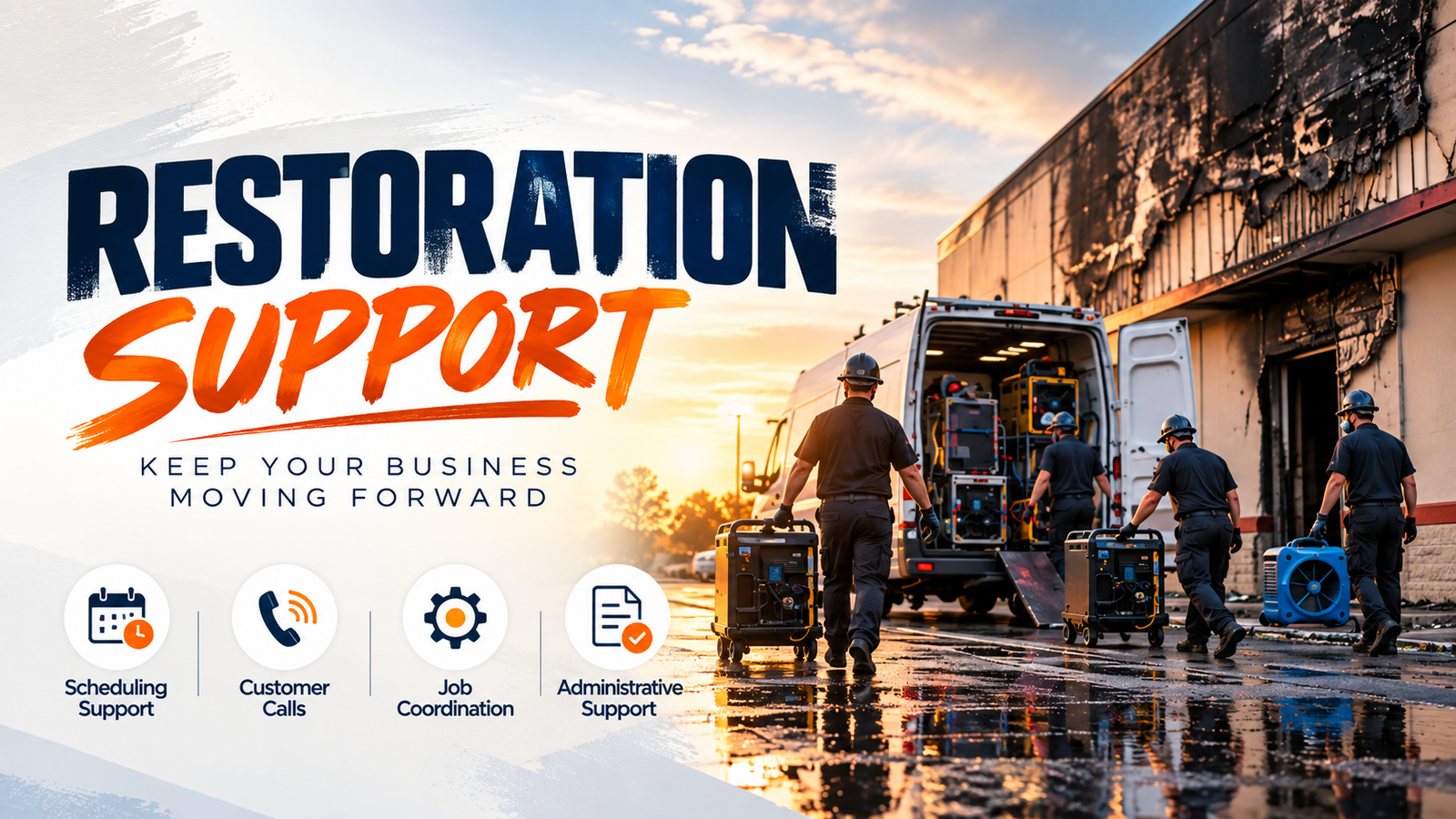
Restoration companies operate in an environment where time matters differently.A roofing estimate can sometimes wait until tomorrow. A routine plumbing appointment may be moved to another day. But when a property experiences water damage, fire damage, mold, or another emergency, delays can quickly make the situation more complicated.
A homeowner wants an immediate response.
A property manager needs communication.
An insurance-related process may require documentation.
The field team needs job information.
Technicians need to know where they are going and what they are walking into.
Meanwhile, the restoration company still has other active projects happening at the same time.
This creates a unique operational challenge: how do you coordinate urgent jobs without allowing the administrative side of the business to become overwhelmed?
For many restoration companies across the United States, a dedicated Restoration Virtual Assistant can become an important part of that coordination process.
The First Call Sets the Tone
Consider a homeowner discovering significant water damage late in the evening.
They search for a restoration company and call.
At that moment, they aren't looking for a complicated explanation. They want to know:
Who can help me?
What happens next?
How quickly can someone respond?
A restoration company's initial response can influence the customer's confidence during an already stressful situation.
A trained VA can support the administrative side of emergency intake by collecting essential information, documenting the request, communicating according to established procedures, and escalating urgent matters to the appropriate team member.
The goal isn't to make the VA responsible for assessing the damage.
The goal is to ensure that the emergency request enters the company's workflow quickly and accurately.
Emergency Work Creates an Information Problem
Restoration companies aren't dealing with just one piece of information.
A single emergency job can involve:
- Customer contact information
- Property address
- Type of damage
- Time of incident
- Access information
- Initial service requirements
- Technician or crew availability
- Job documentation
- Customer communication
- Insurance-related information
- Follow-up requirements
If information is scattered between phone calls, text messages, emails, notes, and different systems, the possibility of communication gaps increases.
A dedicated Virtual Assistant can help organize the administrative information surrounding the job so the right people have access to the right information at the appropriate stage.
The Job Coordination Chain
A restoration company can think of an emergency response as a chain.
Emergency inquiry
↓
Customer information captured
↓
Damage type and urgency documented
↓
Appropriate team notified
↓
Appointment or response coordinated
↓
Customer updated
↓
Job information maintained
↓
Follow-up tasks tracked
The restoration technician doesn't need to manage every administrative step.
The project manager doesn't need to chase every customer communication.
The owner doesn't need to become the default person for every scheduling question.
A VA can help keep the administrative chain moving.
What Happens When Several Emergencies Arrive at Once?
This is where restoration operations become particularly challenging.
Imagine a severe storm affects a local area.
Suddenly, the company receives multiple water-damage inquiries.
At the same time:
- Existing jobs are still active.
- Technicians are already in the field.
- Customers are requesting updates.
- New calls are coming in.
- Documentation needs to be maintained.
- Schedules need to change.
- Management needs visibility.
The company may have enough technical expertise to handle the work.
The problem becomes coordination capacity.
A dedicated VA can help manage the administrative workload surrounding multiple jobs, allowing field personnel and project managers to concentrate on the work requiring their expertise.
Customer Communication During a Restoration Job
Restoration customers are often dealing with stressful circumstances.
They may be displaced from their home.
They may be worried about additional property damage.
They may be trying to understand what happens next.
Even when technicians are doing excellent work, poor communication can create frustration.
Customers may call asking:
"When is the crew coming?"
"What happens next?"
"Did you receive my information?"
"Has the team been scheduled?"
"What information do you still need from me?"
A dedicated VA can help manage approved routine communication and ensure questions requiring project-manager or technical input are escalated appropriately.
This creates a clearer communication channel between the customer and restoration company.
Documentation Is Part of the Job
Restoration work involves more than physical restoration.
There is also an administrative record surrounding the project.
Documents, photographs, job information, customer communication, estimates, work details, and other records may need to be organized according to the company's processes.
A VA can support administrative documentation by maintaining records, organizing files, entering information, tracking missing items, and ensuring that outstanding administrative tasks are visible to the appropriate team members.
This is especially useful when multiple projects are active simultaneously.
Instead of relying on memory, the team has a structured administrative process.
Supporting Insurance-Related Administration
Many restoration companies work alongside homeowners, property managers, and insurance-related processes.
This can introduce another layer of administrative coordination.
A restoration VA may support approved tasks such as:
- Organizing documentation
- Tracking requested information
- Maintaining job records
- Following up on outstanding administrative items
- Coordinating communications
- Updating internal records
- Helping ensure documentation is organized
The VA should not make insurance coverage decisions or provide professional advice outside their role.
Instead, the focus remains on administrative coordination and documentation support.
The Restoration Team Should Stay Focused on Restoration
One of the biggest operational advantages of separating administrative and field responsibilities is focus.
A technician should be focused on the property.
A project manager should be focused on project execution.
A qualified professional should handle technical decisions.
The administrative support team should keep communication, scheduling, documentation, and routine coordination moving.
This creates a clearer division of responsibilities.
Field Team
Inspection | Mitigation | Restoration | Technical work | On-site customer service
Project Management
Job oversight | Scope coordination | Client management | Project decisions
Virtual Assistant
Intake support | Scheduling | Documentation | Follow-up | Administrative communication | Task tracking
When each role has a clear purpose, the operation becomes easier to coordinate.
Why Speed Alone Isn't Enough
Emergency restoration companies often focus heavily on response time.
That makes sense.
But fast response without organized follow-through can still create problems.
Imagine the company responds quickly but fails to document the customer's information correctly.
Or schedules a crew but doesn't communicate the appointment clearly.
Or receives important documentation but doesn't organize it.
Or completes the initial response but forgets the follow-up.
True operational responsiveness isn't just about being fast.
It's about being fast and organized.
A Virtual Assistant can help support that second part.
Where Restoration Companies Can Use a VA
A restoration business may use dedicated administrative support across several stages of the customer journey.
Emergency Intake
Capture customer information and document the initial request according to company procedures.
Scheduling
Coordinate appointments, crew availability, and customer access.
Customer Updates
Handle approved routine communication and escalate issues requiring professional attention.
Job Administration
Maintain records and organize project-related information.
Follow-Up
Track outstanding requests and administrative next steps.
Internal Coordination
Help keep project managers and field teams informed about administrative updates.
The exact responsibilities should be designed around the restoration company's workflow.
Software Should Support the Operation
Restoration companies often rely on specialized systems and tools for estimating, job management, documentation, and communication.
Depending on the company, workflows may involve platforms such as Xactimate, Encircle, Dash, Mika, QuickBooks, Google Workspace, and other business systems.
A Virtual Assistant can be trained around the company's existing processes and software.
The goal isn't to add unnecessary technology.
It is to ensure that the technology already being used is supported by consistent administrative execution.
A Different Kind of Scalability
Restoration companies don't always experience growth in a predictable way.
A normal week can suddenly become an extremely busy week because of storms, flooding, fires, or other regional events.
That means administrative capacity needs to be able to handle changing workloads.
A dedicated VA can provide an additional layer of support without requiring technicians or project managers to absorb every new administrative responsibility when job volume increases.
The business can keep its field professionals focused on restoration while administrative coordination continues in the background.
The Question Restoration Owners Should Ask
Instead of asking only:
"How many restoration jobs can our technicians handle?"
Consider asking:
"How many jobs can our entire operation coordinate effectively at the same time?"
The answer depends on more than crew capacity.
It depends on communication.
Scheduling.
Documentation.
Customer updates.
Follow-up.
Internal coordination.
If those areas become bottlenecks, adding more field capacity alone may not solve the problem.
Administrative support can become part of the solution.
Final Perspective
Restoration companies operate when customers need help most.
That makes organization especially important.
A customer experiencing water or fire damage doesn't want to wonder whether their information was received.
A project manager shouldn't have to spend the day chasing routine administrative updates.
A technician shouldn't have to stop field work repeatedly to answer scheduling questions.
And an owner shouldn't have to personally coordinate every emergency request.
A dedicated Virtual Assistant for restoration companies can help create the administrative structure behind emergency operations.
From initial intake and scheduling to customer communication, documentation, follow-up, and internal coordination, the VA helps keep information moving while restoration professionals focus on restoring the property.
Because in restoration, every minute matters—but every piece of information matters too.