

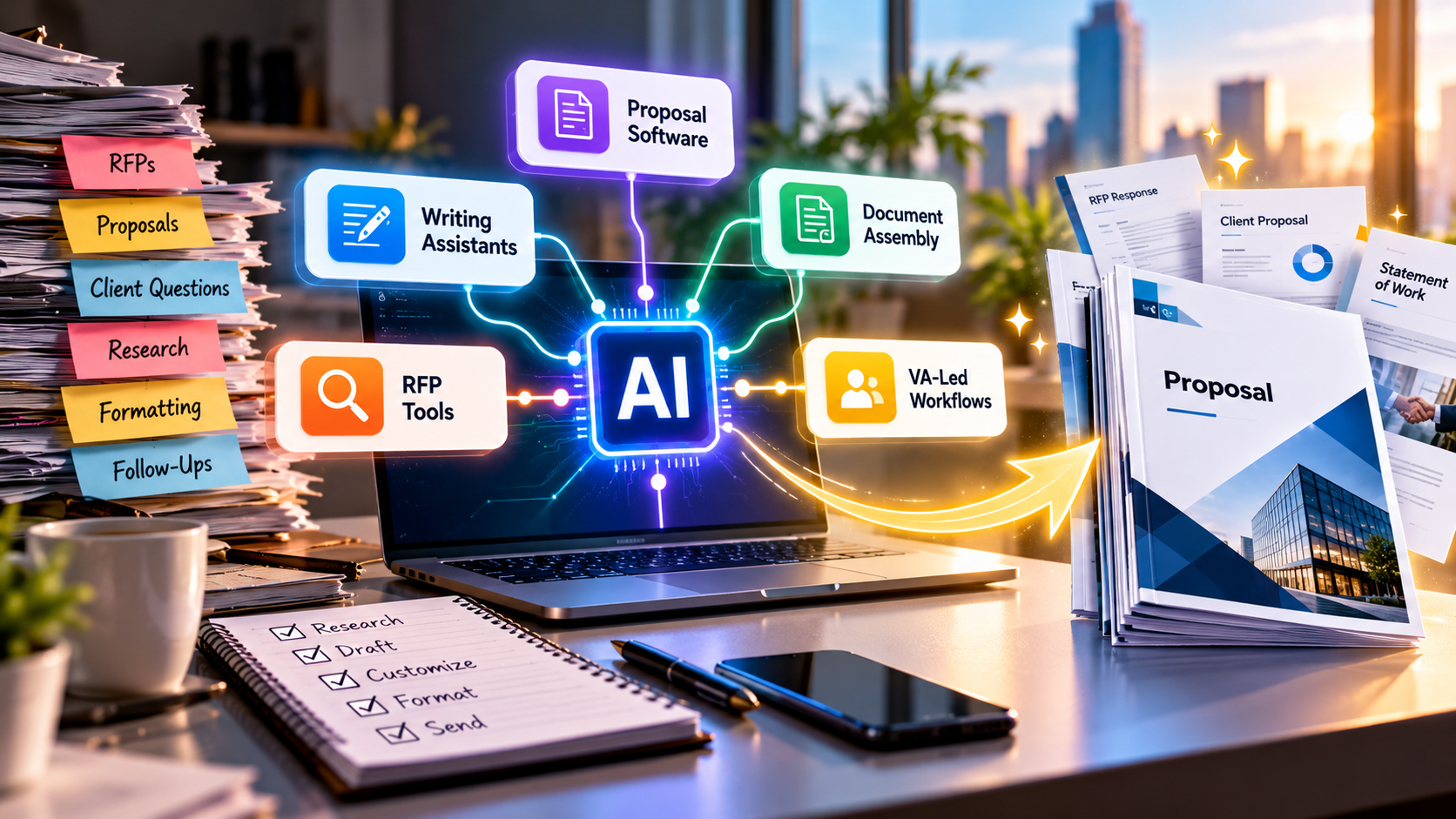
An agency proposal can take hours to assemble, even when the scope, service description, pricing structure, and case studies look familiar. That time adds up across requests for proposals (RFPs), statements of work (SOWs), pricing decks, and scope documents. It can also delay follow-up and pull senior staff away from client work.
AI proposal automation can reduce repetitive drafting, content searching, document assembly, and follow-up. The right solution depends on what you send: a standard sales proposal, a complex consultancy SOW, or a formal RFP response. AI can speed up the process, but your team still needs to verify client fit, scope, pricing, and commitments before anything goes out.
Why does proposal work become repetitive?
Most agency proposals combine recurring information with a small amount of opportunity-specific detail. Teams often repeat:
- Service descriptions, delivery methods, timelines, and team biographies.
- Case studies, credentials, and answers to common client questions.
- Scope language, assumptions, exclusions, and terms.
- Pricing options, retainers, and payment schedules.
- RFP responses that must be mapped to a buyer’s exact questions.
The repetition is not just typing. It is finding the approved version, tailoring it to a prospect, checking that the numbers are right, routing the draft for approval, and formatting the final document. We can call this the proposal rework loop: the same information gets searched, rewritten, checked, and reassembled for every opportunity.
Automation works best when it removes that loop without flattening the proposal into generic copy.
What AI proposal automation solutions are available?
The main options are proposal software with built-in AI, general AI writing assistants, document automation tools, RFP response platforms, and human-in-the-loop support. They overlap, but solve different parts of the workflow.
1. Proposal software with AI features and content libraries
Proposal platforms help teams create branded proposals from reusable templates, sections, and content libraries. Depending on the product and plan, they may also support AI drafting or editing, pricing options, e-signatures, approval workflows, and prospect activity tracking.
For example, Proposify describes a workflow for creating, tracking, and signing proposals, with templates, reusable content, integrations, and approval controls. Nusii focuses on proposals for agencies and consultants, including reusable sections and client-specific variables. These tools are a practical fit when your agency sends a steady flow of similar proposals, quotes, and SOWs.
Their limit: a template can speed up assembly, but it cannot decide what a client actually needs. You still need to personalize the recommendation and check that scope and pricing are accurate.
2. General AI writing assistants
A general-purpose AI assistant can turn meeting notes, a brief, or a discovery-call transcript into a first draft. It can help outline a proposal, simplify language, generate alternative headlines, or adapt a service description to a prospect’s stated goals.
This is a flexible starting point for agencies that create proposals occasionally or have an established writing process. But a writing assistant is not automatically a governed proposal system. Unless it is connected to approved information and your internal process, it may invent details, use outdated language, or miss a required RFP question.
Use it for drafting and editing, not as the final authority on claims, compliance, rates, or deliverables.
3. Document automation and assembly tools
Document automation tools assemble files using approved templates, data fields, and content rules. They can populate client details, select relevant sections, and generate consistent Word or PDF documents. This can be useful when a proposal has fixed formatting requirements, many variables, or a handoff to a contract or project workflow.
Some agency proposal platforms include parts of this functionality. For consulting firms, Projectworks’ CRM and proposal features connect opportunities, AI-assisted proposal drafting, reusable content, signatures, and project setup. Its approach may suit teams that want to carry proposal budgets into delivery rather than re-entering details after a win.
The trade-off is setup. Your templates, fields, and rules need to reflect how the agency actually sells and delivers work. Poorly maintained templates simply automate outdated content faster.
4. RFP response software
RFP platforms are designed for structured, high-volume responses. They help teams organize questions, search a central answer library, assign sections to subject-matter experts, track reviews, and draft responses from approved content. Some tools also support citations, requirement tracking, and document or portal workflows.
Loopio and Responsive are examples of platforms focused on response management. They are more relevant when your agency regularly handles lengthy RFPs, questionnaires, or multi-team bids than when it sends a handful of standard proposals each month.
These platforms may be more than a small agency needs. Evaluate the setup effort, user permissions, content maintenance, integrations, and total cost, not just how quickly the AI produces a first draft.
5. Human-in-the-loop support using AI
A trained virtual assistant can help manage the proposal workflow while your specialists retain control of strategy and commercial decisions. With clear instructions and approved access, a VA can organize discovery notes, find relevant approved content, prepare a tailored draft, assemble documents, update the CRM, route approvals, and track follow-ups.
This is particularly useful when the bottleneck is not just writing. It may be the coordination around writing: collecting input from account leads, chasing approvals, checking document versions, or keeping opportunities moving.
Virtual Nexgen Solutions combines dedicated, industry-trained virtual assistants with AI automation services. A VA can support your chosen tools and process; they do not replace your agency’s decision-makers or take responsibility for unapproved pricing, legal terms, or promises to a client.
How do you choose the right option?
Start with your proposal volume and complexity:
- Mostly repeatable sales proposals: Consider proposal software with templates, reusable content, variables, approvals, and e-signatures.
- Occasional proposals with varied messaging: A general writing assistant may help draft, but pair it with an approved source library and a human review.
- Complex documents with fixed formats: Look at document assembly and automation capabilities.
- Frequent formal RFPs: Evaluate dedicated RFP response software with collaboration, source tracking, and approval controls.
- An overloaded team managing the process manually: Consider a human-in-the-loop workflow supported by AI and automation.
Pilot your shortlist using a few real opportunities. Compare the time to prepare a review-ready proposal, the accuracy of the first draft, the effort required to personalize it, and the quality of the final client document. Also check permissions, data handling, integration needs, and how easy it is to keep approved content current.
How can you make proposal automation reliable?
1. Build a maintained content library.
Start with your most-used service descriptions, case studies, team biographies, methodologies, standard assumptions, and approved answers. Assign an owner to each item and set a review date. Mark material clearly as approved, draft, or expired.
2. Separate reusable content from client-specific decisions.
Use AI to retrieve and adapt relevant material, but require the account lead to confirm the prospect’s goals, recommended approach, deliverables, and exclusions. Personalization should show that you understood the brief, not simply insert a company name.
3. Make pricing a controlled input.
Keep rates, packages, discounts, and optional services in a source that authorized staff maintain. Do not rely on a language model to calculate or approve commercial terms. Route exceptions and discounts to the person with authority to approve them.
4. Set a review path before drafting.
Define who owns the opportunity, who supplies subject-matter input, and who approves scope, pricing, and final language. A practical workflow might be: account lead shares the brief; AI drafts from approved content; a VA or coordinator checks completeness and formatting; the service lead confirms delivery details; an authorized manager signs off on pricing and commitments.
5. Review AI drafts where errors matter most.
A fluent draft can still be wrong. Review claims about results, timelines, client references, deliverables, contractual language, and anything based on an assumption. For formal RFPs, confirm that every required question has a complete, current response and that the cited source supports the answer.
Can a virtual assistant work with your existing proposal tools?
Often, yes. The role is to support the process around your existing systems, not force an unnecessary platform change. During onboarding, you can define the tools, access permissions, approved content, handoffs, and quality checks that fit your agency.
Virtual Nexgen Solutions uses a structured five-step onboarding process to understand workflows, match support, set up systems, and establish quality assurance. The company reports that its support can reduce administrative workload by up to 60% and increase operational capacity by up to 3x; actual results depend on the tasks delegated, workflow design, and volume of work.
For a proposal workflow, start with a defined scope: for example, preparing first drafts from approved materials, formatting documents, logging proposal status, and coordinating review. Keep final strategic, legal, and pricing decisions with your qualified team.
Frequently asked questions
What is AI proposal automation?
AI proposal automation uses artificial intelligence and workflow software to draft, personalize, assemble, review, or track proposals. It can draw from templates or approved content, but people should verify accuracy and approve key decisions before sending.
Is AI proposal automation suitable for a small agency?
Yes. A small agency may start with reusable templates and a general writing assistant, or use a lightweight proposal platform. If the main challenge is coordinating inputs and follow-ups, a trained VA may provide more practical support than adding a complex enterprise tool.
Can AI set proposal prices?
AI can help present or populate pricing from an approved rate card or configured pricing rules. It should not independently determine rates, approve discounts, or make commercial commitments. Keep pricing controls and approvals with authorized team members.
How do we protect confidential client information?
Check each provider’s data-retention, access-control, and security terms before uploading client material. Limit access to what each person needs, avoid placing sensitive information into unapproved tools, and document your review and approval process.
Reduce proposal rework without losing your agency’s voice
The best solution is not necessarily the one that generates the fastest draft. It is the one that helps your agency send accurate, relevant proposals with less searching, reformatting, and chasing, while keeping your people in control of the work that wins trust.
If your team is spending too much time assembling proposals and coordinating approvals, talk with Virtual Nexgen Solutions. We can help you identify what to automate, what to delegate, and how to build a workflow around your existing tools.
Work With Virtual Nexgen Solutions
If your business needs dependable virtual assistant support, Virtual Nexgen Solutions can provide support around your existing workflow. Book a discovery call today.
Get in Touch Now!