
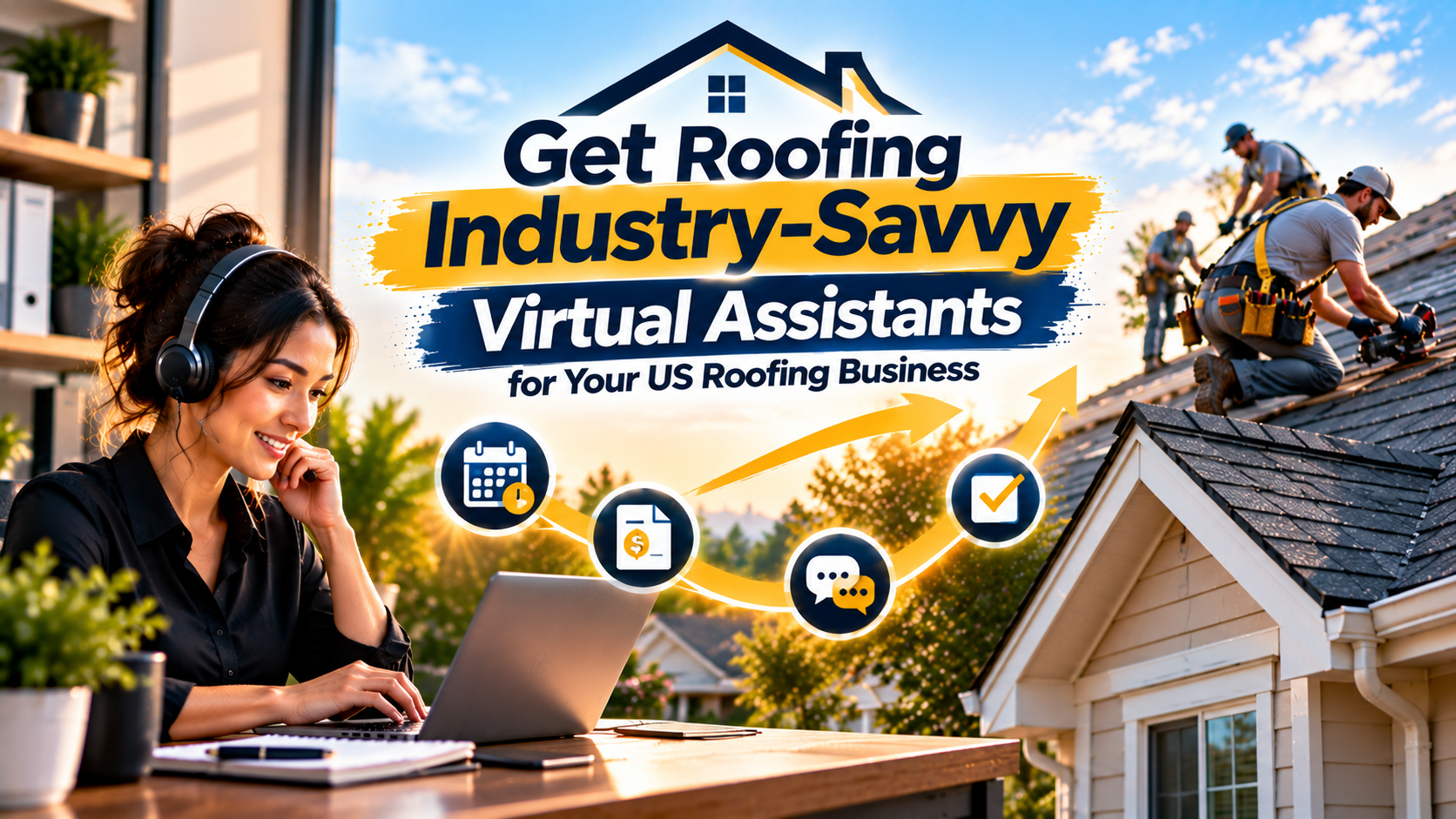
During a storm surge, an unanswered lead or an estimate that never gets followed up can cost a roofing company a job. But adding office staff takes time, and your estimators, project managers, and field leaders shouldn’t have to spend the day chasing paperwork.
Several providers specifically market virtual assistant or back-office support to roofing contractors. Options include roofing-focused agencies such as Work Ninjas, Veristra, Armasourcing, and VirtuHire US. Their services and staffing models differ, so the best fit depends on what you need delegated, the roofing software you use, and how much industry-specific experience you expect.
This guide explains what to compare, and what to keep under contractor oversight.
Why roofing companies need industry-trained virtual assistants
Roofing administration has its own rhythms. Storms can create sudden spikes in calls and inspection requests. A single job may involve estimate follow-up, insurance-claim paperwork coordination, material orders, crew scheduling, homeowner updates, and closeout tasks.
When those workflows sit with the owner or a busy project manager, small delays can compound. Leads wait for a response. Job details are difficult to find. A crew or supplier needs an update while the person with the answer is on a roof.
A roofing virtual assistant can take responsibility for defined administrative steps, helping your team respond consistently and keep information organized. The point isn’t to have a remote assistant make roofing decisions. It’s to free qualified staff from routine coordination so they can focus on inspections, estimating, production, and customers.
Companies to consider for a virtual assistant for roofing companies
These providers publicly describe services for roofing businesses. This is a starting point for your research, not a ranking or independent audit of their current staffing, pricing, or results. Ask each provider to confirm current availability, experience, and references.
Work Ninjas has a dedicated roofing specialists page. Its published service information describes contractor support that can include inbound-call handling, lead management, scheduling, CRM and administrative work, production coordination, and insurance-supplement support. The company also features roofing client references on its site. Ask for current references and a clear breakdown of which tasks are handled by a VA versus specialized staff.
Veristra positions itself around roofing back-office support, including customer communication, CRM updates, scheduling, and supplement-related administrative workflows. If claim documentation is a major bottleneck, clarify exactly what “supplement support” means in practice, who reviews the work, and where your estimator or other qualified professionals remain responsible.
Armasourcing markets Filipino virtual assistants for roofing contractors. Its published task examples include estimate follow-up, scheduling, lead response, review requests, and coordination around crews and materials. If offshore coverage is an option for you, discuss working hours, communication expectations, training, and how the assistant will handle urgent inquiries outside their shift.
VirtuHire US advertises virtual assistant support for roofing businesses, including administrative workflows such as claim-file tracking, follow-up, supplier coordination, and scheduling. Its page also describes roofing software experience. Verify specific experience with your systems and procedures rather than assuming that familiarity with a platform means the assistant is ready to work independently in your account.
Other routes include general VA agencies that serve construction or home-services companies, contractor staffing providers, and freelance marketplaces. A marketplace can offer flexibility, but you’ll likely need to assess roofing knowledge, train the person, and manage continuity yourself. A managed provider may provide more structure around matching, onboarding, and replacement, but you should still check the details of its service agreement.
The right provider is the one that can show how its support will fit your actual roofing workflow, not simply one with “roofing” in its headline.
What a roofing-trained VA can take off your team’s plate
A trained assistant can support the administrative handoffs between a homeowner’s first call and the completed job. Depending on your procedures, access permissions, and the VA’s training, responsibilities may include:
- Lead intake: Record contact details, property location, service need, lead source, and next step; route urgent or unusual calls to the right person.
- Estimate follow-up: Send approved reminders, record responses, and flag prospects who have questions or need a contractor’s attention.
- Scheduling support: Coordinate inspection appointments, update calendars, and communicate approved schedule changes to homeowners and crews.
- Claim administration: Organize documents, track missing items, and follow your process for reminders and status updates. This is administrative coordination, not claim negotiation or coverage advice.
- Supplement documentation organization: Keep relevant records together and track the review or submission status according to your team’s instructions. Your qualified staff should review technical scope and decisions.
- Customer updates: Send routine project-status messages using approved templates and escalate complaints, safety issues, or questions requiring professional judgment.
- Materials and job coordination: Track order details, delivery updates, and follow-up items; route changes or discrepancies to the responsible manager.
- CRM and closeout tasks: Update approved job records, coordinate review requests, and help organize closeout documentation.
Keep roofing judgment and authority with your contractor
Delegation works best when decision rights are explicit. A virtual assistant can organize information and follow an approved process, but should not be treated as a replacement for licensed or experienced roofing professionals.
Keep roof inspections, damage assessments, technical scope, pricing, material specifications, and final estimates with the appropriate contractor or estimator. Insurance coverage decisions and claim negotiations should remain with the authorized people responsible for them. Likewise, assign field safety decisions, licensed work, and production exceptions to qualified staff.
Set escalation rules for issues such as suspected structural damage, active leaks, safety concerns, upset customers, unexpected material changes, or a dispute about the scope. A simple rule helps: the VA records and routes; your qualified team decides and authorizes exceptions.
How to evaluate a roofing industry virtual assistant provider
Before choosing a provider, ask for evidence and process details, not just a list of possible tasks.
- Confirm roofing experience. Ask what roofing workflows the assistant has supported, what tasks they handled, and whether you can speak with a current or recent roofing client.
- Test software fit. Name the tools you use (such as JobNimbus, AccuLynx, CompanyCam, or your scheduling and accounting systems) and ask the provider to describe its hands-on experience. Set permissions based on the role.
- Understand dedicated versus pooled support. A dedicated VA learns your procedures and provides continuity. A pooled model may suit defined, repeatable tasks, but clarify who owns follow-up and what happens when workloads spike.
- Review onboarding and quality checks. Ask how the provider learns your terminology, scripts, escalation rules, and workflows. Agree on a review period and a named point of contact.
- Set privacy and access controls. Discuss confidentiality, account access, password management, data handling, and how access is removed when a role changes. Provide only the information and permissions needed for assigned tasks.
- Confirm coverage and continuity. Clarify time-zone overlap, storm-season availability, backup coverage, replacement policies, and transition procedures if the assistant is unavailable.
- Start with a bounded pilot. Choose a small group of workflows, define success measures, review performance weekly, and expand responsibilities only when the handoffs are reliable.
How Virtual Nexgen Solutions can support contractor operations
Virtual Nexgen Solutions provides dedicated, one-on-one virtual assistants and administrative support designed around a client’s workflows. For a roofing company, the first step is to map the recurring work (such as lead follow-up, calendar coordination, CRM updates, document organization, and customer communications) and agree on which tasks the VA can own and which must be escalated.
Our construction administration and coordination guide describes how virtual support can help organize project information and routine coordination. We also use a structured five-step onboarding and quality-assurance approach, with privacy-conscious workflows and dedicated support.
Virtual Nexgen Solutions reports that its support can reduce administrative workload by up to 60% and increase operational capacity by up to 3x. These are company-reported potential outcomes, not guaranteed results; your actual impact depends on task volume, process clarity, and the scope of support. You can review our administrative support services or contact the team to discuss your needs.
Common questions about roofing virtual assistants
Can a virtual assistant manage roofing insurance claims?
A VA can support administrative steps such as organizing files, tracking documents, updating statuses, and sending approved follow-ups. Coverage interpretation, claim negotiation, technical damage assessment, and other decisions should remain with the appropriately qualified or authorized people.
Does a roofing VA need to know my CRM?
Prior experience helps, but it is not the only factor. Look for familiarity with the software and a clear training plan for your specific setup, stages, permissions, and data-entry standards.
Should I choose an offshore or US-based VA?
Choose based on the work, communication needs, coverage hours, budget, and your comfort with the provider’s security and continuity practices. A US-based assistant may be a fit when close time-zone alignment is essential; offshore support can also work when expectations, training, and escalation coverage are clear.
What should I delegate first?
Start with repetitive work that has clear instructions and measurable completion: lead logging, estimate reminders, appointment confirmations, CRM updates, or review requests. Track response time, overdue follow-ups, record accuracy, and how many hours your internal team gets back before expanding the role.
Turn roofing admin into a defined workflow
The best virtual assistant arrangement doesn’t ask a remote hire to “figure out roofing.” It gives a trained person a clear scope, the right access, documented procedures, and a direct path to escalate decisions.
If storm-season calls, estimate follow-ups, scheduling, or claim-file administration are pulling your team away from field work and customers, start by identifying the three tasks you most want off your plate. Then compare providers against those workflows and their ability to support them consistently. Talk with Virtual Nexgen Solutions about building a practical support plan for your roofing operation.
Work With Virtual Nexgen Solutions
If your business needs dependable virtual assistant support, Virtual Nexgen Solutions can provide support around your existing workflow. Book a discovery call today.
Get in Touch Now!