

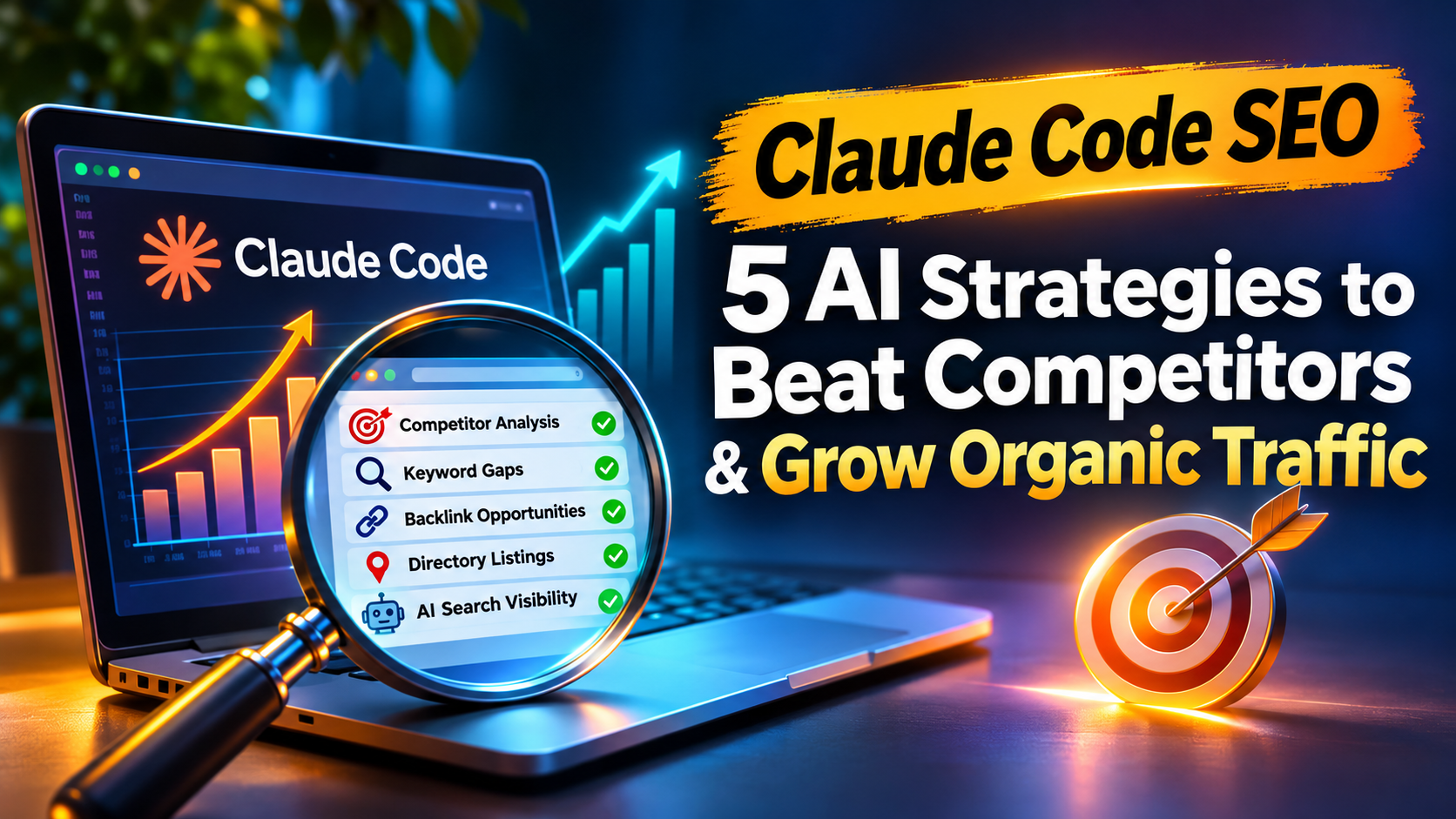
Search engine optimization is changing rapidly. Businesses that once depended on manual keyword research, competitor analysis, and content optimization can now use artificial intelligence to accelerate these activities and discover opportunities that might otherwise go unnoticed.
One particularly interesting development is the use of Claude Code for SEO.
Instead of treating AI as just another content-writing assistant, businesses can use Claude Code to help investigate competitors, analyze website structures, identify keyword opportunities, and organize SEO improvement workflows.
A recent demonstration by Jono Catliff, titled Claude Code SEO: Steal Your Competitor's Traffic (5 Prompts), explores how AI-assisted research can help businesses identify opportunities across competitor pages, keywords, backlinks, directories, and AI search visibility.
At Virtual Nexgen Solutions, we believe the real opportunity goes beyond using AI to generate content. Businesses need a repeatable system that combines AI-powered research, knowledgeable human oversight, and consistent execution.
Let's explore five practical ways businesses can use this approach.
1. Identify High-Performing Competitor Pages
One of the biggest SEO mistakes businesses make is focusing exclusively on their own websites without understanding what is already working for competitors.
Your competitors may have service pages, location pages, industry guides, or educational resources attracting valuable organic traffic.
Claude Code can help organize competitor research and identify pages worth investigating.
What businesses should analyze:
Competitor service and product pages
Pages targeting high-intent commercial keywords
Location-specific landing pages
Educational articles attracting relevant visitors
Website structures and internal linking opportunities
For example, imagine an HVAC company operating in Texas.
Its competitors may be attracting customers through pages targeting searches such as:
HVAC repair services in Dallas
Emergency AC repair in Plano
Commercial HVAC maintenance
Furnace installation services
Rather than guessing which pages to create, the business can investigate competitor websites and identify relevant topics that deserve attention.
Practical takeaway: Build your content strategy around actual customer search demand and competitor gaps, not assumptions.
2. Discover Keyword Gaps Your Competitors Are Already Targeting
Keyword gap analysis helps businesses identify relevant search terms for which competitors have visibility but their own websites do not.
This is especially useful for businesses operating in competitive local markets.
With Claude Code and SEO research tools such as Semrush, teams can organize keyword information, compare competitor coverage, and prioritize opportunities.
Consider a restoration company offering water damage restoration, fire damage cleanup, mold remediation, and reconstruction.
Its website may already rank for water damage restoration but have limited visibility for:
Emergency water extraction
Commercial water damage restoration
Mold remediation services
Fire and smoke damage cleanup
Insurance restoration services
These keyword gaps can reveal opportunities to build dedicated service pages, improve existing content, and answer specific customer questions.
However, not every missing keyword deserves a new page.
Businesses should evaluate search intent, relevance, competition, conversion potential, and whether the topic genuinely deserves its own page.
Practical takeaway: Prioritize keywords that connect directly to your services and the problems your customers are trying to solve.
3. Analyze Competitor Backlinks and Authority Opportunities
Backlinks remain an important part of understanding a website's authority and competitive position.
A backlink is a link from another website pointing to your website. Relevant links can help search engines discover your content and understand its reputation within a particular industry.
AI-assisted competitor research can help identify websites linking to competitors and organize potential outreach opportunities.
For example, a construction company might investigate competitor backlinks from:
Industry associations
Construction directories
Local business organizations
Supplier and manufacturer websites
Industry publications
Relevant business partnerships
Tools such as Semrush can help uncover backlink data, while AI can assist with categorization, prioritization, and research summaries.
However, quality matters more than quantity.
Buying irrelevant links, participating in manipulative link schemes, or submitting websites to low-quality directories can damage long-term SEO performance.
Practical takeaway: Focus on earning relevant, trustworthy backlinks through partnerships, useful resources, industry participation, and genuinely valuable content.
4. Find Relevant Business Directories and Local Citation Opportunities
For companies serving specific cities or geographic areas, local SEO can be an important source of qualified leads.
Customers frequently search for service providers using location-based terms.
Examples include:
Plumbers near me
Roofing contractors in Atlanta
Restoration companies in Houston
HVAC contractors in Dallas
Property management companies in Miami
Business directories and local citations can help reinforce a company's online presence.
An AI-assisted workflow can help research relevant directories, identify missing listings, and organize submission requirements.
For example, an HVAC company could create a directory management checklist containing:
Directory name and website.
Submission requirements.
Business name, address, and phone number.
Relevant service categories.
Listing status.
Verification and follow-up requirements.
Maintaining consistent business information across listings is particularly important.
Do not submit a business indiscriminately to every available directory. Prioritize legitimate platforms that are relevant to the industry, service area, and intended audience.
Practical takeaway: Treat directory management as an ongoing business process rather than a one-time SEO task.
5. Improve Visibility in AI Search and Answer Engines
Search behavior is expanding beyond traditional Google results.
People increasingly use AI-powered platforms to ask questions, compare service providers, understand products, and find recommendations.
This creates an additional opportunity for businesses to make their expertise discoverable.
Answer Engine Optimization (AEO) and Generative Engine Optimization (GEO) focus on improving how clearly and reliably information about a business can be understood, surfaced, and referenced by AI-powered search experiences.
Businesses should consider the following improvements:
Create clear, useful answers.
Publish content that directly answers real customer questions rather than relying exclusively on broad keyword targeting.
Build topical authority.
Develop detailed resources around your core services, industries, products, and customer problems.
Use structured information.
Organize website content with descriptive headings, relevant schema markup, accurate business information, and clear service descriptions.
Demonstrate real expertise.
Include practical examples, industry knowledge, original insights, and accurate information.
Monitor AI visibility.
Investigate whether your business appears in relevant AI-generated answers and identify topics where competitors are being mentioned instead.
Importantly, appearing in AI answers is not guaranteed by adding FAQs or schema markup. These elements help communicate information, but content quality, relevance, trustworthiness, and external recognition also matter.
Practical takeaway: Build your website to be useful to people first and understandable to search engines and AI systems second.
How Businesses Can Turn AI SEO Research Into Actual Results
Identifying SEO opportunities is only the beginning.
Many businesses collect keyword reports, competitor research, backlink information, and content recommendations but struggle to execute the work consistently.
This is where an organized operational workflow becomes valuable.
For example, after identifying SEO opportunities, a business may need someone to:
Maintain keyword research spreadsheets.
Organize competitor analysis reports.
Coordinate blog publishing schedules.
Upload and format website content.
Update internal links and page information.
Track directory submission progress.
Maintain content calendars.
Monitor SEO tasks and reporting deadlines.
Coordinate with marketing specialists and developers.
AI can accelerate research and repetitive administrative activities, but human review remains essential for accuracy, quality, brand consistency, and strategic decisions.
At Virtual Nexgen Solutions, we help businesses improve operational efficiency through dedicated Virtual Assistants and AI-powered support.
Our approach combines human support with AI capabilities to help businesses manage recurring administrative workflows, organize information, coordinate tasks, and maintain consistent execution.
Rather than hiring additional in-house administrative staff for every recurring task, businesses can use a dedicated support model that adapts to their operational requirements.
For companies investing in SEO and digital marketing, this can provide valuable execution support while allowing business owners and marketing specialists to focus on strategy, customer acquisition, and growth.
A Practical AI-Powered SEO Workflow
Businesses looking to implement these ideas can begin with a simple, repeatable process.
| Stage | Activity | Expected outcome |
|---|---|---|
| 1. Research | Analyze competitors and their important pages | Competitor opportunity report |
| 2. Discovery | Identify keyword and content gaps | Prioritized keyword list |
| 3. Authority | Investigate backlinks and directories | Link-building opportunity list |
| 4. Optimization | Improve website pages and content | Better-organized website content |
| 5. Visibility | Review search and AI answer opportunities | AEO/GEO improvement plan |
| 6. Execution | Assign tasks and track progress | Consistent implementation |
Start with a manageable number of competitors and prioritize opportunities based on business value rather than trying to automate everything immediately.
Frequently Asked Questions (FAQs)
1. What is Claude Code SEO?
Claude Code SEO refers to using Claude Code to assist with SEO-related research, analysis, and technical workflows. It can help organize competitor information, investigate website content, identify optimization opportunities, and support repetitive tasks.
2. Can Claude Code analyze competitor websites?
Yes. With suitable website access, tools, and data sources, Claude Code can help investigate competitor pages, website structures, content topics, and other SEO information. The accuracy of its findings depends on the available data and research setup.
3. What tools can be used with Claude Code for SEO?
SEO workflows can combine Claude Code with tools such as Semrush for keyword and backlink research and Firecrawl for website data extraction. The appropriate tools depend on the workflow and access requirements.
4. What is keyword gap analysis?
Keyword gap analysis compares the search terms for which competing websites have visibility against the keywords your website targets. It helps identify relevant content and optimization opportunities.
5. What is the difference between SEO, AEO, and GEO?
SEO focuses on improving visibility in search engines. AEO focuses on making information useful and accessible for direct answers. GEO focuses on improving the discoverability and representation of information in generative AI-powered search experiences.
6. Can AI guarantee higher Google rankings?
No. AI can help improve research, content planning, and optimization efficiency, but it cannot guarantee rankings, organic traffic, or leads. Results depend on relevance, content quality, competition, technical performance, authority, and many other factors.
7. Can a Virtual Assistant help manage SEO activities?
Yes. A trained Virtual Assistant can support keyword research organization, competitor tracking, content scheduling, website updates, directory management, reporting, and other recurring administrative activities. Strategic SEO decisions and technical work should remain with appropriately qualified specialists.
Final Thoughts: Combine AI Intelligence With Consistent Execution
The future of SEO is not simply about producing more content or using more AI tools. It is about identifying the right opportunities, understanding customer search behavior, and consistently implementing improvements.
Claude Code can help businesses accelerate competitor research, keyword discovery, backlink analysis, directory research, and AI search optimization workflows.
But technology alone does not create sustainable growth. Businesses also need structured processes, reliable execution, quality control, and people who ensure that the work gets completed.
At Virtual Nexgen Solutions, we believe the strongest business model combines capable people with intelligent AI-powered support.
Ready to delegate the busywork and give your team more time to grow?
Partner with Virtual Nexgen Solutions for reliable, industry-focused Virtual Assistant support tailored to your business needs.
Discover how our Virtual Assistant and AI-powered solutions can help streamline your operations, improve efficiency, and support business growth.
Ready to explore the possibilities? Schedule a free consultation with our team and discover the right support for your business.
Work With Virtual Nexgen Solutions
If your business needs dependable virtual assistant support, Virtual Nexgen Solutions can provide support around your existing workflow. Book a discovery call today.
Get in Touch Now!