

Your HVAC technicians can be busy all day and still have too few hours to bill. The gap often isn’t a technician problem. It’s an operations problem: paperwork, schedule changes, parts coordination, customer updates, and other work that pulls field staff away from service.
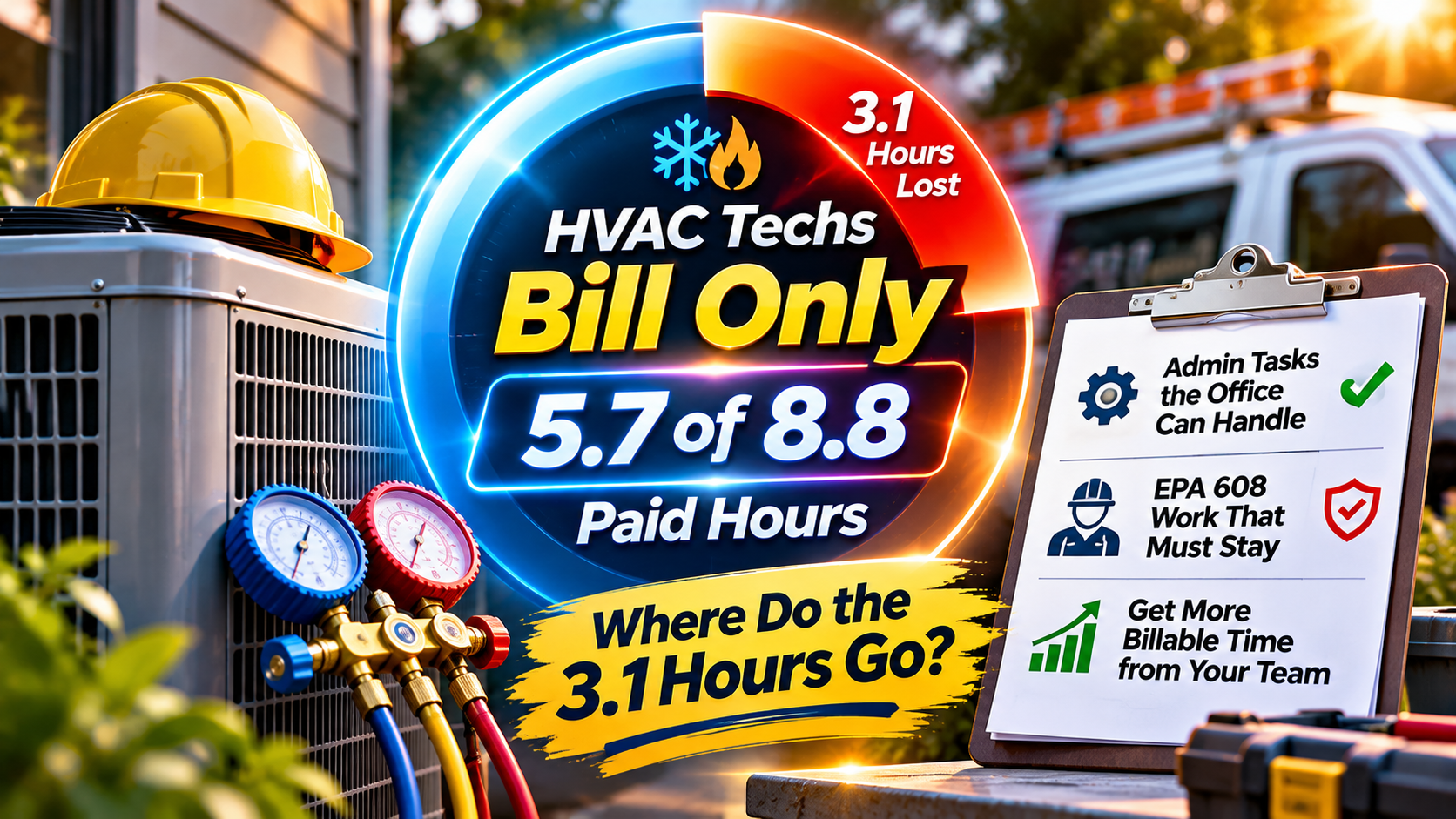
A Field Promax report covered by ACHR News on June 16, 2026 examined more than 10,000 data points across 300 HVAC companies. It reported an average of 8.8 paid hours per technician per day, with 5.7 hours billable. That leaves about 3.1 paid hours not billed to customers.
That’s the three-hour leak. It does not mean every unbilled minute is waste, or that every minute should be charged to a customer. Travel, training, maintenance, and some site work are part of running a service business. But it does mean owners should find out where the hours go and stop using skilled field time for work the office can handle.
Virtual Nexgen Solutions supports HVAC companies with dedicated virtual assistants who can help with customer calls, scheduling, job updates, estimate follow-up, and routine administrative workflows. The goal is to support your existing team, not replace field expertise. Explore HVAC virtual assistant support.
Where does the unbilled time go?
The Field Promax analysis reported that about 1.13 hours per day went to driving time not recovered through trip charges or flat-rate pricing. The remaining time included tasks such as paperwork, idle gaps between jobs, work not captured on a work order, training, and vehicle maintenance.
Those categories need different fixes. A remote admin can’t shorten every drive or eliminate necessary training. But better office workflows can reduce avoidable interruptions and make work easier to complete, document, and invoice.
Look for patterns like these:
- Paperwork after the job: Technicians return to the truck or office to finish notes, update records, or provide details needed for billing.
- Job-status interruptions: A technician stops work to call the office, while someone else tries to reach the technician for an ETA or schedule update.
- Parts coordination: A missing part triggers calls, supplier checks, and customer rescheduling that could be coordinated from the office.
- Unclosed estimates: The technician submits an estimate, but no one follows up with the customer while the job is still top of mind.
- Delayed job closeout: Completed work sits in the field service system while the office waits for missing information before preparing an invoice.
- Unanswered inbound calls: New service requests go to voicemail or wait in a queue while office staff handle other tasks.
The aim isn’t to make technicians rush. It’s to reduce friction around the work so they can focus on qualified service, safe decisions, and complete documentation.
Which HVAC admin tasks can the office take over?
Start with tasks that follow clear instructions and don’t require diagnosis, technical judgment, or an on-site safety assessment. Give each workflow an owner, a written process, and an escalation rule.
A trained office assistant or virtual assistant can support:
- Answering calls, capturing caller details, and booking within your approved rules.
- Sending appointment confirmations, ETA updates, and routine job-status messages.
- Updating customer records and dispatch boards based on manager instructions.
- Following up on open estimates using approved scripts and escalation criteria.
- Preparing invoices from completed work orders for review or sending, where authorized.
- Coordinating parts availability and communicating supplier updates to the team.
- Scheduling maintenance-agreement visits and sending renewal reminders.
- Checking job records for missing notes, photos, signatures, or other required documentation.
- Sending review requests and organizing customer feedback.
- Preparing routine operational reports from your field service management (FSM) system.
For example, after a technician marks a job complete, the office workflow could check that the required details are present, prepare the invoice according to your process, and flag exceptions for a manager. The technician should provide accurate job information; the office should make sure the administrative handoff doesn’t stall.
Virtual Nexgen’s HVAC support page describes administrative workflows including service scheduling, dispatch coordination, job-status updates, estimate follow-up, invoice processing, maintenance reminders, and parts coordination. Tasks should be assigned according to your systems, permissions, and approval rules.
What should never be delegated to a remote admin?
A virtual assistant can organize information and escalate concerns. They should not make technical or safety decisions.
The U.S. EPA’s Section 608 certification requirements, last updated July 15, 2026, state that technicians who maintain, service, repair, or dispose of equipment in ways that could release refrigerants must be certified. Refrigerant handling and technical work that requires certification must stay with appropriately qualified personnel.
Keep the following with certified field staff or authorized company decision-makers:
- Diagnosing equipment faults or recommending technical repairs.
- Handling refrigerants or performing regulated service work.
- Assessing gas, carbon monoxide, electrical, or other on-site safety risks.
- Deciding whether an emergency requires immediate field action.
- Approving prices, discounts, job scope changes, refunds, or disputed charges.
A remote team member who receives a caller’s safety concern should follow your escalation procedure and connect the person to the appropriate qualified resource. They should not diagnose the situation or improvise advice.
How much can improving office workflows matter?
Start with your own baseline, not a revenue promise.
The Invoca Home Services Lead Conversion Benchmarks Report 2026 reports that 34% of HVAC callers in its dataset spoke with a person. The report draws on anonymized call data from Invoca customers and a broader dataset of more than 70 million calls across home services and other industries. Its figures are averages from that platform, not a prediction of your company’s answer rate or lost revenue.
Use the finding as a reason to check your own call handling. Measure what happens to calls during peak periods, after hours, and when dispatch is busy. Then compare answered calls with booked jobs. A call that reaches a person is not automatically a qualified lead or a completed service appointment.
Technician utilization also needs context. Granular’s HVAC utilization analysis discusses 78% as a high-performing reference point, not a universal target for every contractor. Your service mix, travel distances, job types, pricing, and definition of billable time all affect what a useful target looks like.
One practical calculation is:
Billable efficiency = billable technician hours ÷ total paid technician hours × 100
Use the same definition every week. Review utilization alongside job quality, callbacks, customer experience, and safety: otherwise a team may appear more efficient simply by rushing or recording time differently.
How do you reduce the leak in 30 days?
Keep the first pilot narrow. Choose one repeatable workflow, establish its current performance, and review the results before expanding.
- Baseline your numbers. Use your FSM and timekeeping reports to record billable hours, paid hours, call-answer rate, estimate follow-up completion, and the time from job completion to invoice. Confirm that the definitions are consistent.
- Find the avoidable handoffs. Ask technicians and office staff where they repeat information, chase updates, or wait for a decision. Fix unclear ownership before adding another tool or person.
- Assign one office workflow. For example, have an assistant coordinate routine job-status updates or follow up on approved estimates. Document what to do, what not to do, and when to escalate.
- Set permissions and checkpoints. Use role-based system access, an approved communication script, and review steps for invoices or exceptions. Keep technical and financial approvals with the right people.
- Review weekly and adjust. Compare the baseline with current results. If a workflow reduces interruptions but creates rework, revise the SOP before expanding.
How can Virtual Nexgen support an HVAC team?
A dedicated HVAC-trained virtual assistant can take ownership of agreed administrative workflows across tools such as ServiceTitan, Housecall Pro, or FieldEdge, depending on your setup and access requirements. AI automation can also support defined tasks such as capturing after-hours inquiries or sending routine status messages, with clear human escalation paths.
Virtual Nexgen’s HVAC virtual assistant service is designed to work alongside your team. You set the rules, approvals, customer tone, and boundaries; the assistant follows the documented process and flags exceptions.
If you’re already considering phone coverage or maintenance follow-up, see Virtual Nexgen’s guides to the HVAC virtual receptionist and HVAC virtual assistant support. For an operational review, book a consultation.
FAQs about HVAC technician billable hours
Why are my HVAC technicians’ billable hours low?
Common causes include travel, schedule gaps, paperwork, parts coordination, and incomplete job closeout. Use your FSM and time records to identify the largest causes before changing schedules or staffing.
How do I improve HVAC technician utilization?
Define utilization consistently, review it regularly, and remove avoidable delays around scheduling, documentation, and job closeout. Monitor callbacks and service quality too; utilization should not come at the cost of safe, complete work.
What admin tasks can I take off HVAC technicians?
Consider moving customer updates, routine record entry, estimate follow-up, appointment coordination, invoice preparation, and documentation checks to trained office support, with clear approval rules.
Can a virtual assistant help dispatch HVAC jobs?
Yes, with defined limits. A virtual assistant can update schedules, coordinate routine changes, and communicate with customers under your rules. A dispatcher or manager should retain decisions that require operational judgment or technical context.
What HVAC work should never be delegated to a remote assistant?
Remote administrative staff should not diagnose equipment, handle refrigerants, assess on-site safety, or give technical or emergency advice. Keep those decisions with appropriately qualified personnel.
How much revenue do missed HVAC calls cost?
There is no reliable universal amount for every business. Call volume, lead quality, local demand, booking rates, and average job value all affect the result. Track your own call-answer and booking data before estimating the impact.
Sources
Work With Virtual Nexgen Solutions
If your business needs dependable virtual assistant support, Virtual Nexgen Solutions can provide support around your existing workflow. Book a discovery call today.
Get in Touch Now!