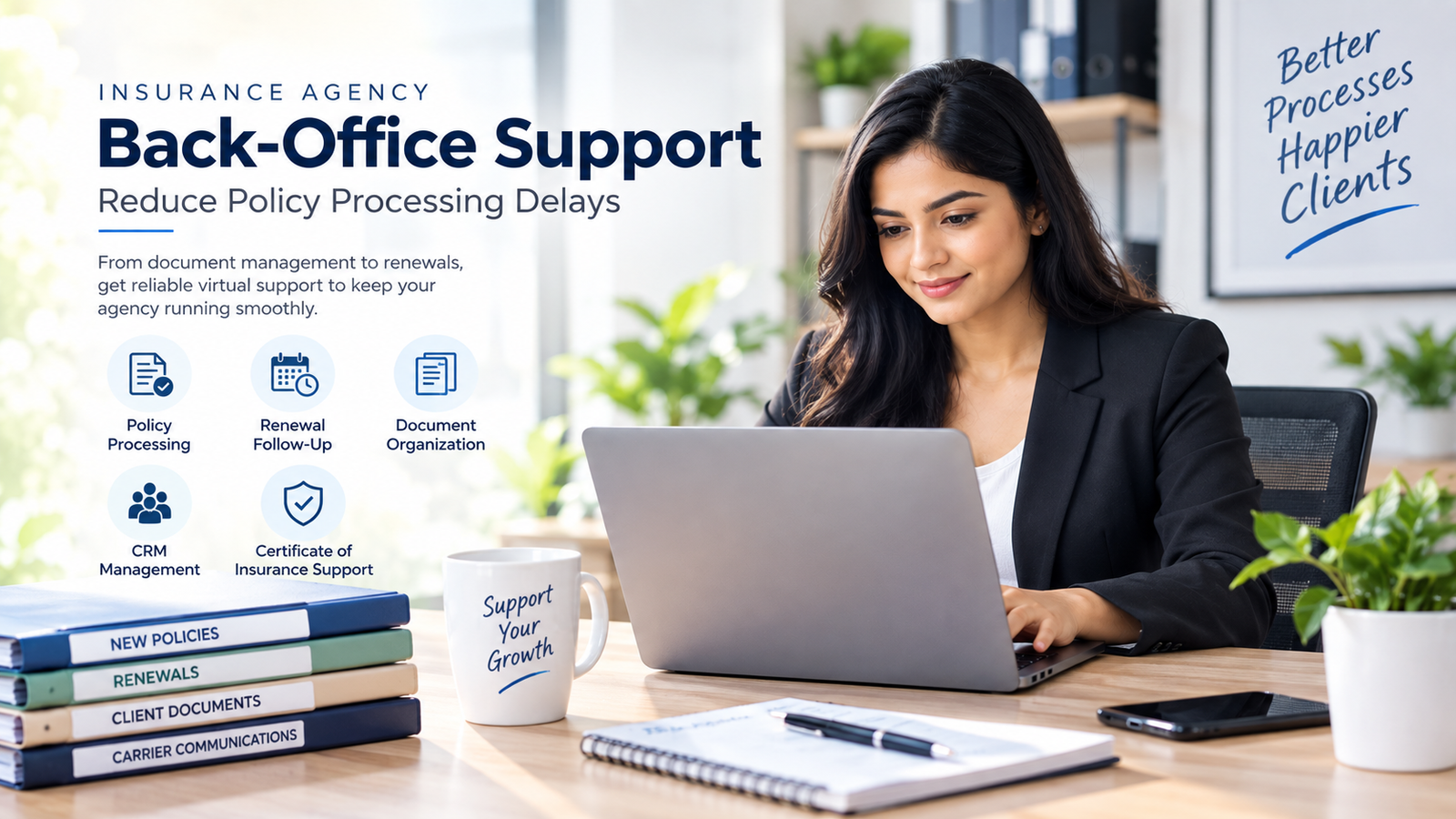


The commercial insurance world is a high-stakes game of specialized knowledge and relationship management, yet most brokers find themselves shackled to the mundane. You didn't enter this industry to spend four hours a day fighting with carrier portals or manually re-keying ACORD 25 data. You entered it to build portfolios, manage risk, and drive revenue. However, as your brokerage grows, you eventually hit a ceiling: a "Capacity Wall": where the sheer volume of administrative friction prevents you from taking on a single new client without something important slipping through the cracks.
At Virtual Nexgen Solutions, we see this cycle daily. Small to mid-sized brokerages start with a surge of growth, only to plateau because their best producers are acting as expensive data-entry clerks. This isn't just an "efficiency problem"; it is "Profit Leakage" in its most aggressive form. When a $200,000-a-year producer is spending thirty minutes issuing a Certificate of Insurance (COI), you aren't just losing time; you are burning capital. The solution isn't to work harder; it is to systematize the friction points using a specialized Insurance Virtual Assistant.
What is the "Capacity Wall" in a commercial insurance brokerage?
The Capacity Wall is the operational threshold where the volume of service tasks, renewals, and administrative requirements exceeds the manual processing power of your current staff. In commercial brokerages, this manifests as stalled growth, missed renewal deadlines, and producers who are too buried in "Admin Debt" to hunt for new business.
Breaking this wall requires a fundamental shift in how you view agency operations. Instead of hiring more high-cost domestic staff to manage low-level tasks, you must implement a "Virtual Assistant layer" that sits between your producers and the administrative abyss. By offloading specialized tasks to a Virtual Nexgen Solutions professional for just $8 per hour, you liberate your top talent to focus on high-value client advisory and closing new accounts. This strategy transforms your brokerage from a service-stuck entity into a scaling powerhouse.
How do you solve the "Carrier Portal Paradox" with a Virtual Assistant?
The Carrier Portal Paradox is the friction caused by carriers demanding that brokers use individual, fragmented portals for every quote, bind, and service request. While these portals aim to simplify the carrier’s side, they force the broker into a nightmare of 15 to 30 different logins, conflicting data requirements, and endless manual re-keying.
A specialized Insurance Virtual Assistant solves this paradox by acting as the primary operator for these systems. Instead of your Account Executive (AE) spending forty minutes navigating Applied Epic and then three different carrier portals for a single GL quote, the VA handles the entire data-entry sequence. They extract information from your Agency Management System (AMS), normalize it, and push it through the required portals. This ensures that your technical staff only sees the final result: the quote: rather than the grueling process required to get it. This level of technical support is standard for Virtual Nexgen Solutions clients who need to scale without the headache of portal sprawl.
SOP: The Multi-Portal Submission Workflow
- Data Extraction: The VA pulls the current ACORD forms, Statement of Values (SOV), and Loss Runs from your AMS (AMS360, HawkSoft, or EZLynx).
- Appetite Matching: The VA checks the carrier's appetite guide to ensure the submission fits the carrier's current focus, preventing wasted effort.
- Portal Navigation: The VA logs into the specific carrier portals (e.g., Travelers, Liberty Mutual, The Hartford) and populates the submission data.
- Underwriter Coordination: The VA tracks the submission ID and follows up with the underwriter to ensure the file is complete and moving toward a quote.
- Quote Normalization: Once received, the VA pulls the quote, identifies key exclusions, and maps the data into a standardized proposal template for the producer.
Streamline your submission cycle today by scheduling a discovery call with Virtual Nexgen Solutions.
What is the 90-60-30 renewal cadence for commercial lines?
The 90-60-30 renewal cadence is a disciplined timeline designed to ensure that no commercial policy ever reaches its expiration date without a strategic plan. It divides the renewal process into three distinct phases: Strategy (90 days), Submission (60 days), and Binding (30 days), preventing last-minute scrambles and coverage gaps.
This cadence is the "Admin Engine" of a successful brokerage. When managed by an Insurance Virtual Assistant, the process becomes a predictable conveyor belt of activity. The VA initiates the process at day 90 by auditing the current policy and requesting updated exposures from the client. By day 60, they have already pushed the submissions to the market. By day 30, the producer has multiple quotes in hand and a ready-to-present proposal. This level of rigor ensures high retention rates and allows the agency to handle twice the volume with zero increase in stress.
SOP: Technical Breakdown of the 90-60-30 Cadence
- 90 Days Out (The Strategy Phase): The VA runs a report in the AMS to identify upcoming renewals. They send a "Renewal Questionnaire" to the client and collect updated payroll, receipts, and vehicle schedules. They also order updated Loss Runs from current carriers.
- 60 Days Out (The Market Phase): The VA reviews the updated data against the incumbent’s appetite. If the risk needs to be marketed, the VA handles the submissions across multiple carrier portals. They track all pending quotes and "nudge" underwriters who haven't responded within 48 hours.
- 30 Days Out (The Closing Phase): The VA compiles the quotes into a side-by-side comparison. They highlight rate changes and coverage deltas (e.g., a new exclusion for Cyber or Professional Liability). Once the producer gets the "green light" from the client, the VA executes the bind order in the portal and files the new policy docs.
How does an Insurance Virtual Assistant reduce the COI issuance cycle?
Issuing a Certificate of Insurance (COI) is a high-frequency, low-complexity task that often creates a massive bottleneck when handled by domestic staff. While it might only take ten minutes to generate a single cert, a busy brokerage might receive fifty requests a day, effectively stealing a full work day from a highly-paid employee.
By redirecting COI requests to a Virtual Nexgen Solutions assistant, you move from a "reactive" posture to a "proactive" one. Our VAs are trained in AMS360, Applied Epic, and EZLynx, allowing them to issue certs, check for additional insured requirements, and email the certificate holder in a matter of minutes. This reduces the turnaround time for your clients from hours (or days) to less than 30 minutes, significantly improving client satisfaction and freeing your local team for complex coverage analysis.
SOP: Rapid COI Issuance Workflow
- Request Capture: COI requests are routed to a dedicated "certs" email folder monitored by the VA.
- Coverage Verification: The VA checks the policy in the AMS to ensure the requested limits and endorsements (e.g., Waiver of Subrogation) are active.
- Certificate Generation: The VA generates the ACORD 25 or ACORD 28 within the AMS.
- Quality Check: The VA verifies the certificate holder's name and address against the request.
- Distribution: The VA emails the certificate to the holder and BCCs the client, then attaches a copy to the client's file in the AMS.
Stop the service bleed and visit www.virtualnexgen.com to see how we can handle your COI volume.
Why is the quote-to-bind cycle the most critical metric for scaling?
The quote-to-bind cycle measures the total time elapsed from the moment a submission is received to the moment the policy is bound. In a manual brokerage, this cycle is often bloated by "white space": the time a file sits on a desk waiting for someone to enter data or follow up with an underwriter.
An Insurance Virtual Assistant eliminates this white space by providing continuous "Operational Uptime." While your domestic team is in meetings or handling claims, the VA is pushing files through the pipeline. They ensure that every submission is complete on the first pass, which underwriters love, leading to faster response times and higher "quote-to-bind" ratios. When you reduce this cycle time, you increase your agency's "Velocity of Capital," allowing you to write more business in the same amount of time.
The ROI Math: $8/hr vs. The Capacity Wall
Let's look at the hard numbers of "Admin Debt." A typical domestic Account Manager in the U.S. costs approximately $60,000 per year plus benefits, taxes, and office overhead, bringing the true cost closer to $75,000. This individual spends roughly 60% of their time on administrative tasks like portal entries, COI issuance, and renewal follow-ups. This means you are paying $45,000 a year for "keystroke work."
By contrast, a specialized Insurance Virtual Assistant from Virtual Nexgen Solutions costs just $8 per hour. For a full-time assistant, your annual investment is approximately $16,640. By shifting that 60% of administrative work to a VA, you immediately save nearly $30,000 in labor costs while simultaneously doubling the capacity of your domestic Account Manager. This isn't just about saving money; it's about reallocating your most expensive resources to revenue-generating activities. The ROI is realized the moment your producers stop doing $8/hour work and start doing $500/hour sales work.
Specialized Commercial Insurance Tasks for VAs
Our Virtual Assistants are not generalists; they are technical support professionals trained in the specific workflows of commercial brokerages. They are experts in systems like Applied Epic, AMS360, and EZLynx. Here is a list of the industry-specific tasks they handle:
- ACORD Form Preparation: Drafting ACORD 125, 126, 127, and 140 forms with 100% accuracy.
- Carrier Portal Submissions: Navigating complex portals for GL, Work Comp, Property, and Cyber lines.
- Policy Checking: Comparing the bound policy against the original quote to identify carrier errors.
- Loss Run Procurement: Contacting carriers and navigating portals to gather 3-5 years of loss history.
- Premium Financing Documentation: Preparing finance agreements for client signature and carrier submission.
- Endorsement Processing: Entering mid-term changes (vehicle adds/deletes, address changes) into carrier portals and the AMS.
- Audit Support: Assisting clients with gathering documentation for annual payroll and sales audits.
- Proposal Deck Creation: Designing professional, branded proposals that highlight coverage gaps and pricing options.
Ready to systematize your growth? Book your 30-minute scaling consultation here.
Frequently Asked Questions (FAQ)
How do I know my data is secure with a Virtual Assistant?
Data security is our top priority. We implement strict security protocols, including secure VPNs, password management systems, and comprehensive background checks for all our assistants. Furthermore, our VAs work within your existing Agency Management Systems (AMS), so your data never leaves your controlled environment.
Do I need to train the VA on insurance basics?
No. While every agency has unique internal SOPs, our Insurance Virtual Assistants come with a baseline understanding of insurance terminology, forms, and common carrier portals. They are trained to hit the ground running with technical tasks like COI issuance and renewal tracking.
Can a VA help with marketing new business?
Absolutely. While they don't "sell" (unless licensed in your state), they handle the heavy lifting of the marketing process. This includes preparing the submission packet, entering data into multiple carrier portals, and organizing the quotes for the producer's review.
What Agency Management Systems (AMS) do your VAs use?
Our VAs are proficient in all major insurance software, including Applied Epic, AMS360, HawkSoft, EZLynx, and Vertafore. We focus on integrating our staff into your existing technical stack for a seamless transition.
How quickly can a VA start handling COIs?
With a clear SOP provided by your agency, a VA can usually begin handling basic COI requests within the first 48 hours of onboarding. We work with you to ensure they understand your specific requirements for "Additional Insured" and "Waiver of Subrogation" language.
Conclusion
Scaling a commercial brokerage in 2026 is no longer about who can hire the most people; it’s about who can build the most efficient engine. The "Capacity Wall" is a choice. You can choose to let your team drown in the "Carrier Portal Paradox" and "Admin Debt," or you can choose to break through using specialized human support.
Virtual Nexgen Solutions provides the administrative engine that allows brokers to be brokers again. For $8 per hour, you can eliminate the service bottlenecks that are killing your margins and preventing your growth. Don't let your brokerage's potential be limited by the number of logins your staff can remember.
Schedule your Discovery Call today and let’s discuss how to double your agency's capacity by next quarter.