

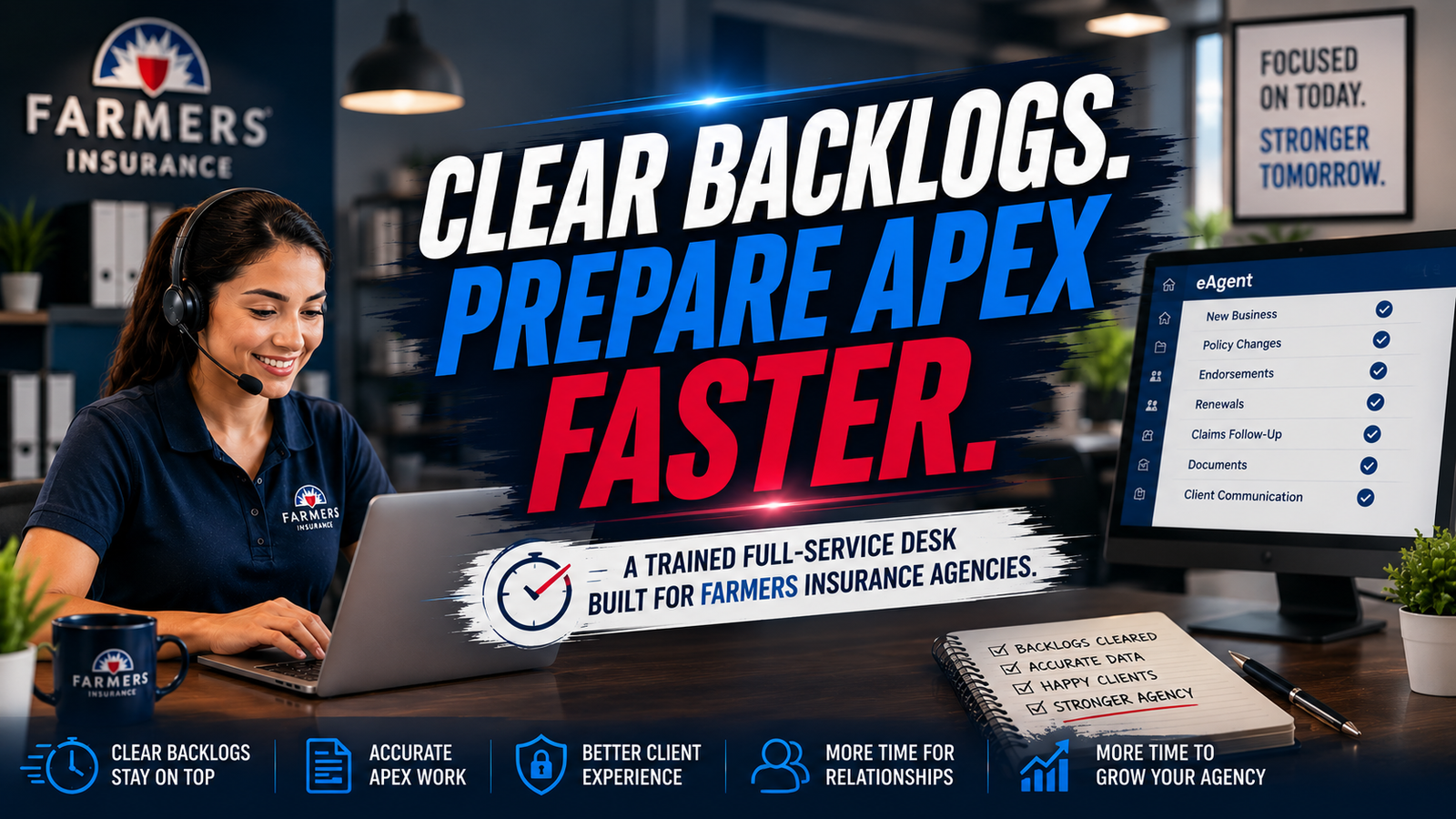
An agent opens eAgent to find a growing list of action items. Meanwhile, an Apex quote still needs data entry, a policyholder is waiting for a certificate of insurance, and a billing question has already been forwarded twice. That is how administrative debt grows inside a Farmers agency.
A producer spends the first two hours of the morning clearing service requests instead of calling prospects. By late afternoon, quote preparation and renewal follow-up move into the evening. The agency is busy, but the work is not moving revenue forward.
What is a Farmers insurance virtual assistant service?
A Farmers insurance virtual assistant service is a trained remote support desk that handles approved administrative work across eAgent, Apex, email, documents, and client follow-up. The service helps you clear routine workload while licensed agents retain responsibility for advice, coverage decisions, binding, and final approvals.
The right model does not provide random task help. It provides structured coverage across the policy lifecycle, with defined handoffs, individual logins, documented procedures, and measurable service standards.
Why do Farmers agencies carry so much administrative debt?
Farmers agents manage more than new business. They also handle endorsements, billing inquiries, non-pay outreach, claims communication, renewal reminders, documentation, and customer questions.
The U.S. Bureau of Labor Statistics describes insurance sales agents as professionals who sell policies, maintain records, assist with claims, and respond to policyholder questions. That broad role explains why licensed producers can become overloaded with work that does not require their license. Read the BLS overview of insurance sales agent duties for additional occupational context.
Common pressure points include:
- eAgent action items: Review, categorize, assign, and track pending work.
- Apex data entry: Prepare quote information and service changes before agent review.
- Endorsement requests: Gather missing details and organize documentation.
- Billing inquiries: Respond to routine questions and route issues that need agent involvement.
- Claims concierge touches: Collect first-notice details and follow up on claim status.
- Renewal follow-up: Contact customers before deadlines and document responses.
- Inbox congestion: Sort urgent requests from routine service messages.
A general assistant may help with email. A trained Farmers insurance agent assistant understands how those requests move through eAgent and Apex and knows when to stop and escalate.
What does a full-service Farmers agency desk handle?
A full-service desk covers multiple workflows instead of solving only one backlog. Assign the work below according to your agency’s access rules and licensed-agent review process.
eAgent workflow support
A eAgent virtual assistant can review dashboard action items, sort requests by urgency, update task notes, and route items to the correct agent. The VA can also organize policy-service requests, identify missing information, and maintain a follow-up queue.
Keep coverage decisions and final approvals with the licensed agent. Require the VA to document every unresolved item clearly.
Apex quoting support
An Apex quoting assistant can prepare information before the producer reviews it. Assign the VA to collect driver details, vehicle information, property characteristics, contact data, and required documents.
The VA can enter approved information, organize submission materials, schedule follow-up, and flag missing data. Do not delegate quote recommendations, premium decisions, binding, or coverage explanations.
Certificate of insurance support
Direct the VA to receive COI requests, verify the requestor’s information, identify missing certificate details, prepare the document according to agency instructions, and route it for required review.
Track request time, completion time, and delivery confirmation. Escalate unusual wording, coverage questions, or requests that require professional judgment.
New business and renewal follow-up
Use the desk to monitor uncompleted quote requests, send approved reminders, schedule agent calls, and record customer responses. For renewals, ask the VA to organize upcoming accounts, confirm contact details, and flag customers who have not responded.
Create a clear escalation rule for rate concerns, coverage questions, cancellations, and retention decisions.
Claims concierge support
A VA can collect first-notice documentation, organize incident details, send approved status requests, and record carrier communications. The VA can also remind policyholders about outstanding documents.
Never permit the VA to interpret coverage, promise payment, recommend a settlement, or make a claims decision. Keep those responsibilities with the carrier and authorized insurance professionals.
Billing and non-pay outreach
Assign routine payment reminders, approved email follow-up, documentation requests, and status tracking. Require the VA to use approved language and route disputes, hardship requests, reinstatement questions, and coverage concerns to the licensed team.
Cross-sell and monoline audit support
A VA can review approved customer lists, identify accounts with only one known policy line, prepare call lists, and schedule producer conversations. The VA should gather information, not recommend coverage or make a suitability decision.
Inbox and customer follow-up
An insurance agency virtual assistant can triage shared inboxes, label requests, draft responses from approved templates, schedule appointments, and track unanswered messages. Set service-level rules for urgent requests, claims, cancellations, and new leads.
What should a Farmers agency VA never do?
Protect your agency by defining boundaries before access is granted. A non-licensed VA should never:
- Make quoting decisions.
- Bind or issue a policy without required licensed approval.
- Provide coverage advice or recommendations.
- Decide premiums, discounts, eligibility, or suitability.
- Interpret policy language for a customer.
- Settle, deny, or evaluate a claim.
- Sign compliance certifications or approve regulatory filings.
- Override an agent’s decision.
- Use another employee’s login.
- Access information unrelated to assigned duties.
Provide an individual login, minimum necessary access, written escalation rules, and an audit trail. Review permissions whenever responsibilities change.
How many hours of support does your agency need?
Right-size the desk around workload, not headcount. Start with the tasks that create the most producer interruption, then expand after the first 30 days of measured performance.
- 10 hours per week: Use this level for inbox triage, basic eAgent action-item organization, document follow-up, and a limited renewal queue. At $8 per hour, the planning cost is about $346.40 per month using 4.33 weeks.
- 20 hours per week: Add Apex pre-quote preparation, COI support, billing outreach, and broader follow-up. At $8 per hour, the planning cost is about $692.80 per month.
- 40 hours per week: Build a dedicated full-service desk covering daily eAgent work, Apex preparation, COIs, renewals, billing, claims concierge support, and inbox management. At $8 per hour, the planning cost is about $1,385.60 per month.
Use the $8 hourly rate as a capacity-planning figure, not a promise that every task will require the same time. Compare it honestly with an in-house administrative employee that may exceed $60,000 per year after salary, payroll costs, benefits, equipment, and management time. Confirm the local employment benchmark before publishing it as a formal cost comparison: [VNS to confirm].
Case study: Texas Farmers agency
A five-producer Farmers agency in Texas used a part-time service desk to organize eAgent action items, prepare Apex quote information, and manage COI follow-up. The measurement plan tracked open action items, quote-preparation time, COI turnaround, and producer hours reclaimed.
What makes a trained service desk different?
Ad-hoc help handles whatever appears next. A trained service desk follows a defined queue and understands how work moves through eAgent and Apex.
Virtual Nexgen Solutions builds support around:
- Farmers workflow familiarity: Train the VA on eAgent action items and Apex preparation.
- Clear ownership: Assign each request to a queue, agent, or escalation path.
- Secure access: Use individual logins and access only the required records.
- NDA-backed support: Protect agency and policyholder information through documented confidentiality practices.
- Quality review: Sample completed work and correct recurring errors.
- Flexible coverage: Start with a small weekly block and expand when the queue proves the need.
Review Virtual Nexgen Solutions’ insurance virtual assistant services to see how specialized administrative support can fit your agency. For broader inbox, scheduling, and documentation work, explore administrative support services.
How can you go live in 7–10 days?
Use a focused launch instead of trying to transfer the entire agency at once.
- Map the workload: List recurring eAgent, Apex, inbox, COI, billing, renewal, and claims-support tasks.
- Set boundaries: Identify work the VA may complete, work requiring review, and work reserved for licensed agents.
- Create access: Set up individual credentials, approved communication channels, and secure document access.
- Train with sample records: Demonstrate your preferred process using non-sensitive or approved training records.
- Pilot one workflow: Start with eAgent triage, Apex preparation, or COI support.
- Review and expand: Check accuracy, escalation quality, and queue movement before adding more responsibilities.
A 7–10 day go-live is realistic when your scope is clear, access is ready, and the first workflow is narrow enough to review properly.
Case study: Florida Farmers agency
A growing Farmers agency in Florida introduced a 20-hour-per-week desk for renewal follow-up, billing outreach, and inbox management. The agency measured response completion, unresolved inbox messages, renewal appointments scheduled, and agent interruptions.
How should you measure results over 30, 60, and 90 days?
Track operational evidence instead of vague claims.
- First 30 days: Measure action-item clearance, completed follow-ups, access issues, escalations, and quality-review corrections.
- By 60 days: Compare quote-preparation turnaround, COI turnaround, renewal contact completion, inbox volume, and billing follow-up.
- By 90 days: Review producer hours reclaimed, customer response consistency, unresolved-work aging, and the number of workflows safely transferred to the desk.
Use the same definitions every month. For example, define “COI turnaround” as the time from complete request receipt to approved delivery. Consistent measurement makes the service easier to manage and easier to scale.
Why choose Virtual Nexgen Solutions?
Virtual Nexgen Solutions provides more than a general virtual assistant for Farmers insurance agents. The service is designed around insurance administration, approved eAgent and Apex workflows, secure access, documented handoffs, and continuous review. That structure helps you build dependable Farmers insurance back office support without forcing every producer to become a full-time service coordinator.
You can begin with 10, 20, or 40 hours per week and adjust after reviewing actual workload. Read the Farmers Insurance virtual assistant playbook for related workflow context, then define the service desk your agency actually needs.
Frequently Asked Questions
What can a virtual assistant do for a Farmers Insurance agent?
A VA can organize eAgent action items, prepare Apex quote data, support COI requests, track renewals, follow up on billing matters, manage approved customer communications, and organize claims documentation. The licensed agent must retain responsibility for coverage advice, binding, premium decisions, and claims judgments.
Can a VA work in eAgent and Apex?
Yes. With approved access, training, and supervision, a VA can perform administrative work in eAgent and Apex. Give the VA an individual login, limit permissions, and require escalation whenever a task involves advice, binding, or professional judgment.
How much does a Farmers insurance VA cost?
Virtual Nexgen Solutions’ planning rate is $8 per hour. That equals approximately $346.40 per month for 10 hours per week, $692.80 for 20 hours, or $1,385.60 for 40 hours, based on 4.33 weeks per month.
What should a Farmers agency VA never do?
A VA should never provide coverage advice, make quote or premium decisions, bind policies, settle claims, interpret policy terms, approve compliance sign-offs, or replace licensed-agent judgment. Define these boundaries in writing before onboarding.
How fast can I get started?
A focused Farmers agency service desk can typically go live in 7–10 days after scope, access, training records, and communication procedures are ready. Start with one workflow, review the output, and expand after the first 30 days.
A full-service desk gives your agency room to sell, advise, and serve customers without allowing routine work to control the day. Choose the hours that match your queue, retain licensed oversight, and measure the results from the first week.
Ready to design your Farmers agency service desk? Schedule a consultation with Virtual Nexgen Solutions.