
The summer of 2026 is projected to be the hottest on record, but for most HVAC business owners, the heat isn't coming from the sun, it’s coming from the phones. You know the feeling: the "Panic Dispatching" phase. It’s 2:00 PM on a Tuesday, your lead technician just called out, three emergency calls came in simultaneously, and your office manager is buried under a mountain of unfiled invoices from last week.
This is the reality of the 2026 technician shortage. Labor is scarce, and the cost of every missed call is skyrocketing. If you aren't answering the phone within three rings, that customer is already calling your competitor. If your dispatching isn't razor-sharp, your expensive techs are spending 30% of their day sitting in traffic rather than turning wrenches.
To dominate your market in this environment, you have to move from "Panic Dispatching" to "Optimized Flow." This transition requires a dedicated HVAC Virtual Assistant, a specialist who lives in your CRM, masters your dispatching board, and ensures no lead ever goes cold. At Virtual Nexgen Solutions, we provide high-caliber VAs for $8 per hour, allowing you to bridge the gap between back-office chaos and a high-performance service operation.
The 2026 HVAC Reality: Why Speed-to-Lead is the Only Metric That Matters
In the home services industry, "Speed-to-Lead" is no longer a luxury; it is your primary competitive advantage. By 2026, consumer expectations have shifted. Homeowners don't want to leave a voicemail and wait four hours for a call back. They want an appointment confirmed via text before they even put their phone down.
When a potential client searches for emergency AC repair, they are in a state of high friction. The first company that responds professionally and secures a spot on the calendar wins the job 80% of the time. If your in-house team is busy handling parts orders or filing warranty claims, they cannot prioritize these incoming leads.
A specialized HVAC Virtual Assistant from Virtual Nexgen Solutions acts as your frontline scout. They monitor incoming leads from Google Local Services, your website, and phone lines in real-time. By implementing a standardized response protocol, they ensure that every inquiry is engaged within 60 seconds. This level of responsiveness transforms your booking rate and eliminates the "Profit Leakage" caused by missed opportunities.
Case Study 1: Residential Pro’s 90% Booking Revolution
A residential HVAC company in Texas, which we’ll call "Residential Pro," operated a 10-tech team but struggled with after-hours and weekend coverage. They were losing nearly 40% of their weekend lead volume because their answering service was merely taking messages rather than booking appointments.
Residential Pro integrated a Virtual Nexgen Solutions VA to handle live dispatching and lead response. The VA was trained specifically on their pricing tiers and ServiceTitan scheduling.
The Result: Residential Pro achieved a 90% booking rate on after-hours calls. By having a human being ready to "sell the appointment" and provide an actual arrival window, they secured jobs that previously would have gone to the competitor down the street. In the first 90 days, the ROI on their $8/hour VA was over 1,200% based on recovered job revenue alone.
SOP: The 60-Second Lead Response Protocol
To achieve "Optimized Flow," your VA must follow a strict Standard Operating Procedure (SOP) for every incoming lead. Use this blueprint to streamline your intake:
- Instant Notification: Monitor the CRM dashboard and email alerts. Any new lead must be acknowledged within 30 seconds.
- The First Contact: Call the lead immediately. If they don’t answer, send a pre-approved SMS script: "Hi [Name], this is [VA Name] with [Company Name]. I saw your request for HVAC service: I can get a tech to you as early as [Time]. Does that work for you?"
- Qualification: Ask the three "Golden Questions": Age of the unit, symptoms of the problem, and authorization to approve the diagnostic fee.
- Live Booking: Enter the data directly into ServiceTitan or Housecall Pro. Do not take notes on paper; everything must be digital and real-time.
- Tech Assignment: Tag the closest available technician based on GPS and skill set.
- Confirmation: Send an automated calendar invite and technician bio to the customer to build trust before the van even arrives.
Dispatch Optimization: Turning Drive Time into Revenue Time
One of the biggest drains on HVAC profitability is inefficient routing. If a technician finishes a job in the north side of town and his next call is 45 minutes away in the south, you are losing money. You are paying for gas, vehicle wear, and labor hours that aren't being billed.
Dispatching is a game of Tetris. It requires constant monitoring of job progress and traffic patterns. Most business owners try to do this themselves or leave it to a busy office manager. This leads to "Panic Dispatching": assigning the first available tech to the next call without considering geography or expertise.
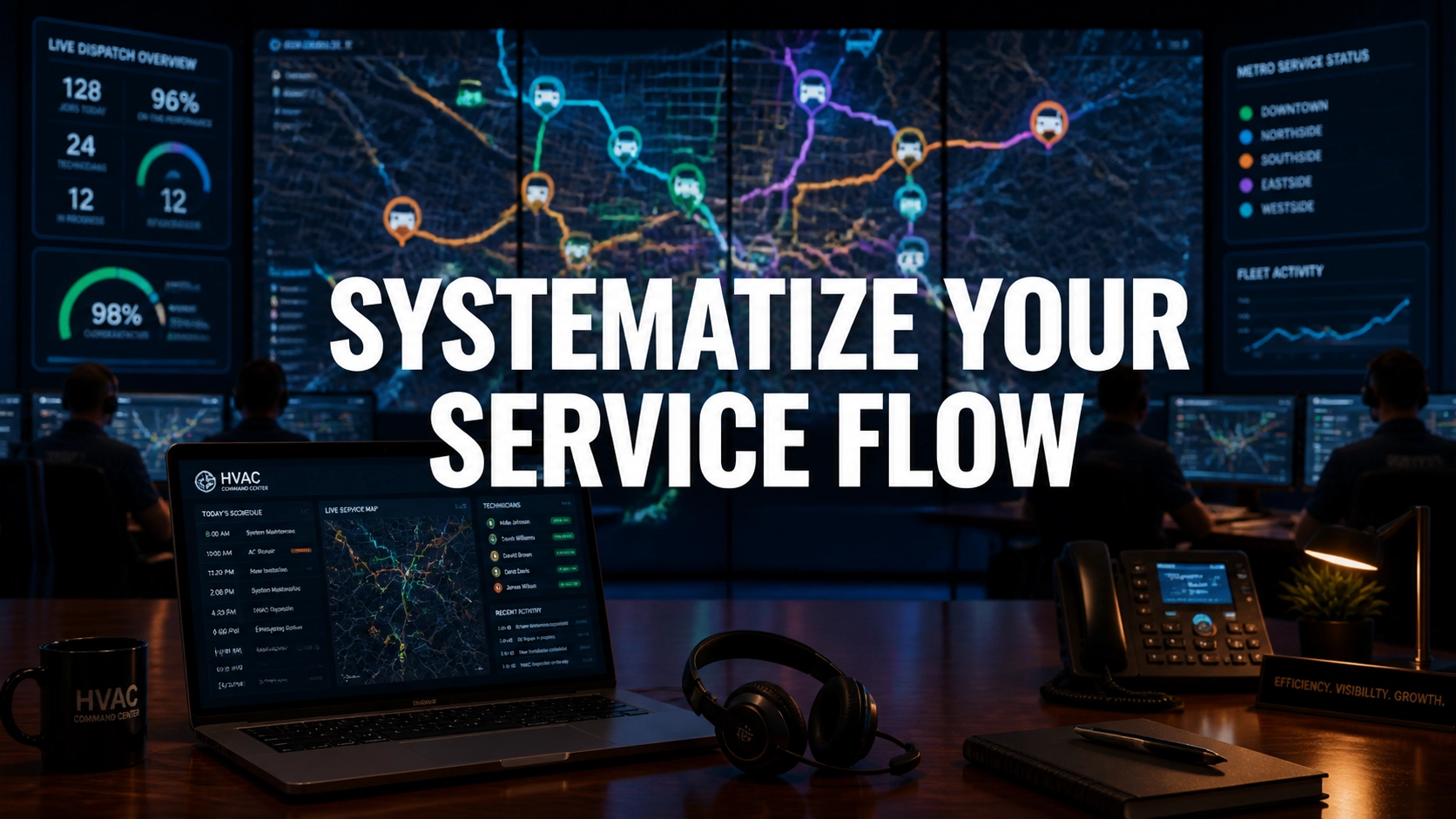
An HVAC Virtual Assistant manages the board with a bird's-eye view. They "scrub" the schedule every morning to ensure routes are tightened. They communicate with techs via Slack or WhatsApp to check job status, ensuring that if a job runs long, the next customer is notified immediately. This proactive communication prevents cancellations and keeps your reviews at five stars.
Case Study 2: Commercial Cool’s 15% Travel Reduction
A commercial HVAC firm in Florida, "Commercial Cool," focused on maintenance contracts and large-scale repairs. Their technicians were spending an average of 2.5 hours a day in their vehicles. The owner felt they were capped out on revenue because they couldn't squeeze more jobs into the day.
We placed a VA with them who specialized in logistics. The VA took over the daily dispatch board, using geographic clustering to group maintenance calls.
The Result: Commercial Cool reduced technician travel time by 15%. This shift allowed every technician to fit one additional "small" job or maintenance check into their daily schedule. The increase in "jobs-per-day" across a 12-person crew added significant five-figure monthly revenue to the bottom line without hiring a single new technician.
Eliminating Admin Debt: Invoicing and AR Management
In the HVAC world, "Admin Debt" is the accumulation of unbilled jobs, unfiled warranty claims, and unpaid invoices. When you are busy in the field, it’s easy to let the paperwork slide. But Admin Debt is a silent killer of cash flow.
If your Accounts Receivable (AR) cycle is 45 days, you are essentially acting as a bank for your customers: often without charging interest. A Virtual Assistant from Virtual Nexgen Solutions ensures that the "money cycle" stays tight. They can handle:
- Real-time Invoicing: Ensuring techs close out jobs in the CRM with photos and signatures before leaving the site.
- Collections: Making polite, professional follow-up calls for overdue residential and commercial invoices.
- Warranty Processing: Filing claims with manufacturers (like Carrier or Trane) immediately so you get credited for parts faster.
- Permit Coordination: Handling the tedious paperwork with local municipalities to ensure your installs are compliant and legal.
Case Study 3: Flow Solutions Cuts the AR Cycle
"Flow Solutions," a mid-sized HVAC and plumbing business, was struggling with a bloated AR cycle. They had over $85,000 sitting in "uncollected" status, with an average payment time of 45 days. The owner was stressed about making payroll despite having a full schedule.
Their Virtual Nexgen Solutions VA implemented a "Clean Close" system. The VA reviewed every job daily. If an invoice wasn't paid on-site, the VA followed up via phone and email on day 2, day 7, and day 14.
The Result: Within four months, Flow Solutions cut their AR cycle from 45 days to just 12 days. The cash infusion allowed the owner to purchase two new vans and hire additional installers, effectively scaling the business using money they had already earned but hadn't collected.
Software Mastery: Integrating Your VA with ServiceTitan and Housecall Pro
You’ve invested thousands of dollars into high-end CRM software like ServiceTitan, Housecall Pro, or Jobber. But are you actually using 100% of the features? Most HVAC owners use about 20%: scheduling and basic invoicing.
A Virtual Assistant acts as your "Systems Architect." They can build out price books, set up automated maintenance reminders, and manage your "customer memberships." Maintenance agreements are the lifeblood of a stable HVAC business; they provide predictable recurring revenue and a "warm" list of leads for the shoulder seasons.
Your VA can proactively call your membership list in March and October to schedule tune-ups, ensuring your board is full before the weather turns. This proactive approach is the difference between a business that survives and a business that dominates.
The $8/Hour Math: ROI vs. In-House Hiring
The cost of a local administrative assistant in the US is roughly $20–$25 per hour. Once you add in payroll taxes, health insurance, workers' comp, office space, and equipment, that $25/hour employee actually costs you closer to $40/hour: or about $80,000 a year.
In contrast, a Virtual Nexgen Solutions VA costs $8 per hour. There are no benefits to pay, no office space to provide, and no payroll tax headaches.
- In-House Admin: $80,000/year (including overhead).
- Virtual Nexgen VA: $16,640/year (full-time).
- Annual Savings: Over $63,000.
That $63,000 in savings can be reinvested directly into your marketing budget or used to offer more competitive wages to your field technicians, helping you win the 2026 talent war.
Scaling During Peak Seasons (Summer and Winter)
HVAC is a seasonal rollercoaster. In July, you need four people in the office. In October, you might only need one. Hiring local staff for these fluctuations is a nightmare. You either over-hire and lose money in the slow months, or you under-hire and lose customers in the peak months.
Virtual Assistants provide the "elasticity" your business needs. You can scale your support team up as the temperature rises and scale back during the mild months. This flexibility ensures your overhead stays lean while your service remains top-tier.
Whether you are managing a small residential team or a large commercial fleet, the "Optimized Flow" blueprint is your ticket to a stress-free, profitable 2026. Stop letting Admin Debt hold you back.
If you’re ready to reclaim your time and scale your HVAC operations, book a 30-minute discovery call with Virtual Nexgen Solutions today. Let’s get your dispatch board in order before the next heatwave hits.
Frequently Asked Questions (FAQs)
1. Can a Virtual Assistant really use ServiceTitan or Housecall Pro?
Yes. Our VAs are selected based on their technical aptitude and experience with industry-standard CRMs. Because they are dedicated to your business, they become experts in your specific instance of ServiceTitan or Housecall Pro, handling everything from dispatching to job closing and price book management.
2. How do they handle emergency after-hours calls?
Your VA can be scheduled to cover specific shifts, including evenings and weekends. Using VoIP systems like RingCentral or Dialpad, the calls are routed directly to them. They follow your emergency protocols: determining what constitutes a true emergency and dispatching the on-call tech according to your rotation schedule.
3. Is an $8/hour VA as effective as a local $25/hour hire?
In terms of administrative and dispatch tasks, often more so. Our VAs are focused entirely on their digital tasks without the distractions of a physical office. When you factor in that you are saving over $60,000 a year in total employment costs, the value proposition is undeniable.
4. What kind of training do they need for HVAC terminology?
While our VAs are highly skilled admins, they will need a brief orientation on your specific "language": your specific service areas, your brands (e.g., Goodman vs. Lennox), and your specific pricing structure. We provide a 14-day onboarding framework to help them get up to speed on HVAC-specific nuances quickly.
5. Is my customer data secure with a remote assistant?
Data security is a priority. We recommend using LastPass or Dashlane for password management so the VA never sees your actual passwords. Furthermore, most modern CRMs allow you to set "Permission Levels," ensuring the VA only sees the information necessary to perform their job.
6. Can I scale my VA team during the summer rush?
Absolutely. One of the primary benefits of Virtual Nexgen Solutions is the ability to add support as your call volume increases. Many of our clients start with one VA for dispatch and add a second for billing and warranty claims as they grow.
7. Do your VAs provide multilingual support?
Yes. We have VAs who are fluent in both English and Spanish, which is a massive asset for HVAC companies serving diverse customer bases. This allows you to capture leads and provide service to a wider demographic that your competitors might be ignoring.
8. What kind of ROI can I expect?
Most HVAC firms see an immediate ROI in three areas: 1) Increased booking rates due to faster response times, 2) Reduced technician "dead time" through better routing, and 3) Faster cash flow through tighter AR management. Typically, a VA pays for themselves by booking just two or three extra service calls per month.