
Your technician is 45 minutes into a service call. He opens the compartment and realizes the capacitor he needs is not there. He hops in the truck, drives 20 minutes to Johnstone Supply, waits in line, and drives back. That $15 capacitor just cost you $150 in lost time.
This is not a parts problem. This is an operations problem.
Every mid-job supply house run creates profit leakage through lost labor, overtime pressure, extra fuel, schedule disruption, and frustrated customers waiting longer than promised. If the trip takes 60 to 90 minutes, which it often does, you can easily burn $75 to $150 in labor, fuel, and overhead on a single run. If five technicians make one unnecessary run per week, your shop can lose $30,000 or more per year without noticing it on one clean line item.
That is how Admin Debt builds in HVAC. Small misses stack up. Parts get pulled but not logged. Trucks drift away from standard stock. Warranty cores sit in the corner. Supplier prices rise, but the pricebook stays stale. The backlog compounds until your techs spend more time chasing parts than producing revenue.
The Admin Debt Behind Parts Chaos
Parts management fails quietly before it fails publicly.
At first, it looks minor. One truck is short a contactor. Another truck has three transformers but no flame sensor. A service tech uses a dual-run capacitor and forgets to add it to the invoice. A warehouse shelf has motors in the wrong bin. Nobody fixes it that day because everyone is busy.
Then the debt comes due.
Missed part charges reduce ticket value. Unlogged truck stock creates false counts. Emergency ordering drives up cost. Missed warranty credits leave money sitting with the supplier instead of in your account. This is Admin Debt: the accumulated administrative backlog that drains margin, slows dispatch, and creates field chaos.
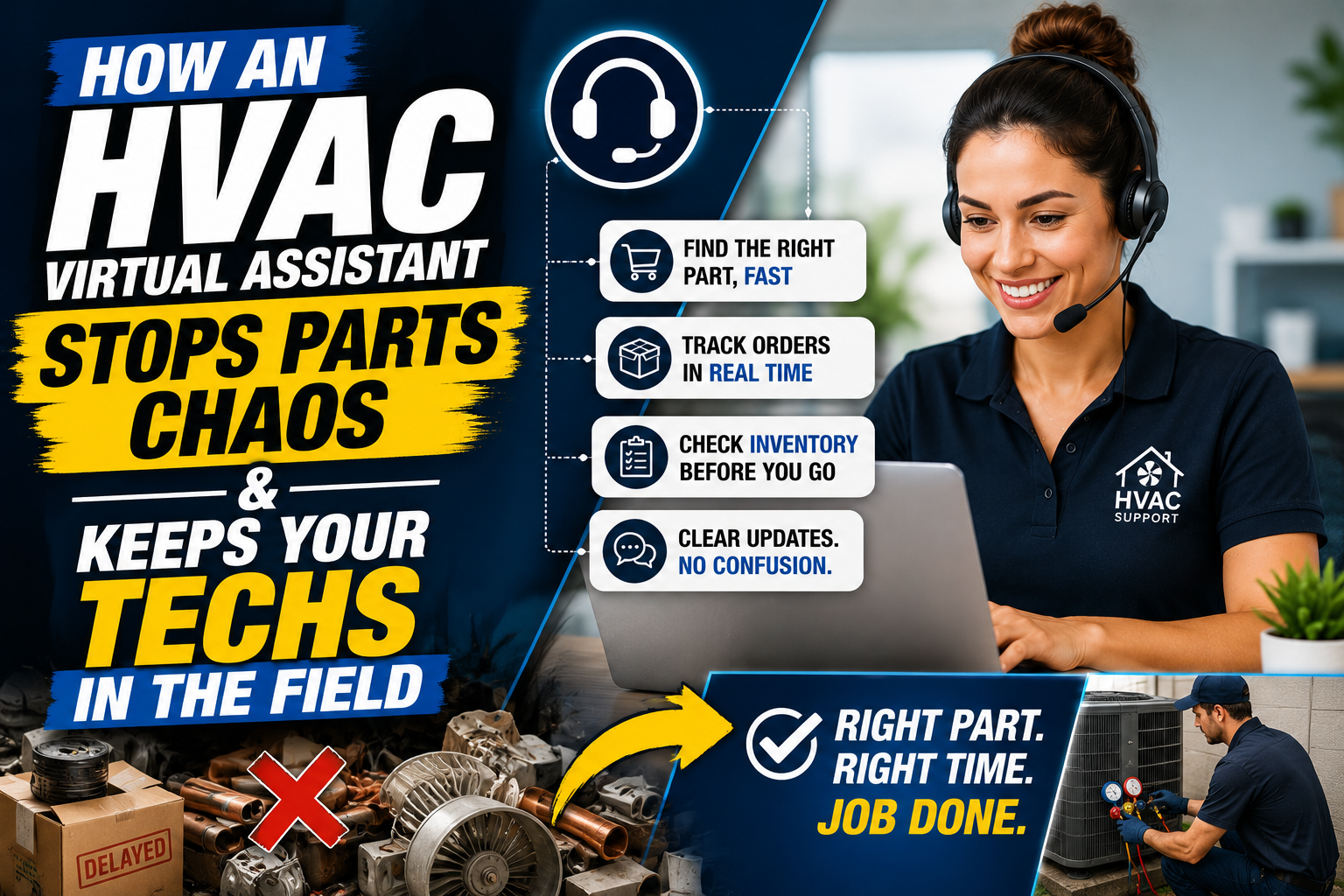
A remote HVAC Virtual Assistant helps stop that debt before it compounds. They work inside your field service software, reconcile what was used versus what was billed, maintain truck stock records, follow up on returns, and keep your parts data clean enough for your operation to trust.
What Parts Should Every HVAC Truck Carry?
This is one of the most searched questions in HVAC operations, and the answer should never live in a tech's memory alone. Build a standard truck stock par sheet and enforce it across the fleet.
Every HVAC truck should typically carry the core service-call essentials:
- Dual-run capacitors
- Single-run capacitors
- Contactors
- Igniters
- Flame sensors
- Pressure switches
- Thermostats
- Transformers
- Fan motors
- Refrigerant, including 410A and R-22 where service demand still justifies it
- Common electrical fittings, wire nuts, fuses, connectors, terminals, and disconnect components
Do not leave this list loose. Set a par quantity for each item by truck type and service mix. A Virtual Assistant maintains that standardized par sheet, updates it when usage patterns change, and makes sure every truck starts from the same baseline instead of every technician stocking by habit.
How Do I Track Parts and Consumables Across My Fleet?
Track them by truck location inside your field service management software. If you use ServiceTitan, Housecall Pro, or FieldEdge, treat each truck as a separate inventory location instead of one blended pool.
This is the cleanest workflow:
- Assign every truck its own inventory location
- Require parts to be pulled against a work order
- Require completed invoices to reflect actual installed parts
- Run end-of-day or next-morning variance checks
- Flag any part that was removed from stock but not billed
A Virtual Assistant can handle the daily reconciliation. They cross-reference parts pulled versus parts billed, review technician notes, and flag discrepancies for the service manager. That gives you a practical answer to another common search question: How do I track parts and consumables across my fleet? You do it with location-based inventory in your FSM, plus daily reconciliation discipline.
What Inventory Management Software Should HVAC Contractors Use?
Most HVAC shops do not need a complicated ERP to get control. They need consistent use of the software they already have.
Strong options include:
- ServiceTitan
- Housecall Pro
- FieldEdge
These platforms can support truck stock counts, purchase orders, pricebook updates, and supplier coordination when you use them properly. If you are asking, What inventory management software should HVAC contractors use?, start with the one already closest to your dispatch and invoicing workflow. The real advantage comes from disciplined execution.
A Virtual Assistant can operate inside any of these systems to create POs, run stock reports, track deliveries, maintain truck counts, and communicate with suppliers. The software matters. The follow-through matters more.
How Do I Set Reorder Points for HVAC Parts?
Use a simple formula and adjust it by season.
Reorder Point = (Average Daily Usage × Supplier Lead Time) + Safety Stock
If you use four dual-run capacitors per day, and your supplier lead time is three days, you need 12 just to cover normal usage during replenishment. Add safety stock on top of that based on seasonality, demand swings, and local supplier reliability.
That gives you a real answer to the Google question, How do I set reorder points for HVAC parts?
A Virtual Assistant can monitor consumption data from work orders and adjust par levels before demand spikes hit. Increase capacitor and contactor stock in March before cooling season ramps up. Pivot toward igniters, pressure switches, and heat-related parts in September before heating demand hits. Do not wait until trucks start coming back empty.
Seasonal Ramp-Up Decides Who Wins the Rush
Inventory needs in HVAC can flip almost overnight.
In spring, cooling repairs surge and your demand shifts toward capacitors, contactors, thermostats, fan motors, and refrigerant-related items. In fall, the mix moves toward igniters, flame sensors, pressure switches, and heat exchangers. Shops that prepare late get trapped by backorders, partial availability, and panic buying.
A Virtual Assistant can manage this seasonal ramp-up with a calendar-based workflow:
- Review prior-year usage by month
- Increase summer-critical stock in March
- Review backorder risk on high-failure items before the first heat wave
- Pivot in September toward heating inventory
- Adjust truck par levels by service type and region
- Coordinate warehouse staging before peak months
This planning reduces the scramble and protects first-time fix rates when your call volume spikes.
How Can I Reduce Emergency Parts Ordering?
Pre-stage tomorrow's work before your technicians leave for the day.
If you are searching How can I reduce emergency parts ordering?, the practical answer is this: review the schedule at 4 PM, identify likely parts needs, and confirm availability before the first dispatch rolls out.
A Virtual Assistant can run that workflow daily:
- Review tomorrow's service and install schedule at 4 PM
- Check notes, equipment model data, and job history
- Identify likely parts needed for each call
- Confirm whether those parts are already on the assigned truck
- Stage parts from the warehouse if truck stock is short
- Coordinate early supplier pickup when needed
This one routine cuts morning chaos, reduces counter waits, and keeps technicians in the field instead of reacting after arrival.
What’s the True Cost of a Mid-Job Supply House Run?
Most owners underestimate it because they only think about the part cost.
The real math is harsher. A single run usually burns 60 to 90 minutes. When you add burdened labor, vehicle expense, fuel, overhead, and schedule disruption, that one trip often costs $75 to $150. Multiply that by fleet size and frequency, and the leak gets ugly fast.
If five technicians each make one unnecessary run per week, you are looking at $30,000 or more in annual profit leakage.
That is why truck stock discipline matters. This is not about being neat. It is about protecting capacity. Every unnecessary run removes a technician from revenue-producing work and increases the odds that the next customer gets delayed.
Supplier Price Monitoring Protects Gross Margin
Price creep from suppliers can quietly eat your gross margin.
Johnstone, Ferguson, and other distributors adjust pricing throughout the year. If your pricebook inside ServiceTitan or another FSM is not updated quickly, your team keeps selling parts at yesterday's rate while buying them at today's higher cost. That gap comes straight out of margin.
A Virtual Assistant can close that gap by handling a simple but high-value routine:
- Review supplier price changes as they come in
- Compare new costs to your current pricebook
- Update line items inside ServiceTitan, Housecall Pro, or FieldEdge
- Flag high-volume parts with material margin impact
- Report on price changes that need owner approval
This single discipline can protect 2% to 5% margin on parts, especially during busy seasons when high-volume replacements move fast.
How Do I Recover Money From Warranty Cores and Returns?
This is where many HVAC shops lose money they already earned.
Failed compressors, motors, and heat exchangers often carry manufacturer credits, but the money only comes back if the return is documented correctly and submitted inside the allowed return window. If you are asking, How do I recover money from warranty cores and returns?, the answer is to manage the full chain from removal to statement verification.
Use this lifecycle:
- Record the failed part when it comes off the job
- Tag the core to the customer, date, supplier, and warranty claim
- Move it to a defined holding area
- Submit required paperwork within the supplier window
- Return the core on time
- Verify the credit on the supplier statement
- Follow up on missing credits immediately
A Virtual Assistant can track each step remotely, maintain the log, follow up with the supplier, and confirm the credit actually hit your account.
Warranty Core Recovery Deep Dive
Take a failed compressor as an example.
The technician removes it on Tuesday. The job gets closed the same day. The compressor core lands in the warehouse on Wednesday. By Friday, nobody has tagged it clearly. By the following week, the paperwork is buried under installs, service callbacks, and payroll. Thirty days later, the return window is gone.
That is how shops lose money.
Run a tighter process. Require the technician to attach the job number and equipment data at removal. Require warehouse intake the same day. Require claim logging inside your tracking sheet or FSM notes. Require supplier return scheduling before the window expires. Require credit verification on the next statement cycle.
Without someone owning that chain, many shops lose 30% to 50% of eligible core credits.
How Can a Virtual Assistant Help With HVAC Inventory Without Being On-Site?
They do not need to stand in your warehouse to run the administrative side of inventory.
This answers one of the biggest objections contractors have: How can a virtual assistant help with HVAC inventory without being on-site? They work remotely inside your software and communication systems.
A skilled VA can:
- Run daily stock reports
- Create purchase orders
- Track deliveries
- Manage supplier price changes
- Update your pricebook
- Reconcile parts pulled versus parts billed
- Run weekly truck stock variance reports
- Track core returns and warranty credits
- Maintain standardized par sheets by truck
- Prepare seasonal stock recommendations
Your field team still touches the physical parts. Your VA handles the data, follow-up, reconciliation, and reporting that usually gets skipped when the office is busy.
The ROI Is Easier Than Most Owners Think
A full-time in-house admin or inventory coordinator often costs around $60,000 per year once you include wages, taxes, benefits, and overhead.
A specialized HVAC Virtual Assistant from Virtual Nexgen Solutions works at $8 per hour.
The comparison becomes practical when you tie it to field waste. If a VA helps your operation prevent just two unnecessary supply house runs per week across your fleet, that recovered time can cover their monthly cost. Add cleaner invoicing, better pricebook accuracy, tighter reorder points, and more warranty credit recovery, and the return gets stronger.
One contractor does not need more heroic effort from technicians. You need fewer preventable leaks in the back office.
FAQ Section
What parts should every HVAC truck carry?
Every HVAC truck should carry core service-call essentials like capacitors, contactors, igniters, flame sensors, pressure switches, thermostats, transformers, fan motors, refrigerant, and common electrical fittings. Set par quantities by truck type and service mix so every technician starts from the same baseline.
How do I track parts and consumables across my fleet?
Track parts by truck location inside your field service management software and treat each truck as its own inventory location. Require parts to be pulled against work orders, match invoices to actual installed parts, and run daily variance checks.
What inventory management software should HVAC contractors use?
Most HVAC contractors do not need a complex ERP. Use platforms like ServiceTitan, Housecall Pro, or FieldEdge consistently, especially when they already connect to your dispatch, invoicing, truck stock, and purchase order workflows.
How do I set reorder points for HVAC parts?
Use a simple formula: average daily usage multiplied by supplier lead time, then add safety stock. Adjust those levels by season, demand swings, and supplier reliability so your trucks do not run short during peak months.
How can I reduce emergency parts ordering?
Review tomorrow's schedule before the day ends and identify likely parts needs for each job. Confirm truck availability, stage missing items from the warehouse, and coordinate supplier pickups before the first dispatch goes out.
What's the true cost of a mid-job supply house run?
A mid-job supply house run usually burns 60 to 90 minutes and often costs $75 to $150 once you include labor, fuel, vehicle expense, overhead, and schedule disruption. Across a fleet, those repeated trips can create major annual profit leakage.
How do I recover money from warranty cores and returns?
Track every failed part from removal to supplier credit. Tag the core, document the claim, return it within the allowed window, and verify the credit appears on the supplier statement.
How can a virtual assistant help with HVAC inventory without being on-site?
A virtual assistant handles the administrative side of inventory remotely inside your software and communication systems. They run stock reports, create purchase orders, reconcile parts used versus billed, update pricebooks, track deliveries, and follow up on warranty credits.
Conclusion: Stop Funding the Parts Chase
If your trucks are stocked inconsistently, your returns are loosely tracked, and your supplier pricing updates happen late, your margins are already under pressure. Fix the process before peak season exposes every weak point.
Use clean truck par sheets. Track each truck as its own inventory location. Reconcile parts daily. Set reorder points with real usage data. Pre-stage tomorrow's work. Track every warranty core until the credit lands.
If you want help building that system, schedule a consultation with Virtual Nexgen Solutions.