
Every time your phone rings and goes to voicemail, you are not just losing a single repair job. In the HVAC industry, where the lifetime value of a residential customer can exceed $20,000 and a commercial contract can represent six figures, a missed call is a catastrophic profit leak. For most HVAC business owners, the struggle isn't finding work, it’s managing the overwhelming administrative friction that comes with success.
You started your business to build something significant, yet you likely find yourself trapped in "Admin Debt." You are dispatching techs from your truck, chasing down invoices while on a roof, and struggling to keep your Field Service Management (FSM) software updated. This operational chaos limits your capacity to scale.
The solution is not just "hiring more people" in-house, which brings heavy overhead and management headaches. The strategy for 2026 is the integration of a specialized HVAC virtual assistant, a dedicated professional who functions as your office’s operational engine for just $8 per hour.
What is an HVAC Virtual Assistant?
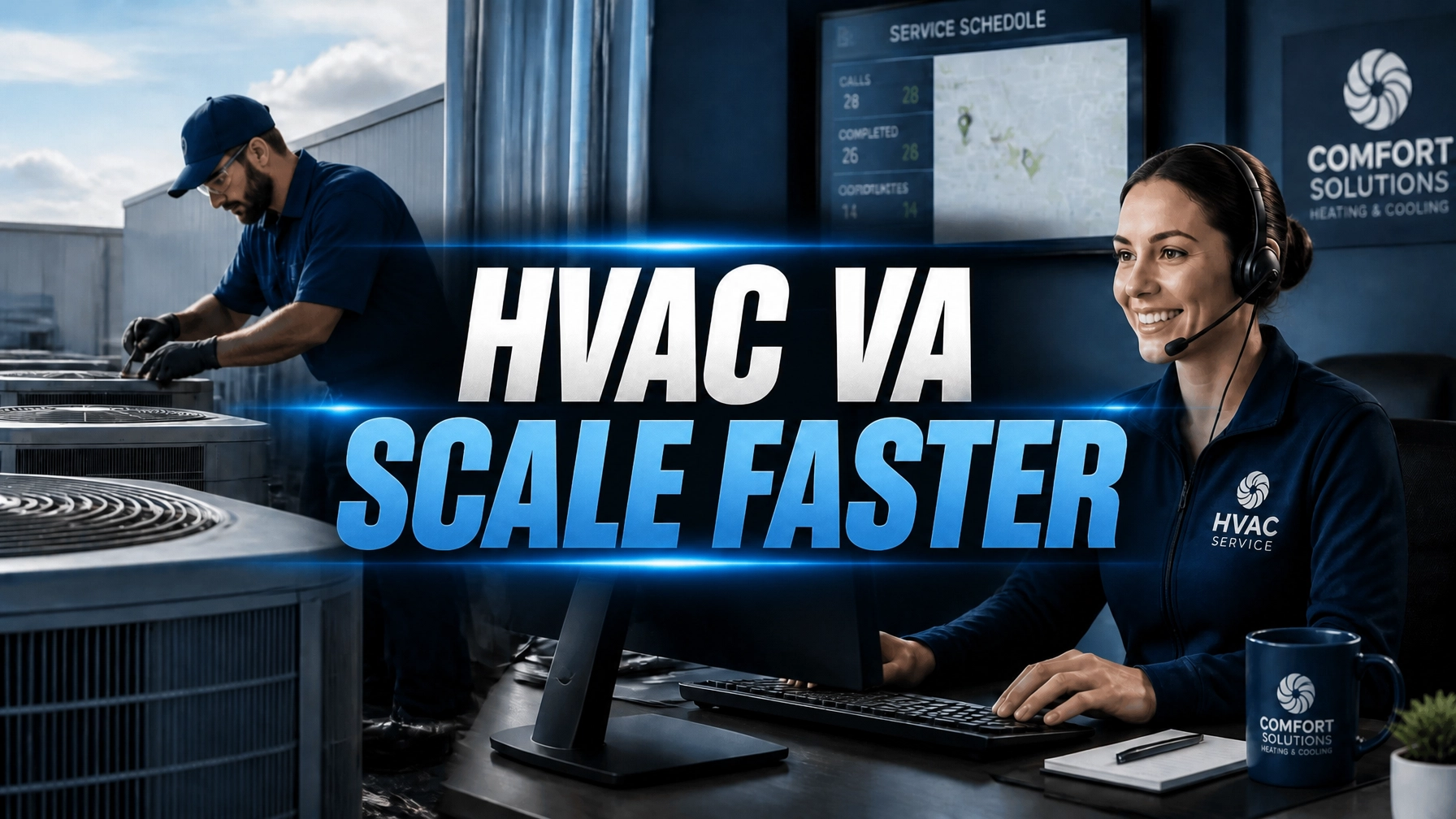
An HVAC virtual assistant is a specialized administrative professional trained specifically in the workflows of the heating, ventilation, and air conditioning industry. Unlike a general secretary, these individuals understand the urgency of a "no-cooling" emergency, the nuances of seasonal maintenance agreements, and the critical importance of technician "wrench time."
They operate remotely but remain fully embedded in your business. By handling the back-office heavy lifting, they allow you to separate the "field" from the "office," ensuring that your technicians stay focused on billable hours while your administrative standards remain elite.
The Cost of the "Dispatch Leak"
If your current call-to-booking ratio is dropping because your office staff is overwhelmed or you are answering calls yourself, you have a dispatch leak. Industry data suggests that 30% of callers will not leave a voicemail; they simply call the next contractor on Google.
By utilizing a virtual assistant through Virtual Nexgen Solutions, you ensure that every inquiry is handled with immediate professional attention. This isn't just about answering phones; it’s about systematizing your growth.
7 Essential SOP Tasks Your HVAC VA Should Handle
To truly scale, you must move away from "tribal knowledge" and toward Standard Operating Procedures (SOPs). Here are seven critical tasks a specialized HVAC VA manages to keep your business running like a well-oiled machine.
1. Dispatching and Intelligent Routing
The goal of dispatching is to maximize the revenue generated per hour for every technician. Your VA monitors the board in real-time, adjusting routes based on traffic, job complexity, and technician skill sets. They ensure that your senior techs are on high-value installs while your juniors handle maintenance, reducing travel time and fuel costs.
2. Lead Qualification and Instant Booking
Not every call is a high-priority lead. Your VA follows a strict qualification script to identify high-intent customers, gathering equipment serial numbers and photos before the tech even arrives. They book these jobs directly into your FSM, ensuring your calendar stays full and organized.
3. Service Agreement Management
Maintenance agreements are the lifeblood of off-season stability. Your VA proactively calls existing customers to schedule their spring or fall tune-ups, manages the recurring billing cycles, and tracks expiration dates to ensure you never lose a recurring revenue stream.
4. Invoicing and Payment Follow-up
Uncollected revenue is a silent killer for HVAC companies. Your VA monitors "unbilled" jobs, ensures technicians have uploaded the necessary documentation and photos, and sends out professional invoices immediately upon job completion. They also follow up on aged accounts receivable, ensuring your cash flow remains healthy.
5. Parts Procurement and Tracking
When a tech identifies a failed blower motor, the clock starts ticking. Your VA contacts local suppliers, checks stock, gets pricing, and updates the customer on the ETA. They track the part from order to delivery, ensuring the follow-up visit is scheduled the moment the part arrives.
6. Reputation and Review Management
In a local service business, your Google Business Profile is your storefront. Your VA sends automated and personal follow-ups to happy customers, encouraging 5-star reviews. If a negative review appears, they alert you immediately and draft a professional response, protecting your brand's integrity.
7. Technician Confirmations and Debriefs
Your VA calls the customer 30 minutes before the technician arrives to ensure someone is home, preventing "dry runs." After the job, they debrief the technician to ensure all notes are in the system and that any recommended upsells are logged for future follow-up.
Software Proficiency: The Tools of the Trade
A high-level HVAC VA must be an expert in the software you already use. At Virtual Nexgen Solutions, our team is experienced in the industry's leading Field Service Management platforms:
- ServiceTitan: Managing the complex workflows of large-scale residential and commercial operations.
- Housecall Pro: Streamlining booking, dispatch, and invoicing for fast-growing service teams.
- Jobber: Optimizing quotes, scheduling, and client communications for maximum efficiency.
- FieldEdge: Deep integration with QuickBooks to ensure seamless financial tracking and technician performance monitoring.
By hiring a VA who already understands these platforms, you eliminate weeks of training time and begin seeing an immediate return on investment.
Case Studies: Real Transformations
Case Study A: Residential HVAC Agency in Florida
The Challenge: A growing residential firm in Florida was experiencing a 30% call drop rate during the peak summer months. The owner was attempting to manage dispatching from his phone while on-site, leading to missed leads and chaotic scheduling.
The Strategy: Virtual Nexgen Solutions integrated two specialized VAs to provide 24/7 coverage. They implemented a standardized dispatching SOP using Housecall Pro.
The Result: Within 60 days, the call drop rate fell to near zero. The agency saw a 15% increase in total revenue simply by capturing the leads they were previously losing. The owner transitioned from 100% "in the van" to a pure management role.
Case Study B: Commercial HVAC Contractor in Texas
The Challenge: A commercial contractor specializing in rooftop units was bogged down by manual scheduling conflicts and parts procurement delays. The owner was spending over 15 hours per week on pure administrative work, preventing him from bidding on new commercial contracts.
The Strategy: A dedicated VA was assigned to handle all commercial service calls, parts tracking, and technician routing through ServiceTitan.
The Result: The VA reclaimed 12 hours of the owner’s week. With optimized routing, technician drive time was reduced by 20%, allowing the team to fit in one additional service call per day across the fleet.
The ROI: $8/Hour vs. The $60k In-House Burden
When you hire a local office manager or dispatcher in the United States, you aren't just paying a salary. You are paying for:
- Payroll taxes and benefits.
- Office space and utilities.
- Equipment and software licenses.
- Management and training time.
A typical in-house admin can cost an HVAC business upwards of $60,000 per year. In contrast, a specialized HVAC virtual assistant from Virtual Nexgen Solutions costs just $8 per hour. This is not about cutting corners; it is about resource optimization. For less than the cost of a daily lunch, you gain a professional who is dedicated to your growth, works in your time zone, and follows your specific SOPs.
How to Standardize Your Growth
Scaling is not a result of working harder; it is a result of building systems that work without you. If you are still the only person who knows how to book a job or order a part, you don't have a business, you have a high-stress job.
By offloading the administrative friction to a VA, you create the space necessary to focus on high-level strategy, such as technician recruitment, fleet expansion, and large-scale commercial bidding.
Frequently Asked Questions
1. How does an HVAC VA learn my specific service area?
We use a detailed onboarding process where you provide your primary zip codes and service boundaries. Your VA uses Google Maps and your FSM software to visualize your territory, ensuring they never book a job that is too far for your techs to reach profitably.
2. Is my customer data secure with a remote assistant?
Security is a top priority. Our VAs work within your existing secure software (like ServiceTitan or Jobber) using individual login credentials. We implement strict data privacy protocols and can work within your existing security framework to ensure all client information remains protected.
3. Can they handle "Emergency" calls?
Yes. We establish a clear "Escalation SOP." Your VA is trained to identify true emergencies (e.g., a server room cooling failure or a residential heat out in sub-zero temps) and alert your on-call technician or manager immediately according to your protocol.
4. What if I use a software not listed above?
While we specialize in the major FSMs, our VAs are highly tech-literate. If you use a proprietary or niche system, we can quickly adapt to your workflow during the initial 48-hour setup period.
5. How do I communicate with my VA throughout the day?
Most clients use tools like Slack, Microsoft Teams, or simple WhatsApp groups for real-time communication. Your VA is available during your business hours, providing constant updates on dispatch status and lead bookings.
6. Do they have a "HVAC accent" or understand the terminology?
Our VAs are selected for their clear English communication and are specifically trained in HVAC terminology. They understand the difference between a heat pump and an AC condenser, and they know what "SEER ratings" and "PMs" mean in a professional context.
7. How quickly can we start?
We can typically have a specialized HVAC VA integrated into your workflow within 72 hours. We start with a discovery call to understand your current bottlenecks and then move straight into SOP alignment.
8. Is there a long-term contract?
We believe in proving our value every single day. Our $8/hour model is designed to be flexible, allowing you to scale your support as your business grows without being locked into rigid, multi-year commitments.
Take the Next Step Toward Scaling
The difference between an HVAC company that plateaus at three trucks and one that scales to thirty is the strength of its administrative engine. You cannot scale on the back of missed calls and disorganized dispatching.
Stop losing revenue to administrative friction. Reclaim your time and focus on the high-value activities that actually move the needle for your business.
Book a 30-minute Scaling Strategy Session with Virtual Nexgen Solutions and let’s discuss how we can plug your dispatch leak this week.