

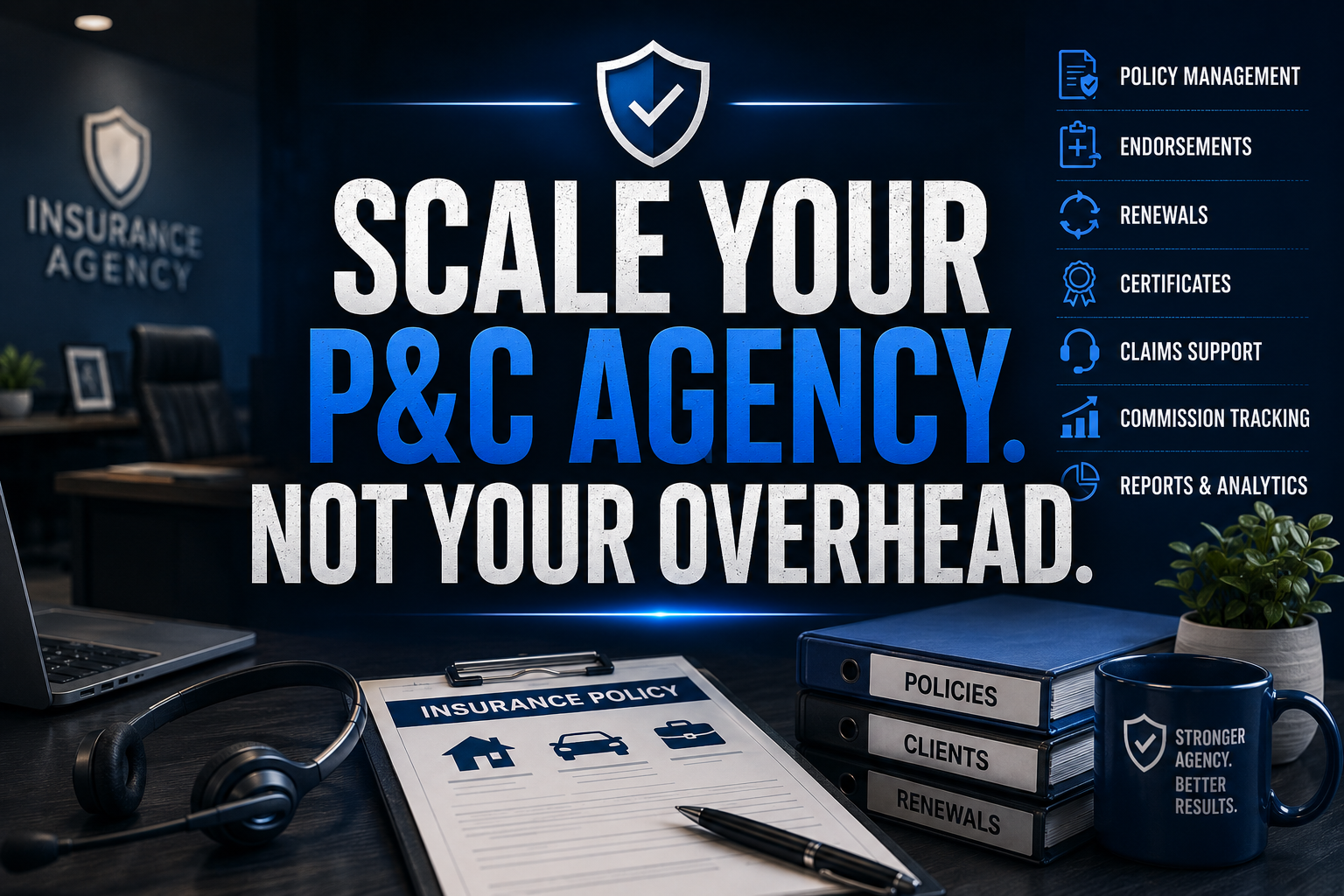
Running a property and casualty (P&C) agency or managing general agency (MGA) today feels like treading water in a storm of administrative debt. Every single day, your licensed producers and account managers get buried under mountains of certificate requests, policy endorsements, loss run consolidations, and endless carrier portal logins. According to the Bureau of Labor Statistics, administrative overhead continues to drain agency profit margins while skilled staff spend less than forty percent of their working hours actually selling policies or servicing clients. When high-paid talent spends hours keying data into legacy agency management systems, your agency suffers from severe profit leakage and delayed client response times.
The traditional remedy of hiring full-time, local administrative staff has become financially unsustainable for independent agencies and growing brokerages. With median salaries exceeding sixty thousand dollars annually plus benefits, payroll taxes, and office space overhead, adding local headcount strains cash flow before the new hire even closes their first book of business. According to Forbes, modern business owners must ruthlessly optimize operating costs and delegate repetitive workflows to specialized offshore talent to remain competitive against aggressive national aggregators and direct-to-consumer digital platforms.
To solve this operational bottleneck, agency principals are turning to remote support models. However, evaluating insurance back office support cost structures can be confusing when comparing providers ranging from eight dollars per hour to twenty-five dollars per hour. Understanding the precise deliverables, skill sets, and hidden operational expenses at each pricing tier allows you to make an informed investment that protects your bottom line and accelerates agency growth without compromising data security or compliance standards.
10 Core Tasks an Insurance Virtual Assistant Handles Daily
- Certificate of Insurance (COI) Issuance: Rapidly generating, verifying, and dispatching COIs through carrier portals and agency management systems within minutes of client requests.
- Commercial Policy Renewal Pipeline Auditing: Reviewing upcoming renewal lists ninety days out, identifying expiring binder dates, and flagging carrier rate increases for account manager review.
- First Notice of Loss (FNOL) Intake: Capturing carrier claim details, logging incident reports, attaching police reports, and setting up initial claims files in your system.
- Loss Run Report Consolidation: Requesting, downloading, and summarizing multi-year loss history reports from various carrier portals into standardized spreadsheets for underwriters.
- Policy Endorsement Processing: Updating insured mailing addresses, adding new vehicle fleets, adjusting property coverage limits, and verifying endorsement schedules against quote requests.
- Commission Statement Reconciliation: Matching carrier direct-bill and agency-bill monthly commission statements against agency management system records to identify missing overrides or discrepancies.
- Document Archival and Indexing: Categorizing incoming carrier declaration pages, cancellation notices, and billing statements into correct client folders inside Applied Epic or AMS360.
- Prospect List Building and Data Scrubbing: Researching local commercial prospects, verifying expiration dates of current policies, and updating CRM records for outbound producer campaigns.
- Billing Inquiry Support: Investigating payment discrepancies, explaining direct-bill installment schedules to policyholders, and coordinating with carrier billing departments to resolve holds.
- Cancellation Notice Processing: Monitoring non-payment cancellation notices, notifying account managers immediately, and issuing cure letters or processing reinstatement requests.
7 SOPs to Streamline Insurance Back Office Operations
SOP 1: Rapid COI Issuance Workflow
- Monitor shared inbox or portal notifications for incoming COI request forms.
- Verify that the requesting client's policy is active and premium payments are current in your agency management system.
- Open Applied Epic or AMS360 and navigate to the certificate module for the specific commercial account.
- Input custom holder names, additional insured endorsements, and waiver of subrogation clauses exactly as requested.
- Generate the ACORD 25 certificate document and perform a secondary accuracy check against the original submission email.
- Email the finalized PDF certificate directly to the holder and client while archiving a copy in the client document repository.
SOP 2: Commercial Renewal Pipeline Auditing
- Pull the ninety-day advance expiration report from your agency database on the first business day of every week.
- Cross-reference each expiring account against historical loss ratios and current premium volume.
- Send standardized renewal data gathering questionnaires to commercial insureds to check for operational changes.
- Compile updated exposure data, payroll figures, and statement of values into a submission-ready folder.
- Assign completed renewal packages to the designated account manager with a priority tag in the task management queue.
- Follow up with insureds via email after seven business days if completed questionnaires remain outstanding.
SOP 3: First Notice of Loss (FNOL) Intake Protocol
- Receive initial loss notice via email, phone intake notes, or direct client portal submission.
- Open a new claim file inside the agency management system, tagging the policy number, date of loss, and type of claim.
- Collect and attach all supporting documentation including photos, police reports, and initial statements.
- Log into the specific insurance carrier's online claims portal and submit the formal FNOL packet.
- Obtain the carrier claim reference number and input it into your internal agency tracking record.
- Send a confirmation email to the insured detailing their claim number and next steps from the carrier adjuster.
SOP 4: Loss Run Report Consolidation
- Review new business or renewal submission checklists to determine required loss run history years (typically 3 to 5 years).
- Access individual carrier portals or submit written loss run requests directly to prior carriers.
- Track pending loss run requests in a master spreadsheet, noting date requested and expected turnaround times.
- Download received PDF loss run statements and verify that insured name and policy numbers match correctly.
- Consolidate separate carrier loss run documents into a single, clean PDF file utilizing standardized file naming conventions.
- Upload the consolidated loss run package into the commercial quote folder and notify the producing agent.
SOP 5: Policy Endorsement Reconciliation
- Receive signed endorsement request forms or carrier-issued endorsement policy changes.
- Review the requested modification (e.g., equipment addition, driver removal, limit change) against underwriting guidelines.
- Enter the transaction into your agency management system, updating effective dates and coverage schedules.
- Calculate pro-rata premium adjustments or verify carrier-calculated return premiums.
- Generate an updated policy binder or invoice and transmit it securely to the insured.
- File the completed endorsement documentation in the client ledger under historical policy records.
SOP 6: Commission Statement Matching
- Download monthly carrier commission spreadsheets and PDF statements from carrier billing portals.
- Import commission data into internal reconciliation templates or agency accounting modules.
- Compare paid commission percentages and dollar amounts against contracted agency commission schedules.
- Flag any mismatched producer splits, missing policy entries, or zero-commission errors for administrative review.
- Compile a discrepancy report and submit formal correction tickets to carrier accounting departments.
- Archive reconciled statements in compliance with state record-retention requirements.
SOP 7: Document Archival and Indexing
- Review unassigned document queues in your agency management software daily.
- Open each incoming PDF document (declaration pages, billing notices, audits, cancellations) to identify the insured.
- Search the agency database for the correct client ID and active policy number.
- Apply standardized document tags and category codes (e.g.,
DOC-DEC-AUTO-2026) to ensure instant retrieval. - Attach the file to the corresponding policy sub-folder and clear the document from the unassigned queue.
- Perform a weekly random audit of archived files to maintain a 99 percent indexing accuracy rate.
Industry Software Mastered by Insurance VAs
When you partner with Virtual Nexgen Solutions, you eliminate the costly onboarding curves associated with complex insurance technology. Our specialized Virtual Assistants arrive fully trained on the leading agency management systems, carrier portals, and rating platforms used across the United States. Whether your agency operates on legacy infrastructure or cutting-edge cloud tools, our professionals integrate seamlessly into your daily workflow.
- Applied Epic & AMS360: Comprehensive management of client profiles, policy entry, document attachment, accounting reconciliation, and activity logging.
- HawkSoft & EZLynx: Fast comparative rating, client relationship tracking, policy management, and streamlined proposal generation for personal and commercial lines.
- Guidewire & Vertafore: Advanced policy administration, billing operations, and enterprise claims management support for larger brokerages.
- Clio & Filevine: Specialized integration for insurance defense law firms managing litigation files, depositions, and settlement documentation.
- Microsoft 365 & Google Workspace: Advanced email management, calendar coordination, shared document collaboration, and secure cloud storage organization.
According to the Society for Human Resource Management, continuous professional training and technical competency are the greatest drivers of remote team productivity. By utilizing experts who already know these platforms inside and out, your agency bypasses months of trial-and-error training.To explore our complete service catalog and organizational structure, visit our
Why Insurance Companies Choose Virtual Nexgen Solutions
Navigating the complexities of modern insurance operations requires more than just an overseas pair of hands; it requires an administrative engine built for reliability, security, and measurable ROI. Traditional staffing options often leave independent agencies vulnerable to sudden resignations, expensive local recruitment fees, and soaring overhead costs. Virtual Nexgen Solutions provides dedicated, highly skilled virtual assistants starting at just eight dollars per hour, delivering an immediate alternative to sixty-thousand-dollar in-house salaries. Our rigorous vetting process ensures every assistant brings deep insurance literacy, rock-solid communication skills, and absolute dedication to data confidentiality.
Consider the operational turnaround experienced by a mid-sized property and casualty brokerage in Tampa, Florida. Prior to partnering with us, their three licensed producers spent nearly twenty hours every week issuing certificates and chasing carrier loss runs, resulting in missed commercial leads and severe staff burnout. After integrating two dedicated virtual assistants at eight dollars per hour, the agency recovered over seventy hours of selling time per month, boosted commercial renewals by twenty-two percent, and slashed operational overhead by thirty-eight thousand dollars in the first year alone.
Similarly, an independent commercial lines agency in Columbus, Ohio struggled with a massive backlog in commission statement reconciliation and policy document indexing, creating compliance vulnerabilities during state audits. By deploying a specialized virtual assistant team to handle daily archival and billing audits, the agency eliminated their backlog within fourteen business days, achieved one hundred percent compliance on document indexing, and redirected internal account managers to high-value client advisory work. These real-world results demonstrate why growing agencies trust Virtual Nexgen Solutions to handle the heavy lifting of back-office administration.
Frequently Asked Questions
What is the exact cost of an insurance virtual assistant with Virtual Nexgen Solutions?
Our dedicated insurance virtual assistants start at an industry-leading rate of eight dollars per hour. This transparent pricing structure allows small and mid-sized agencies to scale support up or down without long-term overhead commitments or hidden fees.
How do virtual assistants access our secure agency management systems?
Our virtual assistants connect to your systems via secure virtual private networks (VPNs), encrypted remote desktop protocols, and role-based user permissions inside Applied Epic, AMS360, or EZLynx, ensuring strict adherence to data privacy standards.
Can insurance virtual assistants handle direct client phone calls?
Yes. Our professionals undergo rigorous accent neutralization and communication training, enabling them to handle inbound policy inquiries, billing questions, and certificate requests with professional telephone etiquette.
What kind of insurance background do your virtual assistants possess?
Every assistant placed in an insurance role has prior experience working with P&C agencies, brokerages, or MGAs, possessing foundational knowledge of ACORD forms, policy terminology, and carrier workflows.
How long does the onboarding and integration process take?
Once we analyze your agency's specific workflow requirements, we match and deploy your dedicated virtual assistant within five to seven business days, complete with system access training.
Are there any long-term contracts or hidden setup fees?
We maintain flexible service agreements with no onerous long-term lock-ins or surprise onboarding fees, giving you complete operational agility as your agency's seasonal workloads fluctuate.
How do we monitor daily task completion and productivity?
You maintain direct oversight through your preferred communication tools (Slack, Microsoft Teams, email) alongside daily task tracking logs and activity reports generated inside your agency management software.
What is the primary difference between an $8 offshore VA and a $25 onshore admin?
An onshore administrative assistant costs roughly sixty thousand dollars annually in salary, taxes, and benefits while handling the exact same routine data entry and certificate tasks that our vetted $8/hr virtual assistants execute with equal or superior precision.
Ready to eliminate administrative debt and scale your agency's profit margins without adding expensive local overhead? Schedule your strategic consultation today through our Calendly booking link and discover how our specialized virtual assistants can transform your daily operations.