
Imagine your top producer, the one you pay $80,000 a year plus commissions, sitting at their desk. Are they closing a $20,000 premium commercial account? Are they building a relationship with a high-net-worth family?
No. They are currently locked out of a carrier portal because the password expired for the third time this month. They are waiting for a multi-factor authentication (MFA) code to hit their phone so they can upload a single document that should have been processed three days ago.
This is the reality for independent insurance agencies in 2026. As carriers continue to push "self-service" features, the administrative burden has shifted directly onto the agency's shoulders. We call this Admin Debt.
Most agencies today juggle between 15 and 30 different carrier portals. Each has its own unique user interface, login requirements, document upload quirks, and underwriting rules. On average, a licensed staff member spends 45 to 60 minutes per submission just navigating these portals. That is time stolen from revenue-generating activities.
When 70% of your licensed staff's time is spent on non-licensed tasks like re-keying data from your Agency Management System (AMS) into a portal, you aren't running an insurance agency; you're running an expensive data entry firm. This is the "Distribution Drag" , the silent friction that prevents you from scaling your book of business without doubling your payroll.
What Is an Insurance Agency Virtual Assistant?
An insurance agency virtual assistant is not a generalist who "does a little bit of everything." At Virtual Nexgen Solutions, our VAs are industry-specific specialists. They understand the difference between a dec page and an endorsement. They know that a Certificate of Insurance (COI) requires precision, not just speed.
Unlike general assistants found on freelance marketplaces, a specialized insurance VA is trained on the software you use every day: Applied Epic, AMS360, HawkSoft, EZLynx, and more. They act as the administrative engine of your agency, handling the "below-the-line" tasks so your licensed agents can focus on "above-the-line" strategy and sales.
For just $8 per hour, you get a dedicated professional who operates within your timezone and follows your specific agency workflows. Compare that to the $60,000 a year (plus benefits, taxes, and office space) it costs to hire a local CSR for basic data entry. The choice isn't just about saving money; it's about reallocating your most expensive resources to their highest and best use.
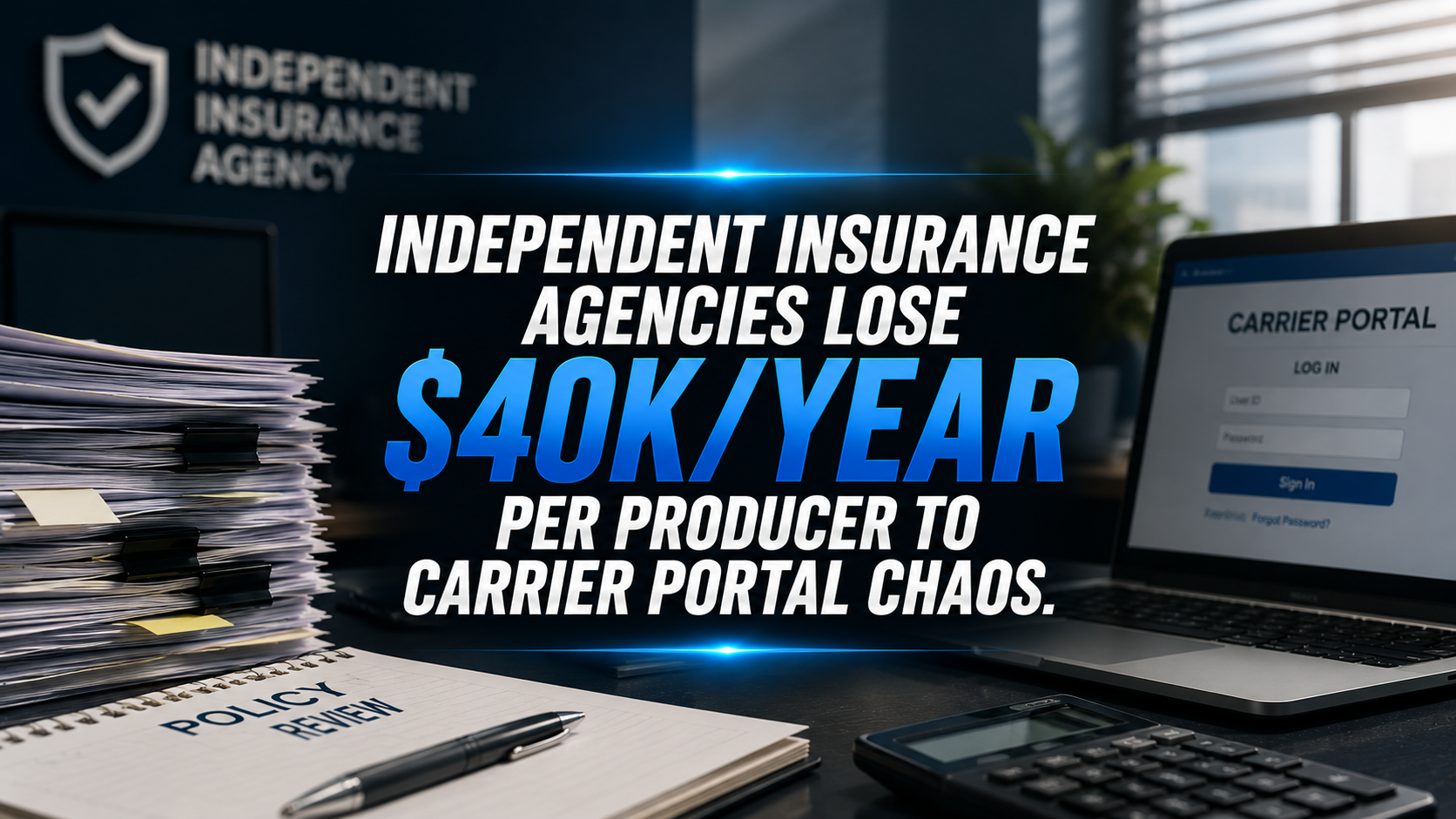
The $40K Math: What Your Agency Is Losing to Portal Time
Let's look at the "Portal Tax" in hard numbers.
If you have a producer who earns an effective rate of $100/hr (based on their salary and the revenue they generate), and they spend just two hours a day on carrier portal data entry, follow-ups, and document retrieval, that is $200 per day in lost opportunity.
Multiply that by 250 working days a year, and you are looking at $50,000 in lost revenue potential per producer. Even if we use a more conservative "Admin Debt" calculation, the cost of a licensed staff member doing unlicensed work typically exceeds $40,000 per year per person.
The Profit Leakage Breakdown:
- The Re-Keying Tax: 15 minutes per quote spent typing the same data from your AMS into the carrier site.
- The Follow-Up Gap: 20% of submissions die in "Underwriting Review" because no one checked the portal for 4 days.
- The E&O Risk: Rushed data entry in multiple portals leads to mismatched coverage details, a primary driver of Errors and Omissions claims.
By delegating these tasks to a Virtual Nexgen Solutions VA at $8/hr, you reclaim that $50,000 in producer capacity for a fractional cost of approximately $16,640/year. That is an immediate ROI that hits your bottom line in the first 30 days.
25 Tasks an Insurance Agency Virtual Assistant Can Handle
To fully eliminate your Admin Debt, you must delegate the following tasks. Our VAs are prepared to handle these within your existing AMS and carrier portals:
Policy Processing & Data Entry
- New Business Entry: Inputting prospect data from lead forms into Applied Epic or AMS360.
- Carrier Portal Submissions: Taking the completed application and entering it into 5-10 different carrier sites for comparative quoting.
- Endorsement Processing: Entering mid-term changes (car swaps, address changes) into portals.
- Document Indexing: Renaming and filing dec pages, policies, and correspondence in your AMS.
- Policy Checking: Comparing the issued policy against the quote to ensure zero discrepancies.
COI & Compliance Management
- COI Issuance: Processing standard ACORD 25 certificates within 30 minutes of the request.
- Holder Management: Updating and maintaining large lists of certificate holders for commercial clients.
- E&O Compliance: Auditing files to ensure signed applications and rejection forms are present.
- Licensing Tracking: Monitoring agent licenses and CE credits to prevent lapses.
- Evidence of Property: Issuing EOI for mortgage lenders on habitational risks.
Claims & Renewals
- FNOL Intake: Taking the First Notice of Loss information and entering it into the carrier portal.
- Claims Tracking: Checking the portal every 48 hours for status updates and updating the client.
- Renewal Prep (90 Days): Running "Upcoming Renewal" reports and checking for price spikes.
- Non-Renewal Alerts: Identifying accounts that the carrier is non-renewing so producers can remarket.
- Remarketing Support: Moving data from the expiring policy into new carrier portals for competitive quotes.
Marketing & Growth
- X-Date Tracking: Monitoring "Expiration Dates" of prospects and setting producer tasks.
- Aged Lead Follow-Up: Calling or emailing leads that didn't bind last year.
- Google Review Management: Sending "Happy Call" emails and links for 5-star reviews.
- Social Media Coordination: Posting industry updates to your agency's LinkedIn and Facebook.
- Newsletter Execution: Sending monthly value-add emails to your current book.
Administrative & Financial
- Commission Reconciliation: Matching carrier commission statements against your AMS records.
- Producer Payroll Prep: Generating reports on bound business for payroll processing.
- Billing Inquiries: Helping clients understand "Direct Bill" vs. "Agency Bill" invoices.
- Canceled Policy Follow-Up: Contacting clients who have a "Pending Cancellation" for non-pay.
- Data Hygiene: Merging duplicate records and cleaning up your AMS database.
5 Actionable SOPs for Insurance Agency Operations
Do not just hire a VA and hope for the best. Systematize your agency with these Standard Operating Procedures.
SOP 1: Daily Carrier Portal Audit & Submission Tracking
Objective: Ensure no submission sits in "Underwriting Review" for more than 24 hours without a follow-up.
- The Trigger: Every morning at 9:00 AM, the VA logs into the top 10 carrier portals used by the agency.
- The Audit: The VA checks the "Submission Status" dashboard in each portal.
- The Action: If a quote is "Pending Info," the VA emails the producer immediately. If it is "Underwriting Review" for >24 hours, the VA calls the underwriter for a status update.
- The Update: The VA logs the status update in the "Activities" section of the AMS (Applied Epic/AMS360).
SOP 2: COI Issuance & Certificate Holder Management
Objective: 30-minute standard for all ACORD 25 requests.
- The Request: Client emails
certificates@youragency.com. - The Verification: VA checks the AMS to ensure the policy is active and limits meet the requester's needs.
- The Issuance: VA generates the COI, adds the new holder, and attaches the required endorsements (Additional Insured, Waiver of Subrogation).
- The Delivery: VA emails the COI to the client and holder, then attaches the outgoing email to the AMS file.
SOP 3: Policy Checking , 10-Point Checklist
Objective: Zero discrepancies between what was quoted and what was issued.
- The Check: VA compares the issued policy from the carrier portal against the bind-spec in the AMS.
- The Points: Verify Named Insured, Address, Effective Dates, Limits, Deductibles, Scheduled Items (Vehicles/Drivers), Premium, Commissions, and all requested Endorsements.
- The Correction: If an error is found, the VA files a "Policy Change Request" immediately through the portal.
- The Completion: Once verified, the VA sends the "Welcome Kit" or Policy to the client.
SOP 4: Renewal Prep , 90-60-30 Day Workflow
Objective: Proactively manage the renewal to prevent "Premium Shock" and churn.
- 90 Days Out: VA runs a renewal report and checks for any carrier non-renewal notices in the portal.
- 60 Days Out: VA checks the carrier portal for "Renewal Quote" availability. If the premium increased by >15%, the VA flags it for remarketing.
- 30 Days Out: VA confirms the renewal is bound and the invoice has been sent to the client.
SOP 5: Commission Reconciliation & Producer Payroll
Objective: Accurate accounting and timely producer payouts.
- The Import: VA downloads commission statements from all carrier portals (usually mid-month).
- The Match: VA uses the AMS "Commission Reconcile" tool to match payments to policies.
- The Discrepancy: VA flags any underpayments or missing commissions for the Agency Principal.
- The Report: VA generates a "Producer Production Report" to show exactly what each agent is owed.
Case Study 1: Midwest P&C Agency Transformation
Scenario: A 5-producer Property & Casualty agency in Illinois was struggling with stagnant growth. Despite a high volume of leads, their "Quote-to-Bind" ratio was dropping. Upon analysis, we found that producers were spending nearly 18 hours a week each on carrier portal management and basic data entry.
The Virtual Nexgen Solutions Intervention:
rnWe integrated one specialized Insurance VA to handle all portal submissions and document indexing. We implemented SOP #1 (Submission Tracking) and SOP #4 (Renewal Prep).
The Results:
- Reclaimed Capacity: Each producer gained back 15 hours per week of sales time.
- Revenue Impact: The agency bound $22,000 more in new business premium within the first 60 days.
- Profitability: By replacing the need for a $55,000/year in-house CSR with an $8/hr VA, the agency saved $38,360 in overhead in year one while increasing top-line revenue.
Case Study 2: Commercial Lines Agency Scaling
Scenario: A growing commercial lines agency in Texas was drowning in Certificate of Insurance (COI) requests. Their turnaround time was 3 days, leading to complaints from contractors who couldn't get on job sites.
The Virtual Nexgen Solutions Intervention:
rnWe assigned a VA dedicated to COI management and Policy Checking. We established a "30-minute COI Guarantee" using our standardized workflow in Applied Epic.
The Results:
- Turnaround Time: Dropped from 72 hours to 22 minutes on average.
- Client Retention: Referral rates from existing commercial clients increased by 40% due to the improved service speed.
- Operational ROI: The agency principal was able to focus on high-value MGA relationships, leading to a new exclusive program launch that added $1.2M in annual premium.
Software Recommendations for 2026
To maximize the efficiency of your insurance agency virtual assistant, you should utilize a modern tech stack. Our VAs are highly proficient in:
- Agency Management Systems (AMS): Applied Epic, AMS360, HawkSoft, EZLynx, QQCatalyst.
- Comparative Rating Engines: PL Rating, EZLynx Rating Engine, ITC TurboRater.
- Data Collection Tools: Indio (for commercial apps), Canopy Connect (for personal lines data retrieval).
- Document Management: DocuSign, PandaDoc, eSignLive.
- Communication: Slack or Microsoft Teams for real-time coordination with your VA.
Common Mistakes When Hiring an Insurance VA
Avoid these pitfalls to ensure your partnership with Virtual Nexgen Solutions is successful:
- Mistake 1: Treating them like a generalist. Don't ask an insurance specialist to plan your vacation. Keep them focused on the carrier portals and AMS workflows where they provide the most ROI.
- Mistake 2: Skipping the SOPs. A VA is only as good as the system they follow. Use the SOPs provided in this guide to set clear expectations.
- Mistake 3: Fragmented Access. Ensure your VA has their own sub-user logins for your AMS and carrier portals to maintain security and audit trails.
- Mistake 4: Managing via Email. Use a project management tool (like Asana) or a chat tool (like Slack) to keep tasks organized and visible.
Expert Opinions & Industry Insights
Industry veterans agree that the "Hybrid Agency Model" , a core group of licensed advisors supported by a specialized remote administrative team , is the only way to survive the tightening margins of 2026.
According to recent 2026 surveys, agencies that leverage specialized VAs report 30% higher profit margins than those relying solely on in-house staff. The shift isn't just about cost; it's about the speed of service. In a world where clients expect instant gratification, the agency that can issue a COI or a quote in minutes, not days, wins the account.
Future Trends: The Specialized Agency of 2027
As we look toward 2027, the role of the insurance agency will evolve. We will see more "Niche MGAs" and "Specialized Wholesalers" who use VAs to handle the heavy lifting of compliance and portal management. The "Admin Debt" crisis will separate the agencies that scale from those that stagnate. By systematizing your operations now, you are future-proofing your business against the rising cost of local labor and the increasing complexity of carrier requirements.
Frequently Asked Questions
- Can a virtual assistant handle complex commercial lines submissions?
Yes. Our specialized VAs are trained to handle middle-market commercial submissions, including gathering loss runs, completing SOVs (Statement of Values), and entering data into commercial carrier portals. - Is it safe to give a VA access to my carrier portals?
Absolutely. We recommend creating unique sub-user credentials for each VA. This allows you to track their activity and revoke access instantly if needed. Our VAs follow strict data security protocols. - How do I know my VA is working productively?
We use time-tracking and productivity software. Additionally, because they work within your AMS (Applied Epic, etc.), you can see their activity logs, completed tasks, and indexed documents in real-time. - Can a non-licensed VA process endorsements?
VAs can handle the administrative data entry for endorsements. In most states, as long as they are not "selling, soliciting, or negotiating" insurance, they can perform administrative processing tasks. - What software do insurance VAs need to know?
They should be proficient in your specific AMS (like AMS360 or HawkSoft) and the major carrier portals in your niche (e.g., Travelers, Progressive, Liberty Mutual, Farmers). - How quickly can a VA be integrated into my agency?
With Virtual Nexgen Solutions, we can typically have a specialized VA integrated into your workflows within 7 to 10 business days. - What's the difference between a VA and an offshore CSR?
A general offshore CSR often lacks industry context. A specialized Insurance VA from Virtual Nexgen Solutions understands ACORD forms, E&O risks, and specific agency management system workflows. - Can a VA handle COI requests in real-time?
Yes. Many of our clients have VAs dedicated solely to the "Certificates" inbox, ensuring turnaround times of under 30 minutes. - Do I need to provide a computer for my VA?
No. Virtual Nexgen Solutions provides all necessary hardware and high-speed internet infrastructure for our VAs. - How do I communicate with my VA during the day?
Most agencies use Slack, Microsoft Teams, or Zoom. Your VA is available during your standard business hours for seamless collaboration. - Can a VA help with my agency's social media?
Yes. They can schedule posts, share carrier news, and engage with followers to build your local brand presence. - What happens if my VA is sick or on vacation?
We have a redundancy plan in place. Another trained VA can step in to handle critical tasks so your operations never stop. - How do I measure the ROI of a VA?
Measure the increase in producer "Time on Task" for sales, the reduction in COI turnaround time, and the overall savings in payroll versus an in-house hire. - Can a VA handle claims intake and FNOL?
Yes. They can take the initial details from the client and enter the First Notice of Loss directly into the carrier portal, saving your CSRs significant time. - What's the onboarding process for a new VA?
We start with a discovery call to understand your tech stack, provide the VA with access, and then run through your specific agency SOPs during the first week. - Can I start with a part-time VA and scale up?
Yes. We offer flexible solutions that allow you to scale your support as your book of business grows. - How does a VA handle sensitive client data?
All data is accessed via secure, encrypted connections. Our VAs are trained in HIPAA and PII (Personally Identifiable Information) compliance. - What if my VA doesn't work out?
We have a 100% satisfaction guarantee. If the fit isn't right, we will provide a replacement VA who better matches your agency's culture and needs. - Can a VA help with agency audits and compliance?
Yes. They can perform "File Audits" to ensure every client record has the necessary signed documents and disclosures required by your state's DOI. - How much does an insurance agency virtual assistant cost?
At Virtual Nexgen Solutions, our rate is a flat $8 per hour for specialized, industry-trained VAs.
Conclusion
The choice to hire an insurance agency virtual assistant is no longer just an "option" for the modern independent agency : it is a strategic necessity. By eliminating the $40,000/year "Portal Tax" and reclaiming your producers' time, you position your agency for exponential growth.
Stop letting carrier portal chaos dictate your profitability. Reclaim your time, streamline your operations, and focus on what you do best: protecting your clients and growing your business.
Work With Virtual Nexgen Solutions
If your business needs dependable virtual assistant support, Virtual Nexgen Solutions can provide support around your existing workflow. Book a discovery call today.
Get in Touch Now!