
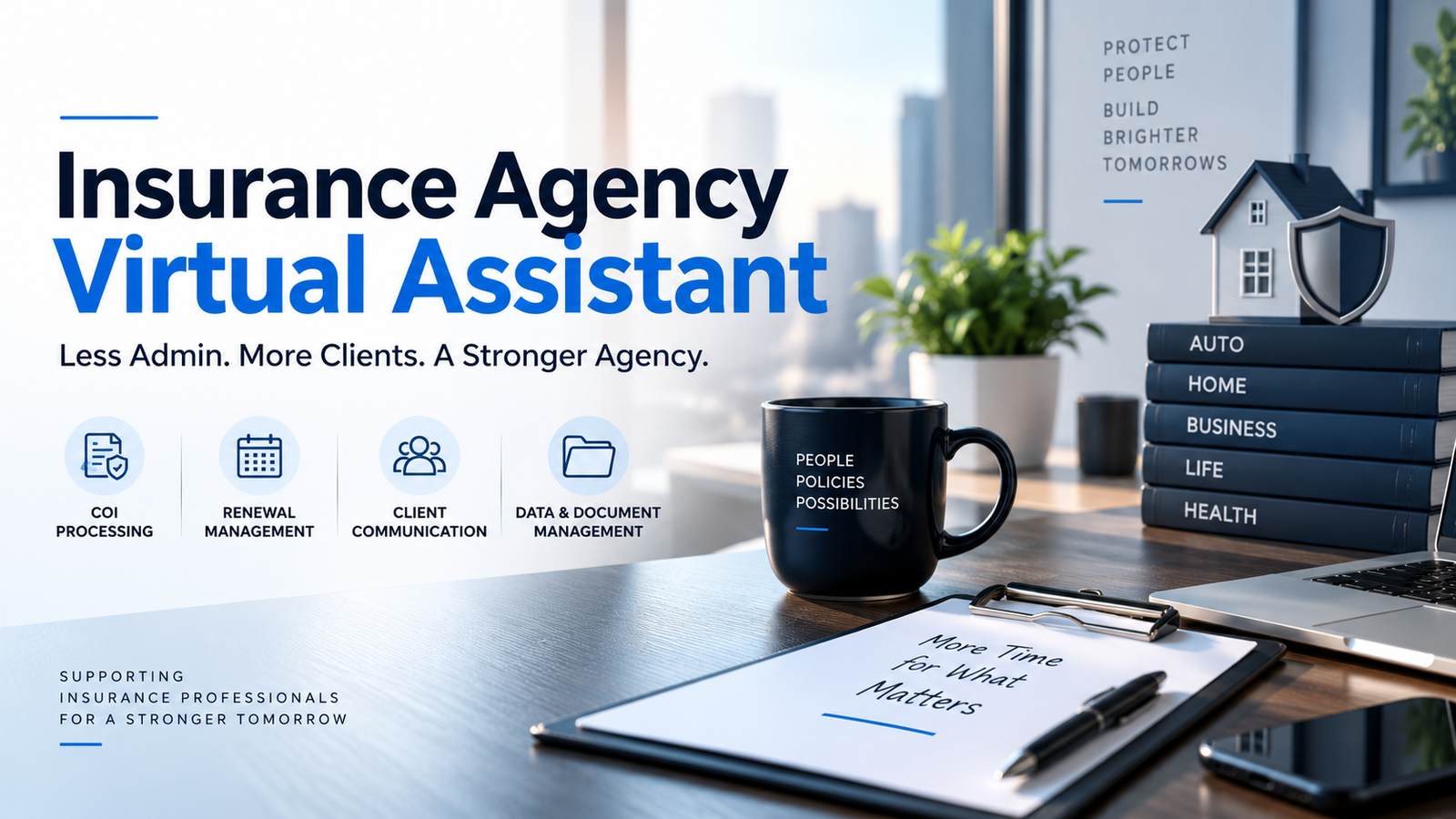
Insurance agencies don't lose productive hours only in meetings or client conversations. A significant amount of time can disappear into certificates, renewal follow-ups, data entry, documentation, scheduling, claims communication, and routine customer requests.
At the same time, customers increasingly expect fast responses and convenient digital communication. An Insurance Agency Virtual Assistant can help agencies handle these administrative demands without pulling producers and account managers away from higher-value client work.
Direct Answer: An insurance agency virtual assistant provides remote administrative and back-office support for tasks such as COI processing, renewal follow-ups, CRM updates, document management, customer communication, claims administration, scheduling, and data entry. By delegating repetitive workflows, agencies can give their internal team more time to focus on clients, sales, and retention.
Why Insurance Agencies Are Looking for More Administrative Support
Insurance operations are becoming increasingly technology-driven, but technology alone doesn't eliminate administrative work.
The Big “I” Agents Council for Technology's 2026 Tech Trends Report found that 68% of agencies plan to increase AI use during the next 12 months, while only 8.29% reported using AI regularly and strategically. The report also identifies staffing challenges, workflow complexity, and technology/tool sprawl as important concerns.
This creates an important opportunity: instead of asking producers and account managers to do everything themselves, agencies can combine technology with specialized administrative support.
1. Streamline Certificate of Insurance Processing
COI requests can consume a surprising amount of agency time.
A virtual assistant can support the administrative workflow by:
-
Receiving and organizing COI requests
-
Reviewing requests for required information
-
Entering approved information into agency systems
-
Preparing certificates according to agency procedures
-
Tracking outstanding requests
-
Communicating with clients about missing information
-
Maintaining completed COI records
The result is a more organized process and less repetitive administrative work for account managers.
2. Keep Renewals on Track
Renewals require consistent follow-up.
A missed reminder or delayed request for updated information can create unnecessary last-minute work for an agency team.
An insurance VA can help maintain renewal workflows by:
-
Tracking upcoming renewal dates
-
Sending approved reminder communications
-
Requesting required documents
-
Following up on outstanding information
-
Updating CRM records
-
Maintaining renewal status lists
-
Escalating accounts that require producer attention
The VA doesn't make coverage or underwriting decisions. Instead, they keep the administrative process moving.
3. Keep CRM and Policy Data Accurate
Insurance agencies depend on accurate information.
When customer records are incomplete or outdated, employees may spend additional time searching for information or correcting records.
A trained insurance virtual assistant can help with:
-
Customer data entry
-
Policy information updates
-
Contact information maintenance
-
Activity logging
-
Follow-up task creation
-
Data cleanup
-
Document attachment
-
CRM record organization
Consistent data-entry processes make it easier for agency staff to find the information they need.
4. Organize Documents and Policy Records
Insurance generates a substantial amount of documentation.
Policies, endorsements, applications, certificates, renewal documents, correspondence, claims information, and client forms all need to be stored and organized correctly.
A VA can support document-management workflows by:
-
Naming and organizing files
-
Uploading documents
-
Maintaining folder structures
-
Tracking missing documentation
-
Updating document records
-
Preparing files for internal review
-
Following agency-specific documentation procedures
This gives account managers and producers less administrative cleanup to handle themselves.
5. Support Claims Administration
Claims require communication and follow-up, but not every claims-related task requires a producer's direct involvement.
Depending on the agency's procedures, an insurance VA can help:
-
Track claim-related documentation
-
Maintain claim status records
-
Organize correspondence
-
Follow up on outstanding administrative items
-
Update CRM notes
-
Schedule follow-ups
-
Communicate approved status updates
The VA should work within clearly defined procedures and escalate coverage, legal, or technical questions to qualified agency personnel.
6. Improve Client Communication
Customers expect insurance businesses to be responsive.
J.D. Power's 2026 Insurance Digital Experience Study found that 47% of new auto and home insurance policies are purchased digitally, showing how important convenient digital interactions have become throughout the customer journey.
An insurance VA can support routine client communication through:
-
Appointment confirmations
-
Document requests
-
Renewal reminders
-
Follow-up messages
-
Policy-service updates
-
Scheduling
-
Email management
-
Approved customer notifications
This doesn't replace the producer-client relationship. It gives that relationship better administrative support.
7. Handle Scheduling and Everyday Agency Administration
Producers and account managers often become the default solution for small administrative tasks.
A VA can take responsibility for many routine activities, including:
-
Calendar management
-
Meeting scheduling
-
Appointment confirmations
-
Email organization
-
Task tracking
-
Follow-up lists
-
Spreadsheet updates
-
Data entry
-
Administrative reporting
These tasks may appear small individually, but handling them consistently can create meaningful capacity across the workweek.
8. Create a More Organized Back Office
The biggest advantage of an insurance virtual assistant isn't necessarily one individual task.
It's the ability to create a repeatable administrative workflow.
For example:
New Request → Data Entry → Documentation → Follow-Up → Status Update → Completion
A VA can help keep each stage moving while your licensed professionals focus on decisions that require their expertise.
This approach can be particularly useful for growing agencies that need more operational capacity but don't want every new administrative responsibility to fall on producers or account managers.
What Should an Insurance Agency Delegate First?
The best starting point is usually a task that is:
-
Repetitive
-
Process-driven
-
Time-consuming
-
Easy to measure
-
Clearly documented
For many agencies, that means starting with COI processing, renewal follow-ups, data entry, document management, or scheduling.
Once the workflow is stable, additional responsibilities can be added based on the agency's needs.
What Should an Insurance VA Not Handle?
A virtual assistant should support administrative processes rather than replace licensed insurance professionals.
Tasks involving coverage interpretation, underwriting decisions, legal advice, binding authority, complex claims decisions, or other regulated professional judgments should remain with appropriately qualified personnel.
The strongest VA model uses clear SOPs, permissions, escalation rules, quality checks, and defined responsibilities.
Frequently Asked Questions
What does an insurance agency virtual assistant do?
An insurance agency virtual assistant supports administrative workflows such as COI processing, renewal follow-ups, CRM updates, policy data entry, document management, scheduling, client communication, claims administration, and billing-related follow-up.
Can an insurance agency outsource administrative work?
Yes. Many repetitive, process-driven administrative workflows can be delegated to a trained virtual assistant while licensed professionals retain responsibility for coverage, underwriting, legal, and other regulated decisions.
Can an insurance VA handle COI processing?
Yes. A trained VA can support the administrative side of COI processing, including receiving requests, organizing information, preparing documents according to agency procedures, tracking requests, and following up on missing information.
Can an insurance virtual assistant help with renewals?
Yes. A VA can maintain renewal lists, send approved reminders, request documents, track outstanding information, update CRM records, and escalate accounts requiring producer attention.
Is an insurance virtual assistant useful for a small agency?
Yes. A small agency can start by delegating one or two repetitive workflows and expand the VA's responsibilities as processes become established.
Give Your Insurance Team More Time for Clients
Insurance agencies need technology, skilled professionals, and reliable processes—but they also need administrative capacity.
A specialized Insurance Agency Virtual Assistant can help keep COIs, renewals, documents, customer communication, CRM records, claims administration, and everyday back-office tasks moving.
That means producers can spend more time selling, account managers can focus on clients, and agency owners can focus on growth.
Virtual Nexgen Solutions provides experienced, industry-focused Virtual Assistants who understand the day-to-day administrative demands of insurance businesses—helping you stay organized, responsive, and focused on your clients.
If administrative work is taking too much time away from your insurance team, a VNS virtual assistant can help identify the workflows worth delegating first.
Book a free 30-minute consultation with Virtual Nexgen Solutions