

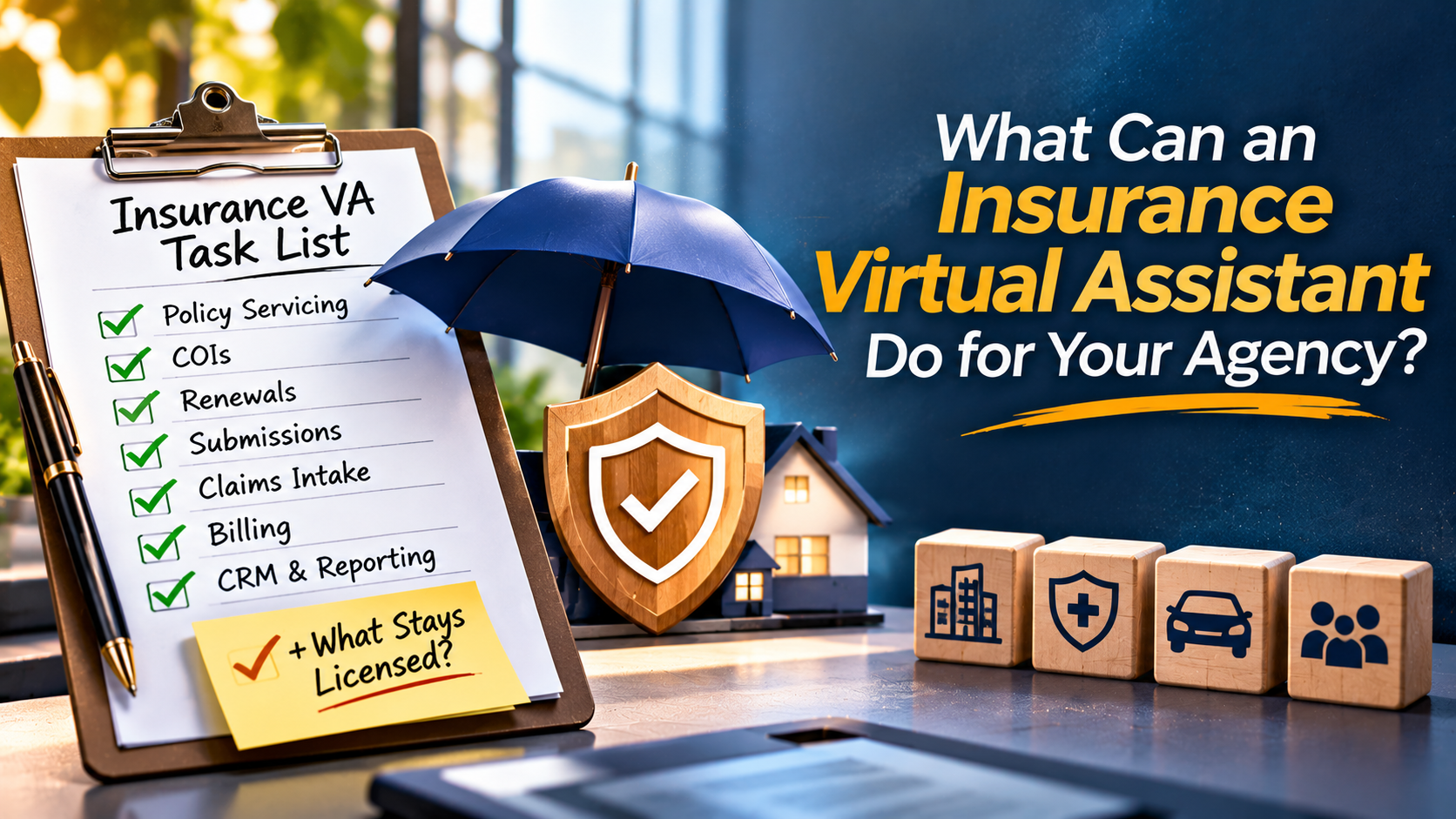
When licensed producers and account managers spend the day chasing documents, updating records, and scheduling routine calls, they have less time for client advice and revenue-generating work. An insurance virtual assistant can take on many of those repeatable administrative tasks: provided the agency defines the role, access, and escalation rules clearly.
Virtual Nexgen Solutions’ insurance virtual assistants provide dedicated, industry-trained support for agency operations. Here’s a practical task catalog to help you decide what a virtual assistant for insurance agents can handle, and what should stay with licensed staff.
The key boundary: prepare and coordinate, not advise or bind
A VA can often collect, record, organize, and transmit information, prepare documents for review, and keep follow-ups moving. Activities such as interpreting coverage, recommending a policy, negotiating terms, or binding coverage may require a licensed producer.
Licensing rules vary by state. The NAIC’s implementation guidance offers examples of clerical and licensable activities, but it is informational guidance, not a substitute for state law or a regulatory opinion. Confirm each task with your state regulator, carrier requirements, and qualified compliance counsel.
1. Policy administration and servicing
A VA can receive routine service requests and keep their supporting work organized. For example, they can:
- Enter client-provided changes to contact details, vehicles, drivers, locations, or mortgagee information.
- Create service tickets, attach documents, and track missing information.
- Prepare change requests or supporting documents for producer review.
- Follow up on requests submitted to a carrier and record the response.
- Deliver approved policy documents through the agency’s authorized channels.
Licensed staff should handle coverage interpretation, advice about policy changes, and decisions about whether a requested change is appropriate. A VA can record a client’s request and prepare it for review; the VA should not promise that the requested change is effective.
2. Certificate of insurance (COI) requests
COIs are a common source of repeat administrative work, especially for commercial agencies. Depending on state law and carrier procedures, a VA may be able to log a request, verify basic details against approved records, populate a standard template, and send a draft or completed certificate through the agency’s process.
The agency should set a clear rule for which certificates can be processed routinely and which need review. Requests involving unusual wording, additional-insured status, waivers, changed limits, expired policies, or unclear details should be escalated.
A VA should not invent coverage, alter policy terms, backdate a certificate, or imply that a party has coverage when the policy does not support it. The NAIC guidance distinguishes preparing certificates under producer instructions from issuing them in a way that may affect the insurance contract. Treat COI authority as a state- and carrier-specific question.
3. Renewals and expiration-date tracking
A virtual assistant can help prevent renewal tasks from slipping between inboxes and calendars. Common insurance virtual assistant tasks include:
- Maintaining renewal lists and flagging approaching expiration dates.
- Sending approved reminders and requesting updated documents or exposure information.
- Tracking missing applications, schedules, signatures, and carrier requirements.
- Organizing renewal materials for a producer or account manager.
- Scheduling renewal reviews and recording next steps.
Licensed staff should review the account, assess coverage needs, recommend options, negotiate with carriers, and confirm coverage decisions. The VA keeps preparation and follow-up moving; the producer provides the professional judgment.
4. Quoting and submission preparation
A VA can collect applicant-provided facts using agency-approved forms, check that fields are complete, request missing documents, and organize a submission package. Under instructions and with authorized access, they may enter factual information into agency or carrier systems and track outstanding underwriting questions.
The producer should determine which markets to approach, review the application for accuracy, assess coverage needs, interpret quote terms, make recommendations, negotiate, and bind coverage. A VA should not tell a prospect which policy to buy or represent that coverage is bound.
5. Claims intake support
For a first notice of loss, a VA can record the caller’s information and the facts they provide: date and location, a brief description, parties involved, contact details, and available supporting documents. They can direct the client to the carrier’s approved reporting channel, transmit information according to agency procedures, create a follow-up task, and document the handoff.
The VA’s role is to capture and route, not to determine coverage, fault, liability, claim value, or whether a claim will be paid. Urgent safety concerns, complex questions, and requests for a coverage decision should go promptly to the appropriate carrier contact or licensed agency staff.
6. Billing and commission statements
Administrative finance work can also be delegated. A VA may send approved invoices or payment reminders, organize billing correspondence, match statement entries to agency records, and flag missing or inconsistent items for review.
For commission statements, a VA can organize carrier reports, enter figures into an approved tracking system, and identify discrepancies for the agency’s accounting or management team. The responsible staff member should review adjustments, resolve disputes, and approve payments. Any compensation arrangement for an unlicensed VA should also be checked against applicable state rules.
7. Client communication and onboarding
A VA can help new clients move through the agency’s administrative setup by sending approved welcome materials, requesting required documents, tracking signatures, organizing records, and scheduling an introductory or review call.
For existing clients, a VA may handle routine status updates, document reminders, and requests that use approved scripts. If a client asks, “Am I covered?” or “Which limit should I choose?”, the VA should record the question and route it to a licensed professional, not improvise an answer.
8. CRM and AMS data hygiene
Accurate records make every other agency process easier. A VA can update contact details, attach documents to the right account, enter activity notes, flag duplicate records, and maintain task statuses in your customer relationship management (CRM) or agency management system (AMS).
Set clear standards for naming, notes, required fields, and quality checks. Use individual accounts and role-based access rather than shared credentials, and only grant access needed for assigned duties.
9. Appointment scheduling and inbox triage
A VA can schedule client reviews, producer calls, inspections, or follow-up meetings; send confirmations and reminders; and route incoming messages to the right team member. A simple triage guide should identify urgent claims, cancellation or lapse notices, coverage questions, complaints, and other matters that cannot wait in the routine queue.
The VA coordinates the appointment and captures the reason for the call. Licensed staff handle substantive insurance discussions.
10. Reporting and pending-task visibility
A VA can prepare routine reports on open service requests, upcoming renewals, missing documents, aging follow-ups, and items awaiting carrier response. This gives agency managers a clearer view of the workload and where cases are getting stuck.
Reports should support decisions, not replace them. Assign an owner to review exceptions and decide what action to take.
Why task lists break down without operating rules
A long task list does not automatically create a reliable workflow. Delegation often falters when the VA has no written procedure, cannot tell which cases require approval, or has broader system access than the job needs.
Before handing off work, define:
- The trigger: What starts the task, and where does it arrive?
- The steps: What should the VA do, in what order, and where should it be documented?
- The boundary: What can be completed independently, and what requires licensed review?
- The escalation rule: Who handles exceptions, and how quickly?
- The quality check: Which items will a supervisor sample, and how will errors be corrected?
Use unique logins, least-privilege access, approved communication channels, and documented procedures for handling customer information. The FTC’s Safeguards Rule overview explains information-security responsibilities for covered financial institutions, including oversight of service providers. Confirm which privacy and security requirements apply to your agency and the information it handles.
A practical four-week rollout
Week 1: Choose the first tasks. Review where service backlogs form. Select one or two repeatable areas, such as document follow-up or appointment scheduling, and name an internal owner.
Week 2: Document and configure. Write short procedures, approved message templates, escalation triggers, and quality standards. Set up individual user accounts and restricted permissions.
Week 3: Train and test. Walk through sample cases with the VA. Start with supervised work; have licensed staff review tasks that touch policy changes, COIs, quotes, or claims.
Week 4: Review and expand carefully. Check accuracy, turnaround time, open exceptions, and staff feedback. Refine the process before adding another task category.
A dedicated assistant who learns your systems and procedures can provide more continuity than ad hoc task coverage. Virtual Nexgen’s model includes 1-on-1 industry-trained support, structured onboarding and quality assurance, and privacy-first workflows. Its stated goals, such as reducing administrative workload by up to 60% or increasing operational capacity up to 3x, depend on your starting workload, processes, and scope; they are not guaranteed results.
How Virtual Nexgen can support your agency
Virtual Nexgen Solutions provides dedicated insurance virtual assistants to support routine administrative work while your licensed team retains responsibility for advice and insurance decisions. Support can be shaped around your agency’s procedures, systems, communication standards, and review requirements.
If your team is spending too much time on renewals, data cleanup, document collection, scheduling, or other repeatable tasks, book a 30-minute conversation to discuss a practical starting scope.
Frequently asked questions
What tasks can an insurance virtual assistant handle?
Depending on your procedures and applicable rules, a VA may support policy administration, renewal tracking, COI processing, submission preparation, claims intake, billing follow-up, client onboarding, CRM/AMS maintenance, scheduling, and reporting.
Can a virtual assistant give insurance advice?
Not unless appropriately licensed and authorized for the relevant activity. A VA in an administrative role should collect and route questions; licensed staff should interpret coverage, recommend policies, negotiate, or bind as required by state law.
Can an insurance VA prepare or issue COIs?
A VA may be able to prepare certificates under agency instructions. Whether the VA can issue them, and what review is required, depends on state law, carrier rules, and whether the action could affect the insurance contract. Establish written approval and escalation rules before delegating.
What should an agency delegate first?
Start with frequent, repeatable tasks that have clear instructions and low judgment requirements, such as appointment scheduling, document follow-up, record updates, or pending-task reports. Add more complex work only after the process and review controls are working.
How do you protect client information when working with a VA?
Use individual accounts, limited permissions, approved systems, secure communication channels, and documented privacy and incident procedures. Review vendor arrangements and requirements with your compliance or security lead, especially when handling sensitive customer data.
How can an agency tell whether delegation is working?
Track task accuracy, completion time, overdue items, exception volume, and the time licensed staff regain for client work. Review the results regularly and adjust the scope when the process or risk profile changes.
Work With Virtual Nexgen Solutions
If your business needs dependable virtual assistant support, Virtual Nexgen Solutions can provide support around your existing workflow. Book a discovery call today.
Get in Touch Now!