
Manufacturing leaders often find themselves trapped in a paradox. The more you produce, the more complex the administration becomes. What started as a streamlined operation suddenly transforms into a mountain of unentered production logs, missed inventory reorder points, and a growing cloud of "Admin Debt" that eats your margins from the inside out.
Scaling a manufacturing business is not just about adding more machines or hiring more floor labor. It is about hardening the systems that support those machines. When your administrative backbone is weak, your production capacity hits an invisible ceiling. You cannot scale what you cannot measure, and you cannot measure what remains stuck in a pile of handwritten notes on a shop manager's desk.
This guide provides the blueprint for using a specialized Logistics Virtual Assistant to eliminate these bottlenecks, protect your margins, and ensure your facility operates at peak efficiency for a fraction of the cost of local administrative hires. If you are searching for a Logistics Virtual Assistant to support production visibility, inventory coordination, and shipping follow-through, this blueprint shows where that support creates the fastest margin gains.
The Invisible Margin Killer: Admin Debt in Manufacturing
Admin Debt is the accumulated cost of postponed administrative tasks. In manufacturing, this debt manifests as production logs that haven't been digitized, material usage reports that aren't updated, and shipping schedules that live only in someone’s head.
When a production manager spends three hours a day entering data into a system instead of optimizing the floor, you are losing money. You are paying a high-level manager to perform $8-an-hour tasks. Worse, if those tasks are ignored, you face "Profit Leakage." This occurs when you lose high-value contracts because you couldn't verify lead times, or when you pay expedited shipping fees because a raw material ran out unexpectedly.
A dedicated Manufacturing Virtual Assistant acts as the corrective force. By offloading these essential but time-consuming tasks to a professional at $8 per hour, you preserve your high-level talent for high-level problems. Compare this to the $60,000 annual salary (plus benefits and overhead) of a local administrative assistant, and the ROI becomes immediate.
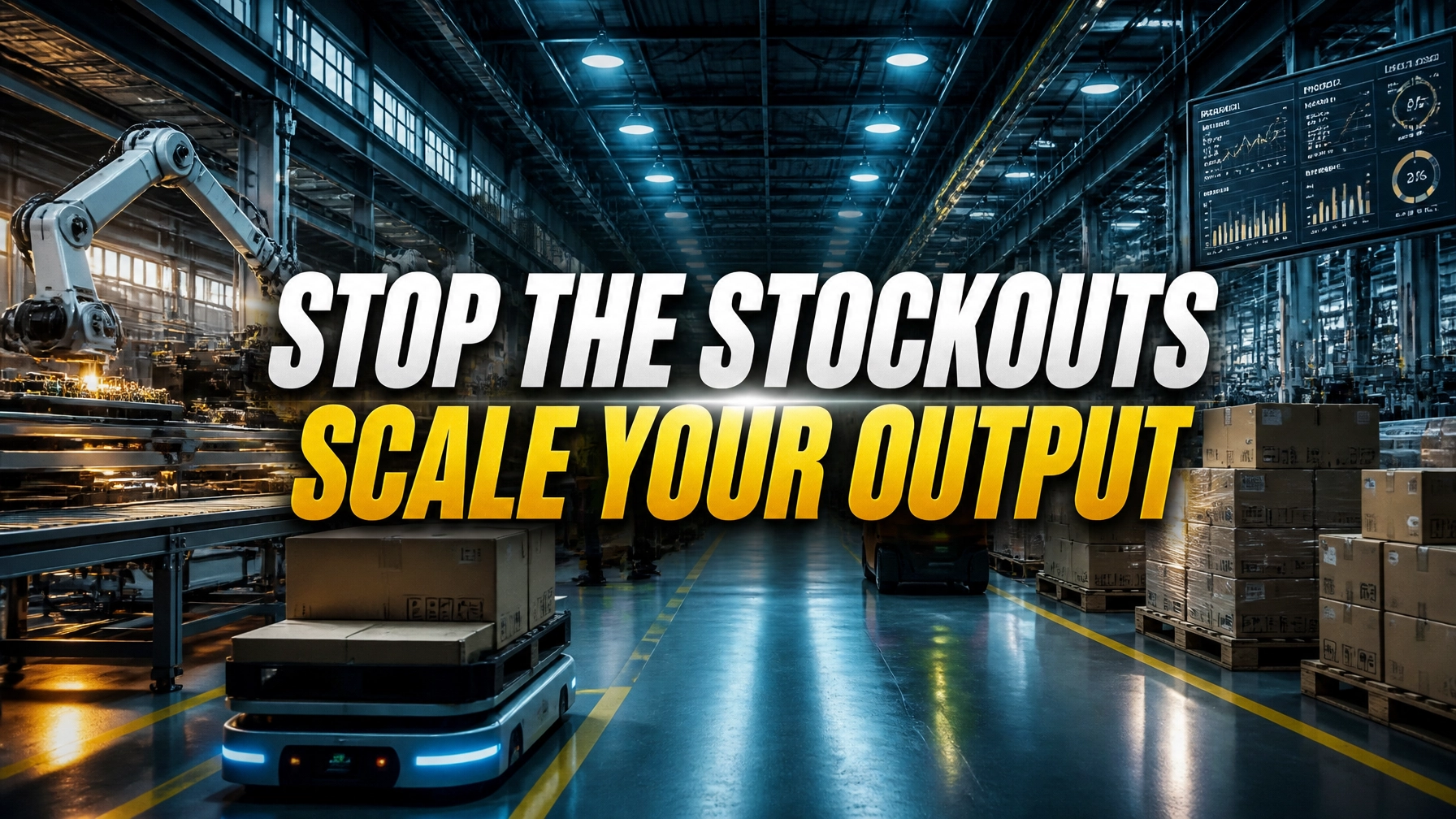
STOP THE STOCKOUTS SCALE YOUR OUTPUT
The most visible sign of administrative failure is the stockout. When a $50,000 order is delayed because a $5 part is missing, your margins evaporate. A Logistics Virtual Assistant prevents this by maintaining a "Living Inventory."
Instead of waiting for a monthly physical count, your assistant reconciles production logs daily. They track the "burn rate" of raw materials against active work orders. When a material hits its pre-defined reorder point, the assistant initiates the procurement process, gathers quotes from vendors, and presents the purchase order for your approval.
This proactive management ensures that production never grinds to a halt. It transforms your supply chain from a reactive headache into a streamlined, predictable engine.
Tactical SOP: Daily Production Log Management
To scale production margins, you must have real-time visibility into your yield and scrap rates. Use this procedure to systematize your data entry with a remote assistant.
Purpose: To ensure 100% accuracy in production reporting and provide leadership with daily performance metrics.
Step 1: Data Collection. Require shop floor leads to photograph or scan all handwritten production logs at the end of every shift. Upload these images to a shared secure folder (e.g., Dropbox or Google Drive).
Step 2: Verification. The Logistics Virtual Assistant reviews the logs for legibility and completeness. If data is missing (e.g., a machine number or a shift timestamp), the assistant immediately notifies the floor lead via Slack or Microsoft Teams.
Step 3: Entry. The assistant enters the data into your ERP or production tracking spreadsheet. They must record units produced, total labor hours, scrap quantity, and downtime reasons.
Step 4: Discrepancy Alert. If the scrap rate exceeds a 5% threshold or if downtime is recorded for more than 60 minutes, the assistant must flag this in a daily "Red Flag" report sent to the Plant Manager.
Step 5: Daily Briefing. By 8:00 AM the following morning, the assistant delivers a summary report showing the previous day’s efficiency versus the weekly target.
Solving the Logistics and Dispatch Bottleneck
For manufacturing businesses that handle their own shipping or work closely with freight carriers, the coordination effort is massive. A Logistics Virtual Assistant functions as your remote dispatch center.
They manage the communication between your warehouse and the trucking companies. They track shipments in real-time, update customers on delivery windows, and handle the inevitable "Where is my order?" inquiries that bog down your sales team. By centralizing this communication, you ensure a professional customer experience while keeping your internal team focused on the product.
At Virtual Nexgen Solutions, we see manufacturing clients regain 15 to 20 hours of leadership time per week simply by delegating freight coordination and bill-of-lading (BOL) management to a remote professional.
Scaling Beyond the "Hobby" Bench to Industrial Output
Scaling requires a shift from manual oversight to system-driven management. If you are moving from 500 units a month to 5,000, your current "mental checklist" will fail. You need a Logistics Virtual Assistant to build and maintain the digital infrastructure of your growth.
This includes:
- Vendor Management: Maintaining a database of secondary suppliers to mitigate supply chain risks.
- Cost Analysis: Regularly auditing invoices to ensure vendors are sticking to agreed-upon pricing.
- Compliance Tracking: Managing safety certifications and equipment maintenance schedules.
When you remove the friction of these administrative tasks, your capacity to scale is limited only by your equipment and your market, not your ability to keep up with paperwork.
Tactical SOP: Inventory Reorder Point Management
Preventing stockouts requires a rigid system of checks and balances. Implement this SOP to maintain your production flow.
Purpose: To eliminate production delays caused by raw material shortages.
Step 1: Inventory Audit. The Logistics Virtual Assistant performs a weekly digital audit by cross-referencing shipping receipts against production consumption logs.
Step 2: Buffer Level Monitoring. The assistant checks current stock levels against the "Minimum Safe Quantity" (MSQ) defined for each SKU.
Step 3: Vendor Inquiry. Once an item reaches its MSQ, the assistant contacts at least three approved vendors to confirm current pricing and lead times.
Step 4: Order Preparation. The assistant prepares a digital Purchase Order (PO) with the best available terms and sends it to the Operations Manager for a digital signature.
Step 5: Delivery Tracking. Once the order is placed, the assistant monitors the delivery status and updates the production schedule to reflect the arrival of new materials.
The Financial Reality: VA vs. In-House Admin
The math for a manufacturing business is simple. To hire a local administrative assistant in the US, you are looking at a base salary of roughly $45,000 to $50,000. Once you add payroll taxes, health insurance, office space, and equipment, that cost easily climbs to $60,000 or more annually.
A Virtual Nexgen Solutions assistant costs $8 per hour. This equates to roughly $16,640 per year for a full-time, dedicated professional.
By choosing the remote model, you save over $43,000 per year per administrative head. In a manufacturing environment, that $43,000 can be reinvested into:
- New tooling or machinery.
- Higher-quality raw materials to improve product durability.
- Marketing budgets to drive more volume.
- Performance bonuses for your floor staff to improve retention.
Choosing a specialized Logistics Virtual Assistant isn't just a "cost-saving" move; it is a strategic reinvestment in your company's competitive advantage.
Systematizing the Warehouse and Shop Floor
Efficiency is born from clarity. When your shop floor is cluttered with "to-do" lists and the warehouse manager is buried in receipts, clarity is impossible. Your virtual assistant serves as the "Digital Librarian" for your physical operations.
They can manage your equipment maintenance logs, ensuring that every machine is serviced before it breaks down. They can track employee certifications, ensuring you remain compliant with OSHA or industry-specific regulations. They can even handle the scheduling of temporary labor during peak seasons.
By moving these responsibilities to a remote professional, you create a "Clean Floor" environment where your physical team can focus entirely on the craft of manufacturing.
Integrating with Manufacturing Software
Whether you use a specialized ERP or a custom-built series of spreadsheets, your Logistics Virtual Assistant is trained to integrate into your existing tech stack. They handle the "data heavy lifting" that most managers find tedious.
If you are using tools like Fishbowl, NetSuite, or even a robust QuickBooks setup, your assistant ensures that every transaction is recorded correctly. This level of detail is critical for accurate COGS (Cost of Goods Sold) reporting, which is the heartbeat of your production margins. Without accurate data entry, your financial reports are just guesses. With a dedicated assistant, they are actionable insights.
Transforming Your Manufacturing Culture
When you introduce a Logistics Virtual Assistant, you send a message to your team: We value your specialized skills.
Your master welders should be welding. Your production supervisors should be optimizing workflows. Your sales team should be closing deals. By removing the "administrative drag" from their daily lives, you improve morale and reduce burnout.
You transition from a "firefighting" culture, where everyone is reacting to the latest crisis, to a "systematic" culture, where problems are anticipated and handled before they impact the bottom line.
Frequently Asked Questions
How does a virtual assistant track inventory if they aren't in the warehouse?
The assistant relies on digital inputs. Your floor team scans or photographs receiving slips and production logs. The assistant then reconciles these against your digital inventory system. This creates a "double-check" system that often catches errors a physical worker might miss while in a rush.
Is an $8/hour assistant experienced enough for manufacturing logistics?
Yes. At Virtual Nexgen Solutions, we source assistants with specific backgrounds in logistics and administration. Because our pricing is competitive in global markets, we attract high-level professionals who are dedicated to long-term roles.
How do I communicate with my assistant during a busy shift?
Most clients use a combination of Slack, Microsoft Teams, or WhatsApp for quick communication, and Zoom or Google Meet for weekly strategy sessions. Your assistant operates during your business hours to ensure they are available when you need them.
What if I already have an ERP system? Do I still need a VA?
An ERP is only as good as the data entered into it. Most manufacturing "ERP failures" happen because the team is too busy to keep the data updated. A VA ensures your ERP remains the "Single Source of Truth" by handling all data entry and reconciliation daily.
Can a Logistics Virtual Assistant handle international shipping?
Yes. They can coordinate with customs brokers, manage commercial invoices, and track international freight containers. This is particularly valuable for manufacturers who source raw materials globally.
How long does it take to get a Manufacturing VA up and running?
With our SOP-driven approach, we can typically have an assistant integrated into your workflow within a week. We focus on mastering one or two key bottlenecks first (like production logs) before expanding their role.
What happens if I need to scale up my VA support quickly?
That is the beauty of the Virtual Nexgen Solutions model. You can add additional assistants as your volume increases without the friction of traditional hiring, interviewing, and office-space planning.
Will a VA help me reduce my scrap rate?
While a VA doesn't touch the machines, they provide the visibility needed to reduce scrap. By tracking scrap rates shift-by-shift and reporting them daily, they allow you to identify which machines or teams need attention immediately, rather than discovering the loss at the end of the month.
Protect Your Margins Today
The difference between a manufacturing business that struggles and one that scales is the strength of its systems. Don't let administrative debt and profit leakage hold your production back.
Stop the stockouts and start scaling your output by delegating your high-impact administrative tasks to a professional.
Ready to streamline your production and save over $40,000 in administrative costs?
Schedule your 30-minute operational strategy call here to build your custom scaling blueprint.