
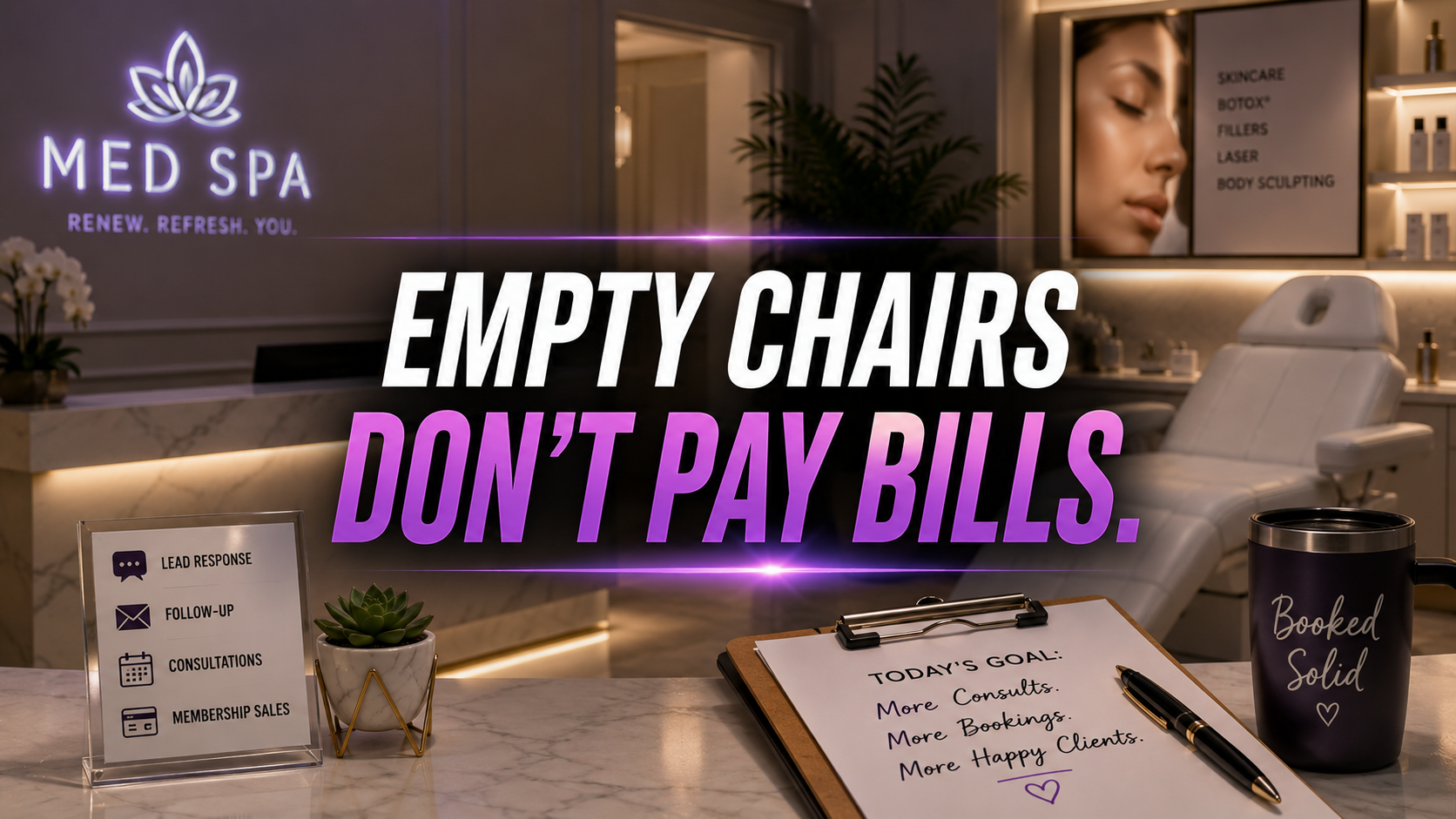
You spend thousands of dollars on high-intent lead generation. Your aesthetic injectors are world-class, and your facility looks like a page out of Architectural Digest. Your calendar is packed with consultations. On paper, your medical spa is a runaway success. But look closer at your bank balance and your treatment room utilization rates. There is a massive, silent leak in your operation.
Between the moment a prospect finishes their consultation and the moment they swipe their card for a full treatment package, 60% to 70% of your potential revenue vanishes. This is the "Consultation-to-Cash" gap. It is the friction that occurs when a patient walks out of your clinic with a treatment plan in hand, only to be met with total silence from your front desk.
In the medical spa industry, the "Consultation-to-Cash" gap is the primary cause of Admin Debt. Your team is busy, so they prioritize the person standing in front of them. Meanwhile, the $5,000 treatment plan you just presented sits in a folder or a CRM tab, slowly dying. Without a specialized medical spa virtual assistant to bridge this gap, you are effectively paying to educate your competitors' future clients.
The Severe Reality of Medical Spa Admin Debt
Admin Debt is the accumulation of unperformed administrative tasks that eventually cripple your growth. In a medical spa, this looks like unreturned lead calls, unconfirmed appointments, and, most critically, the lack of post-consultation follow-up.
When your lead response time exceeds five minutes, your chances of qualifying that lead drop by a staggering 400%. If you wait 24 hours, the lead is essentially dead. This operational lag creates a "Profit Leakage" that most owners try to fix by spending more on ads. But you don't need more leads; you need to monetize the leads you already have.
The cost of this friction is not just a missed sale. It is the wasted marketing spend, the wasted clinician time during the consultation, and the loss of the Lifetime Value (LTV) that a loyal patient provides. At Virtual Nexgen Solutions, we see medical spas losing between $50,000 and $100,000 every single year simply because they lack a dedicated system to move a prospect from "interested" to "invoiced."
Industry Statistics: The Numbers Behind the Bleeding
The data surrounding the medical spa industry reveals a harsh truth about the modern consumer. Patience is non-existent, and competition is fierce.
- The 5-Minute Rule: Responding to a new lead within 5 minutes makes you 21 times more likely to qualify that lead compared to responding after 30 minutes.
- The Follow-Up Failure: 60-70% of medical spa leads never book a treatment after their initial consultation due to a lack of proactive follow-up.
- The 24-Hour Window: Sending a personalized treatment plan and follow-up message within 24 hours of a consultation increases conversion rates by 38%. Delaying this to day five drops conversion to a dismal 12%.
- The Retention Gap: 45-70% of first-time medical spa patients never return for a second visit.
- The Membership Lift: Patients enrolled in membership programs have a 3-5x higher lifetime value than one-time "transactional" patients.
- The Review Impact: 90% of aesthetic patients read reviews before booking. Yet, most clinics only collect reviews from less than 2% of their clients.
Revenue Leaks: Identifying Your Specific Points of Failure
To fix the profit leakage, you must first identify where the water is escaping. In most medical spas, revenue leaks occur at three critical junctions:
- Lead Decay: Your front desk is checking a patient out, answering the phone, and handing a towel to a clinician all at once. The lead that just came in through your Instagram DM or web form sits for two hours. By the time someone calls back, that prospect has already booked with the spa down the street that answered in three minutes.
- The "Ghost" Consultation: The patient leaves the consultation feeling excited but needs to "talk to their spouse" or "check their schedule." They walk out the door. No one calls them the next day. No one sends them the before-and-after photos of people with their exact concern. The excitement fades, and they stay in "analysis paralysis" forever.
- The Rebooking Void: A patient gets their first Botox treatment. They love the results. But because no one followed up at the 90-day mark to remind them they are due for a refresh, they forget. Or worse, they see a promotion from another clinic and move their loyalty there.
Operational Challenges in the Modern Med Spa
Running a medical spa is not just about aesthetics; it is a complex logistics operation. You are managing high-cost inventory, expensive medical equipment, highly specialized labor, and a demanding client base.
The primary operational challenge is the "Front Desk Bottle-Neck." Most owners hire one or two receptionists and expect them to be masters of customer service, sales, inventory management, and technical troubleshooting. It is an impossible ask. When the clinic gets busy, the first thing that gets dropped is the "invisible" work: the follow-up calls, the CRM data entry, and the membership sales outreach.
This leads to "Staffing Burnout." Your high-quality employees leave because they are overwhelmed by repetitive administrative tasks, and you are forced into a constant cycle of hiring and training. This churn destroys the patient experience and increases your operational overhead significantly.
Industry Trends: Moving Toward a Membership Model
The most successful medical spas in 2026 are moving away from transactional, one-off treatments and toward recurring revenue models. Memberships and high-ticket packages are the gold standard for stability and growth.
However, selling and managing a membership program requires constant communication. You need to track usage, manage failed payments, and proactively reach out to members who aren't using their credits. If your staff is already overwhelmed with the daily grind, your membership program will fail.
A specialized medical spa virtual assistant provides the administrative engine required to scale these high-margin programs. They handle the "boring" back-end work, allowing your in-person team to focus on providing a luxury, high-touch experience for every patient who walks through the door.
Leveraging Industry Software for Maximum Efficiency
Your medical spa software is only as good as the data entered into it. Whether you use Zenoti, Boulevard, Mindbody, Vagaro, or Booker, these systems are designed to streamline your business, but they require a dedicated operator.
A Virtual Nexgen Solutions VA is trained to work within these specific platforms to:
- Manage Calendars: Optimize scheduling to ensure no "dead air" between appointments.
- Clean CRM Data: Ensure every lead has a phone number, email, and treatment interest tagged correctly.
- Manage Payment Processing: Handle invoicing via Square or your integrated system, and follow up on declined membership payments.
- Execute Nurture Campaigns: Use integrations with Mailchimp or Klaviyo to send targeted treatment information based on consultation notes.
- Digital Paperwork: Send and track intake forms and consents via DocuSign to ensure they are completed before the patient arrives.
Actionable Industry SOPs: The Consultation-to-Cash Blueprint
To bridge the gap, you need a system that functions without your direct supervision. Implement these five Standard Operating Procedures (SOPs) using a specialized virtual assistant to transform your conversion rates.
SOP 1: Lead Intake & 5-Minute Speed-to-Response
The goal is to eliminate Lead Decay. Every second counts.
- Monitor All Channels: The VA monitors web forms, Instagram/Facebook DMs, and third-party lead aggregators in real-time.
- The Immediate Response: Within 60 seconds of a lead coming in, the VA sends a personalized text message: "Hi [Name], this is [Your Spa Name]. We saw you were interested in [Treatment]. I'm here to answer any questions or help you grab a consultation spot before they fill up for the week! Would you like to see our availability?"
- The Qualification Call: If no response to the text within 10 minutes, the VA makes an outbound call to qualify the lead and book the consultation.
- CRM Logging: The VA logs the source, the interest, and the status in your practice management software.
SOP 2: Consultation Preparation & Pre-Visit Communication
The goal is to reduce no-shows and increase the patient's "readiness" to buy.
- Confirmation Sequence: Immediately upon booking, the VA sends a confirmation email and text with calendar invites.
- Education Delivery: 48 hours before the visit, the VA sends a "What to Expect" guide and a link to 3-5 relevant before-and-after results for the specific treatment the patient is interested in.
- Intake Completion: 24 hours before the visit, the VA checks for completed medical history and consent forms. If incomplete, the VA sends a reminder: "We want to maximize your time with our clinician! Please complete your digital forms here so we can get started the moment you arrive."
- Morning-of Text: A simple, high-touch text with parking instructions and a welcoming note.
SOP 3: Post-Consultation Follow-Up & Treatment Plan Delivery
This is the most critical SOP for closing the revenue leak.
- The 2-Hour Summary: Within 2 hours of the patient leaving, the VA sends a personalized text: "It was great having you in today, [Name]! [Clinician Name] was so excited about the plan you discussed. I've sent your full treatment summary and financing options to your email. Check it out here: [Link]."
- The 24-Hour Treatment Plan: The VA compiles the clinician's notes into a professional PDF treatment plan and emails it with clear "Next Steps" and a "Book Now" link.
- The Social Proof Follow-Up (Day 3): If the patient hasn't booked, the VA sends a video testimonial of a patient who had the same concerns.
- The Financing Push (Day 5): The VA sends a friendly check-in: "Hi [Name], just checking in to see if you had any questions about the plan! We also have flexible monthly payment options through [CareCredit/PatientFi] that can split this into easy payments. Would you like the link to see if you qualify?"
SOP 4: Membership & Package Sales Management
The goal is to increase Lifetime Value and recurring revenue.
- Prospect List Management: The VA identifies patients who have had 2+ transactional treatments and adds them to a "Membership Prospect" list.
- Outreach: The VA sends a personalized benefit breakdown: "You've been such a great client! Based on your last two treatments, our [Membership Level] would actually save you $[Amount] per year and give you [Benefit]. Should I set that up for your next visit?"
- Member Retention: The VA monitors member usage. If a member hasn't used a credit in 60 days, the VA reaches out to book them: "You have a credit waiting for you! Let's get you on the schedule for a refresh."
- Failed Payment Recovery: The VA proactively manages declined cards, calling members to update billing info before the membership is canceled.
SOP 5: Post-Treatment Follow-Up & Review Collection
The goal is to ensure clinical safety and build your online reputation.
- The 48-Hour Check-In: The VA sends a text: "Hi [Name], this is [Your Spa Name]. We just wanted to check in and see how you are feeling after your treatment! Do you have any questions about your aftercare?"
- The 7-Day Results Reinforcement: The VA sends an email explaining what results they should be seeing now and what to expect in the coming weeks.
- The Review Request (Day 10): Once the patient is likely seeing great results, the VA sends a personalized request: "We loved having you! Would you mind sharing your experience on Google? It helps our small team so much! [Link]."
- Rebooking Reminder (Day 90): The VA monitors the treatment cycle and reaches out to rebook before the results fade.
Case Study 1: Scottsdale Med Spa Recovers $36,000 in 90 Days
A high-end medical spa in Scottsdale, Arizona, was struggling with a "Consultation Ghosting" problem. They were seeing 40 new consultations per month but only converting 45% into paid treatments. Their staff was overwhelmed with in-person demands and rarely had time to call leads back more than once.
Virtual Nexgen Solutions implemented SOP #1 and SOP #3 with a dedicated $8/hr virtual assistant.
- The Scenario: The VA took over all digital lead responses and executed a 7-day follow-up cadence for every unbooked consultation.
- The Impact: Within 90 days, the consultation-to-booking rate jumped from 45% to 68%. The spa recovered $36,000 in previously "lost" revenue from patients who had ghosted after their initial visit. The front desk staff reported a 50% reduction in stress levels, allowing them to focus on high-touch patient hospitality.
Case Study 2: Aesthetic Clinic Boosts Membership Revenue by 40%
A growing aesthetic clinic in Florida had a membership program that had plateaued. They had 100 members but were losing 5-8 members every month due to failed payments and a lack of engagement.
Virtual Nexgen Solutions deployed a specialized VA to handle SOP #4.
- The Scenario: The VA audited the membership database, recovered failed payments, and began a proactive re-engagement campaign for members who hadn't visited in over 60 days.
- The Impact: In six months, the clinic grew its membership base to 165 active members. The VA recovered $4,200 in failed payments that would have otherwise been written off. Overall monthly recurring revenue increased by 40%, providing the owner with the stability to open a second location.
Cost Comparison: Specialized VA vs. In-House Admin
The financial argument for a virtual assistant is undeniable when you look at the total cost of employment.
- In-House Administrator:
-
- Salary: $45,000 - $55,000/year
- Taxes & Benefits: $10,000 - $15,000/year
- Recruitment & Training: $3,000/year
- Office Space & Equipment: $5,000/year
- Total Annual Cost: $63,000 - $78,000
- Limitations: Limited to 40 hours a week, requires management, prone to local labor market fluctuations.
- Virtual Nexgen Solutions Specialized VA:
-
- Hourly Rate: $8/hour
- Annual Cost (Full Time): ~$16,640
- Taxes & Benefits: $0 (Included in rate)
- Recruitment & Training: $0 (Pre-trained)
- Office Space & Equipment: $0
- Total Annual Cost: ~$16,640
- Advantages: 24/7 availability options, specialized in medical spa software, scales instantly with your needs.
By choosing a virtual solution, you save over $45,000 per year in overhead while gaining a more specialized, results-driven team member.
ROI Comparison: The Value of a Single Percentage Point
In the medical spa world, small improvements in your funnel lead to massive swings in net profit.
Consider a spa doing 50 consultations a month with an average package price of $2,500.
- Baseline (40% conversion): 20 sales = $50,000/month
- With Specialized VA (65% conversion): 32 sales = $80,000/month
- The Lift: $30,000/month increase in revenue.
Even if you only increase your conversion by 5%, the VA pays for their entire annual salary in less than two months. Everything after that is pure profit.
Future Trends: The End of the "Generalist" Admin
As we look toward the end of 2026 and beyond, the medical spa industry will become even more specialized. Generalist virtual assistants who "just answer phones" will no longer be enough. You need a partner who understands the nuance of aesthetic sales, the importance of HIPAA compliance, and the technical intricacies of Zenoti or Boulevard.
The spas that thrive will be those that treat their "Consultation-to-Cash" funnel as a high-performance machine. They will move away from manual work and toward standardized, repeatable systems that ensure no lead is ever forgotten and no patient is ever left without a follow-up.
Tips and Tricks for Efficiency
- The 5-Minute Script: Never ask "Are you still interested?" instead ask "Would you like to see our availability for [Specific Day]?" It forces a scheduling decision rather than a "yes/no" to interest.
- Consult Prep Checklist: Include a "What to Wear" section in your pre-visit emails. It sounds small, but it reduces patient anxiety and no-shows.
- The Post-Consult Cadence: Set your CRM to alert your VA the moment a patient's status changes to "Consult Completed - Not Booked." The first follow-up must happen before they leave the parking lot.
- Membership Sales Hack: Have your VA send "Monthly Member Spotlights" showing the specific results members are getting. It makes the membership feel like an exclusive club, not just a discount.
- Review Collection Timing: Send the review link exactly 10 days after a filler or Botox treatment. This is when the "honeymoon phase" of the results is at its peak.
Frequently Asked Questions (FAQ)
- How does a virtual assistant access our medical spa software like Zenoti or Boulevard?
We set up a secure, unique user profile for your VA within your system. This allows them to manage your calendar, update client records, and trigger follow-up sequences in real-time, just like an in-person staff member would. - Is a virtual assistant HIPAA compliant?
Yes. At Virtual Nexgen Solutions, our VAs are trained on privacy standards and use secure, encrypted connections to access your data. We ensure that all patient communication follows industry-standard security protocols. - Can an $8/hr VA actually handle high-end sales follow-up?
Absolutely. Because our VAs specialize in the medical spa industry, they aren't learning on your dime. They use proven scripts and SOPs designed to maintain a luxury, professional tone that aligns with your brand's high-end image. - Will my patients know they are talking to a virtual assistant?
Not unless you want them to. Our VAs use your business phone number for texting and calling and your company email address. They act as a seamless extension of your "Patient Coordination" team. - How long does it take to implement these SOPs?
Most medical spas can have a VA fully integrated and executing these SOPs within 7 to 10 days. We handle the heavy lifting of the initial setup and training. - What happens if a patient asks a technical medical question the VA can't answer?
The VA is trained to act as a coordinator, not a clinician. If a technical question arises, the VA immediately notifies your medical team and tells the patient: "That is a great question for our specialist! Let me get [Clinician Name] to provide a detailed answer for you. Would you like them to call or email you back?" - Do we have to pay for the VA's software or equipment?
No. The $8/hr rate is all-inclusive. We provide the infrastructure, the high-speed internet, and the training. You only pay for the productive hours spent growing your business. - Can the VA help with our social media DMs and comments?
Yes. Monitoring DMs is a key part of SOP #1. Your VA can respond to inquiries, book consultations directly through Instagram, and ensure that no social media lead goes cold. - What is the minimum contract length?
We believe in proving our value through results. We offer flexible terms that allow you to scale your VA support up or down as your clinic’s needs change.
Closing the Gap Once and for All
Your medical spa doesn't have a lead problem; it has a follow-up problem. By bridging the "Consultation-to-Cash" gap, you stop the profit leakage that is currently draining your potential. You eliminate Admin Debt, reduce staff burnout, and create a predictable engine for growth.
Stop letting your hard-earned leads walk out the door and into the arms of your competitors. Implement a system that works while you are treating patients. Let Virtual Nexgen Solutions provide the specialized support you need to turn every consultation into a loyal, high-value client.
Work With Virtual Nexgen Solutions
If your business needs dependable virtual assistant support, Virtual Nexgen Solutions can provide support around your existing workflow. Book a discovery call today.
Get in Touch Now!