

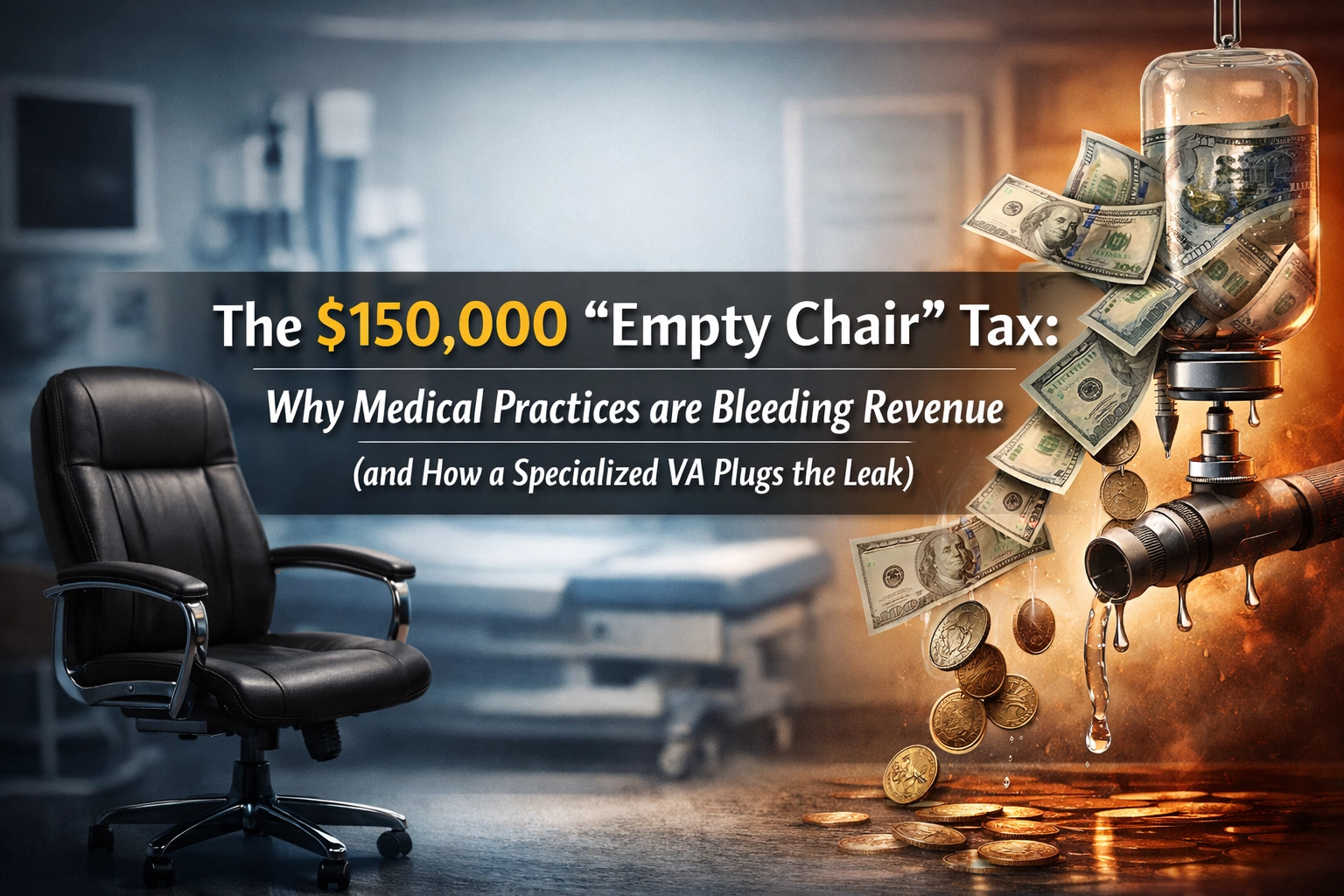
Every empty chair in your medical practice is a silent revenue killer.A dentist misses a $2,500 crown appointment because the patient didn't show up. A dermatologist's chair sits vacant for an hour: that's a $600 Botox treatment that never happened. A physical therapist watches their 3 PM slot go unused because no one called to confirm the appointment.
The "Empty Chair Tax" isn't a government fee. It's the invisible cost of operational chaos: no-shows, last-minute cancellations, and missed patient callbacks that drain six figures from your bottom line every year.
For most practices, this isn't a minor inconvenience. It's a full-blown crisis.
The Math That Should Terrify Every Practice Owner
Let's break down what the average medical practice loses annually:
- No-show rate: 15-30% across most specialties (higher for MedSpas and elective procedures)
- Average appointment value: $350-$500
- Monthly appointments: 400-600 for a mid-sized practice
If your practice sees 500 appointments per month with a 20% no-show rate and an average value of $400:
500 appointments × 20% no-show rate = 100 missed appointments/month
100 missed appointments × $400 = $40,000/month in lost revenue
$40,000 × 12 months = $480,000/year
And that's just no-shows. Add in:
- Patients who couldn't get through on the phone and booked with a competitor
- Insurance verification delays that force appointment cancellations
- Follow-up appointments that never get scheduled
- New patient inquiries that go unanswered for 48+ hours
Suddenly, you're staring at a $150,000+ annual leak that no one is actively plugging.
Why Your Front Desk Can't Fix This (Even If They Tried)
Here's the uncomfortable truth: Your front desk staff isn't failing you. They're drowning.
Walk into any busy practice at 9 AM on a Tuesday and watch what happens:
- Phone rings while they're checking in a patient
- Insurance verification request comes in via fax
- Patient walks up asking about their bill
- Doctor needs a chart pulled immediately
- Another patient calls to reschedule
Your front desk is playing Whac-A-Mole with a hundred competing priorities. And when they're forced to choose between the patient standing in front of them and the one calling to book an appointment, the phone loses every time.
The result?
- Voicemails sit unanswered for 6+ hours
- Appointment confirmations don't happen until it's too late
- No-show follow-ups never get made
- New patient leads go cold
It's not a staffing problem. It's a capacity problem. And throwing more in-house staff at it only increases your overhead without solving the root issue.
The Hidden Costs You're Not Tracking
The "Empty Chair Tax" isn't just about the missed appointment revenue. It's the compounding damage that happens when operational chaos becomes your normal:
1. Provider Burnout
When your hygienist shows up expecting a full day and half the schedule is no-shows, morale tanks. Providers start questioning whether the practice is thriving or dying.
2. Patient Churn
When a patient calls three times and can't get through, they don't wait. They call the practice down the street. You just lost a $10,000 lifetime patient value because your phone went to voicemail.
3. Reputation Damage
Online reviews don't forgive poor communication. "I called five times and no one answered" is a one-star review waiting to happen.
4. Stress-Induced Errors
Overwhelmed staff make mistakes. Double-booked appointments. Wrong insurance verifications. Missed lab results. These errors cost time, money, and patient trust.
The "tax" isn't just financial: it's operational, emotional, and reputational.
Why a Specialized Healthcare VA is the Only Real Solution
You don't need more bodies in your office. You need dedicated, HIPAA-trained professionals whose sole job is patient coordination: nothing else.
Enter the Healthcare Virtual Assistant.
Not a generalist VA who "can help with admin tasks." Not a chatbot that handles basic FAQs. A specialized Patient Coordinator who understands medical terminology, HIPAA compliance, and the empathy required to work with patients who are scared, confused, or in pain.
What a Healthcare VA Actually Does
A properly trained Healthcare VA becomes your practice's retention engine:
1. Proactive Appointment Confirmations
They call every patient 48 hours before their appointment. If the patient can't make it, they re-book immediately: filling that chair before it ever goes empty.
2. No-Show Recovery
When a patient misses an appointment, your VA calls within 2 hours. Not to scold them: but to reschedule with empathy. "We missed you today! Let's find a time that works better for you."
3. New Patient Intake & Follow-Up
Every inquiry gets a callback within 30 minutes. Every new patient gets a welcome call explaining what to expect. First impressions are handled with care.
4. Insurance Verification & Pre-Authorization
Your VA takes over the soul-crushing task of verifying insurance before every appointment: eliminating the last-minute cancellations that happen when a patient shows up and realizes they're not covered.
5. EHR/EMR Mastery
They're trained on your specific system: whether it's Jane, ModMed, DrChrono, Athenahealth, or AdvancedMD. They don't just "use" the software. They master it.
The Human Touch That AI Can't Replicate
Let's be clear: This isn't about bots, automation, or "AI assistants."
When a patient calls because they're terrified about an upcoming biopsy, they don't want to talk to a machine. They need a human voice that listens, reassures, and books them with care.
When a mother is trying to schedule a pediatric appointment while juggling two screaming kids in the background, she needs someone who understands and doesn't rush her off the phone.
Healthcare is intimate. It's personal. It requires empathy, judgment, and trust: things that only a trained human can deliver.
A Healthcare VA is that human. They're not in your office, but they're an extension of your team. Patients don't know they're offsite: they just know someone answered the phone with warmth and professionalism.
Real Results from Real Practices
Here's what happens when practices bring on a specialized Healthcare VA:
Case 1: Family Medicine Practice (3 Providers)
- Before VA: 22% no-show rate, averaging 88 missed appointments per month
- After VA: 9% no-show rate, dropping to 36 missed appointments per month
- Revenue recovered: $20,800/month ($249,600/year)
Case 2: MedSpa (2 Locations)
- Before VA: Phone answer rate of 62% during business hours
- After VA: Phone answer rate of 97%
- New patient conversion: Increased by 34% in 90 days
- Revenue impact: $32,000 additional monthly revenue from captured leads
Case 3: Dental Practice (Solo Practitioner)
- Before VA: 18% no-show rate, no follow-up system
- After VA: 7% no-show rate, automated confirmation + same-day re-booking
- Annual revenue saved: $127,000
These aren't hypothetical projections. These are real practices that plugged the leak.
The ROI is Immediate (and Measurable)
A Healthcare VA isn't a cost. It's a revenue protection tool that pays for itself in the first month.
Here's the math:
- Cost of a full-time in-house Patient Coordinator: $40,000-$55,000/year + benefits + training
- Cost of a Healthcare VA: $15,000-$24,000/year
ROI Scenario:
If your VA prevents just 10 no-shows per month at an average appointment value of $400:
- Revenue saved: 10 × $400 = $4,000/month
- Annual revenue saved: $48,000
If your VA costs $2,000/month ($24,000/year), you're netting $24,000 in pure recovered revenue: and that's only counting no-show prevention. Add in the new patients captured, insurance errors avoided, and reputation protection, and the ROI skyrockets.
What Makes a Healthcare VA "Specialized"?
Not all VAs are created equal. A Healthcare VA requires:
- HIPAA Training & Compliance: They handle PHI (Protected Health Information) daily. They must understand privacy laws inside and out.
- Medical Terminology Fluency: They're not Googling "rhinoplasty" mid-call. They speak the language.
- EHR/EMR Proficiency: Trained on your specific system before day one.
- Empathy Under Pressure: Patients call when they're scared, frustrated, or in pain. Your VA needs emotional intelligence.
- Proactive Communication: They don't wait for problems. They prevent them.
This level of specialization is what separates a true Healthcare VA from a generic "admin assistant."
Your Next Step: The Practice Efficiency Audit
If you're reading this and thinking, "This is exactly what we need," here's what to do next:
Book a free 30-minute Practice Efficiency Audit.
We'll walk through:
- Your current no-show rate and revenue leak
- Where your front desk is getting overwhelmed
- How a Healthcare VA would integrate with your specific EHR/EMR system
- What your ROI would look like in the first 90 days
No sales pitch. No pressure. Just a clear-eyed assessment of whether a Healthcare Virtual Assistant makes sense for your practice.
Final Thought: Every Empty Chair is a Choice
You can keep accepting the "Empty Chair Tax" as the cost of doing business. Or you can plug the leak with a specialized professional whose only job is to make sure every chair is filled, every patient is cared for, and every dollar is protected.
The math doesn't lie. The solution is clear.
The only question left: How much longer are you willing to let $150,000 walk out the door?