

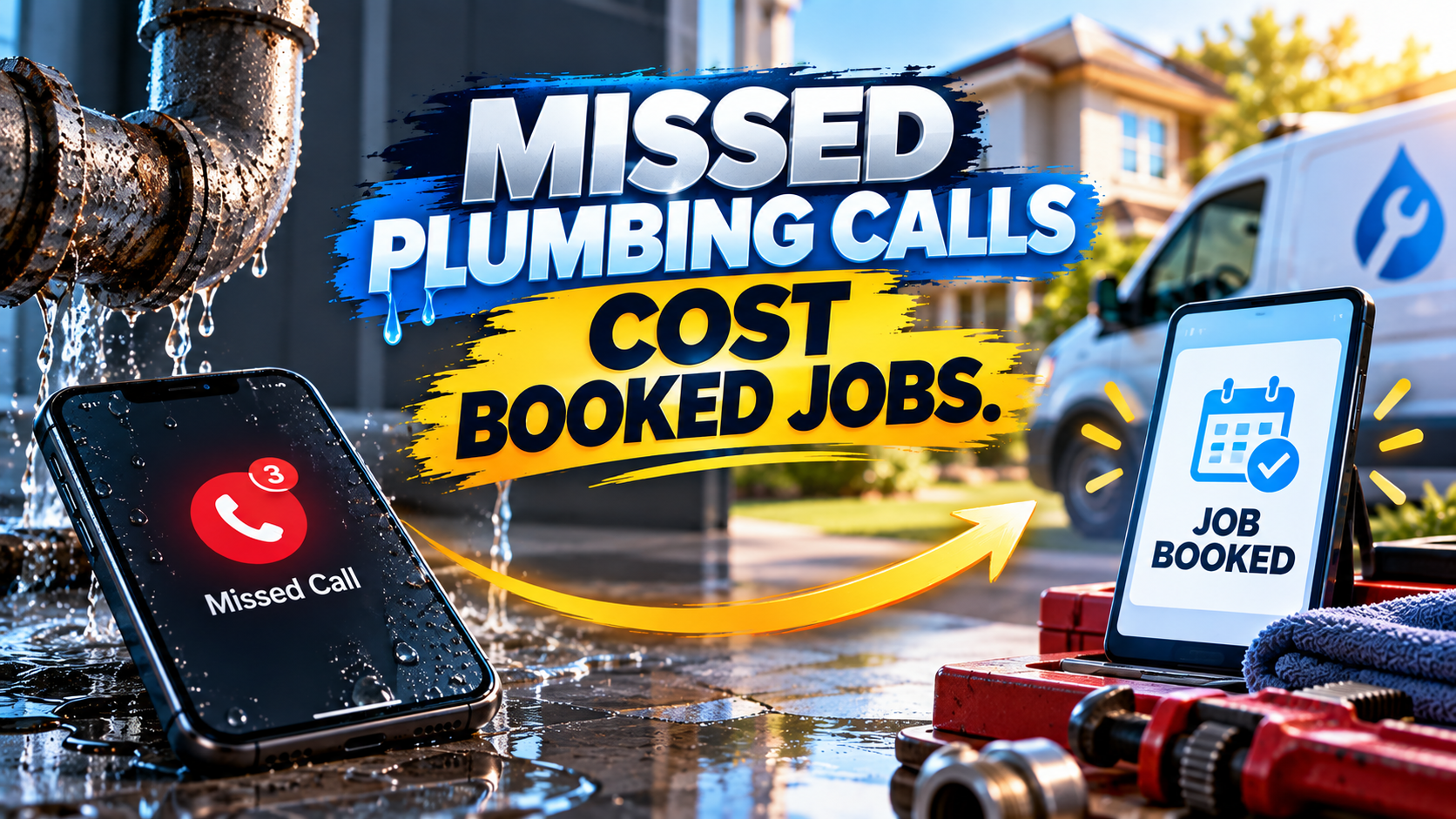
A missed plumbing call is rarely just a missed conversation. It can be a lost emergency job, a canceled water-heater replacement, or a customer who hires the next company in Google results.
Some contractor benchmarks place missed-call rates near 58%, especially during peak hours and after-hours coverage. Treat that figure as a planning benchmark, not a universal industry fact.
What is a plumbing virtual assistant?
rnA plumbing virtual assistant is a trained remote professional who handles call intake, scheduling, dispatch coordination, estimate follow-up, invoicing support, and customer communication. The goal is simple: respond faster, protect booked work, and keep your technicians focused on field service.
The 58% Problem: What Missed Calls Cost a Plumbing Company
A plumbing business can lose revenue before a technician ever receives a dispatch notification.
Commonly cited contractor data suggests that:
- Plumbing companies may miss approximately 58% of calls during busy periods.
- A two- to five-truck company may lose around $85,000 per year from unanswered calls, depending on average ticket size and call volume.
- Fewer than 3% of callers may leave a voicemail after an unanswered call.
- Approximately 78% of buyers may choose the first company that responds.
- Emergency jobs can be worth three to five times more than routine service calls.
Use these figures as a starting point for your own measurement. Review your phone logs for seven days. Count missed calls, after-hours calls, returned calls, booked jobs, and average ticket value.
The Plumbing-Heating-Cooling Contractors Association emphasizes professional education, advocacy, and stronger business practices across the trade. That same operational discipline must apply to your front office. A great technician cannot recover a customer who already hired someone else.
The Five-Minute Rule: Why Speed Decides Who Gets the Job
Lead-response research has consistently shown that speed affects qualification and conversion. The frequently cited 21-times-more-likely figure for responding within five minutes varies by study and lead type, so mark it before using it in formal reporting.
The practical lesson remains reliable: respond while the customer is still actively searching.
For a plumbing owner, a five-minute delay can mean:
- The homeowner calls two competitors.
- The customer stops answering unknown numbers.
- An emergency becomes a different company’s service ticket.
- A web lead grows cold before anyone reads it.
- A technician loses a profitable job slot.
The Harvard Business Review lead-response research reinforces the business case for rapid follow-up. Set a five-minute response target for every missed call, web form, text inquiry, and estimate request.
What Does a Plumbing Virtual Assistant Actually Do?
Assign revenue-protecting work first. A plumbing virtual assistant can handle:
- Answering inbound calls and collecting customer details.
- Identifying emergency indicators such as burst pipes, sewage backups, and active flooding.
- Booking appointments in ServiceTitan, Housecall Pro, or Jobber.
- Coordinating dispatch information without overriding service-manager judgment.
- Following up on open estimates and unbooked jobs.
- Sending appointment confirmations and arrival updates.
- Checking completed tickets for missing notes, photos, or customer details.
- Supporting invoice preparation, payment reminders, and accounts receivable.
- Tracking permits, warranties, memberships, and maintenance reminders.
- Preparing daily reports on missed calls, response times, booking rates, and open follow-ups.
Can a VA Handle the 2 a.m. Burst-Pipe Call?
Yes, if you provide clear scripts and escalation rules.
Give the assistant an approved intake script. Require the assistant to capture the caller’s name, address, callback number, problem description, water shutoff status, property type, and immediate safety concern.
Escalate immediately when the call involves:
- Active flooding or major property damage.
- Sewage exposure.
- Gas odor or suspected gas-line damage.
- Electrical hazards near standing water.
- Commercial facilities with critical operations.
- A customer requesting a price, refund, or exception outside the approved policy.
Keep emergency priority judgment, pricing approval, technician assignment judgment, and safety decisions with the owner, service manager, or qualified dispatcher.
What a Plumbing VA Never Does
Protect your business with firm boundaries. A plumbing virtual assistant should not:
- Diagnose a plumbing problem.
- Promise a repair outcome.
- Approve discounts or final pricing.
- Decide which technician receives a complex job.
- Give safety instructions beyond your approved script.
- Override on-call or emergency escalation rules.
- Represent a licensed plumber.
- Collect sensitive payment information outside your approved system.
Use role-based access and individual logins. Review call notes and booking decisions during the first two weeks.
Seven SOPs to Stop Missed-Call Revenue Loss
SOP 1: Missed-Call Response
Goal: Contact every missed caller within five minutes.
- Review the call log.
- Call the customer back.
- Send an approved text if unanswered.
- Record the response time.
- Book or escalate the request.
- Mark the outcome.
SOP 2: Emergency Intake
Goal: Capture urgent details without making technical decisions.
- Confirm the property address.
- Ask the approved triage questions.
- Identify immediate hazards.
- Notify the approved contact.
- Record the escalation.
- Confirm the next communication step.
SOP 3: New Lead Booking
Goal: Convert qualified inquiries into scheduled visits.
- Confirm service area.
- Capture the problem description.
- Offer approved time windows.
- Verify customer contact details.
- Enter the appointment.
- Send confirmation.
SOP 4: Estimate Follow-Up
Goal: Prevent open estimates from disappearing.
- Pull open estimates daily.
- Sort by age and value.
- Send the approved first follow-up.
- Call unresolved opportunities.
- Record objections.
- Escalate high-value opportunities.
SOP 5: Completed Ticket Review
Goal: Reduce billing delays and missing job information.
- Review completed tickets.
- Check notes and photos.
- Confirm parts and labor entries.
- Flag missing approvals.
- Route the ticket for billing.
- Update the completion status.
SOP 6: Membership and Warranty Desk
Goal: Protect recurring service revenue.
- Review upcoming renewals.
- Identify overdue inspections.
- Contact customers using approved messaging.
- Schedule eligible visits.
- Update membership records.
- Report unresolved accounts.
SOP 7: Daily Performance Report
Goal: Show whether response speed improves results.
- Count inbound calls.
- Count missed calls.
- Calculate average response time.
- Record booked jobs.
- List open estimates.
- Send the report to management.
How Fast Can You Go Live?
Follow a focused seven- to ten-day launch:
- Days 1–2: Define responsibilities, escalation rules, access levels, and reporting.
- Days 3–5: Train the assistant on scripts, service areas, software, and booking standards.
- Days 6–8: Pilot missed-call response or estimate follow-up.
- Days 9–10: Review call notes, refine SOPs, and expand the task list.
Start with one revenue leak. Do not hand over every office process on day one.
What Does a Plumbing Virtual Assistant Cost?
Virtual Nexgen Solutions provides plumbing virtual assistant support at $8 per hour.
Using 4.33 weeks per month:
- 10 hours per week: approximately $346.40 per month
- 20 hours per week: approximately $692.80 per month
- 40 hours per week: approximately $1,385.60 per month
Compare that investment with the cost of an in-house administrative employee, including payroll taxes, benefits, equipment, recruiting, and paid time off. Use BLS customer service representative data as one reference point when reviewing local staffing costs.
Case Study: Plumbing Company in Texas
A four-truck plumbing company reviewed seven days of phone records and found that missed calls clustered around lunch, late afternoons, and weekends. The owner modeled 12 missed calls per week at a $550 average opportunity value.
A plumbing virtual assistant was assigned to call intake, missed-call response, and estimate follow-up. The company then tracked response time, booked calls, and recovered estimates for 60 days. The modeled opportunity value exceeded the monthly support cost. This is an illustrative scenario, not a client claim.
Case Study: Plumbing Contractor in Ohio
A nine-truck contractor had two office employees but no consistent process for returning missed calls. Management created a five-minute response target, a clear emergency escalation script, and a daily performance report.
The virtual assistant handled first response and documentation while the service manager retained dispatch and pricing decisions. The company used the report to compare answer rate, response time, and booked jobs over 90 days. This is an illustrative scenario, not a client claim.
How Should You Measure Success in 30, 60, and 90 Days?
Track operational results before making assumptions about revenue.
Within 30 days, measure:
- Missed-call count.
- Average callback time.
- Percentage of calls documented.
- Appointment confirmation completion.
- Open estimate follow-up completion.
Within 60 days, measure:
- Booking rate by lead source.
- Emergency-call capture.
- No-show rate.
- Estimate conversion by follow-up stage.
- Invoice submission delays.
Within 90 days, measure:
- Revenue from recovered opportunities.
- Average ticket value.
- Invoice aging.
- Technician utilization.
- Cost per booked opportunity.
Review results weekly. Change one workflow at a time.
Frequently Asked Questions
How fast should a plumbing company answer a missed call?
Set a target of returning the call within five minutes. For active emergencies, aim for immediate live response or rapid escalation under your approved safety protocol.
How much money do plumbers lose from missed calls?
The amount depends on call volume, average ticket value, season, and emergency mix. Contractor estimates range widely. Build your own estimate by multiplying missed qualified calls by average booked-job value. Industry figures such as $85,000 per year for smaller shops require verification.
Can a plumbing virtual assistant answer emergency calls?
Yes. A trained assistant can collect approved intake details, identify escalation triggers, notify the responsible manager, and document the call. Keep safety, diagnosis, pricing, and technician assignment decisions with qualified personnel.
How much does a plumbing virtual assistant cost?
Virtual Nexgen Solutions charges $8 per hour. A 20-hour weekly schedule equals approximately $692.80 per month using 4.33 weeks per month.
How fast can a plumbing virtual assistant start?
A focused program can go live in seven to ten days after scope, access, scripts, training, and pilot tasks are approved.
Stop Paying Competitors for Your Missed Calls
Protect every qualified inquiry before it becomes someone else’s service ticket. Book a consultation with Virtual Nexgen Solutions to review your missed-call volume, response-time gaps, and best first workflow.
Work With Virtual Nexgen Solutions
If your business needs dependable virtual assistant support, Virtual Nexgen Solutions can provide support around your existing workflow. Book a discovery call today.
Get in Touch Now!