

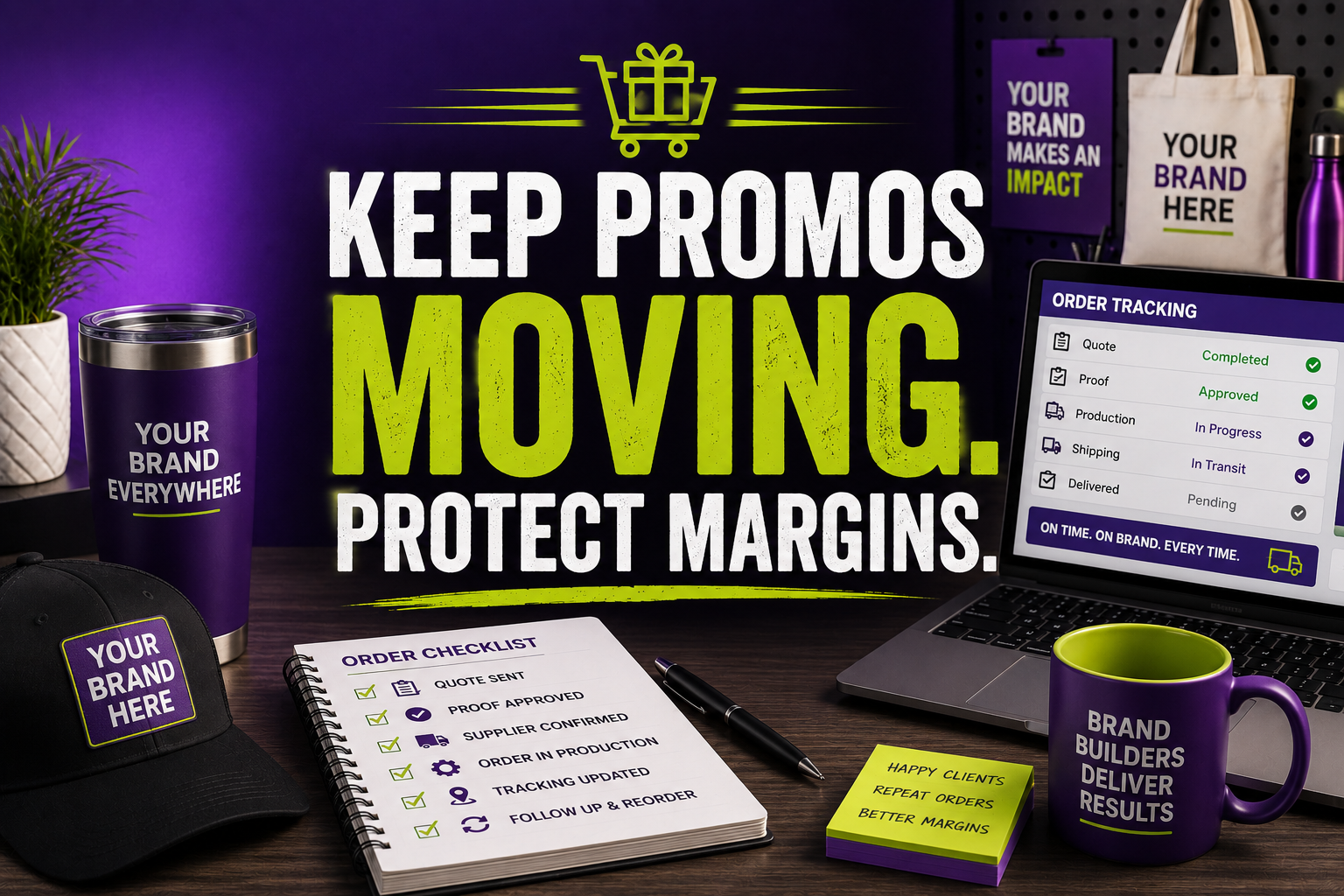
A corporate client orders 1,000 branded tumblers for a conference in Dallas. The quote looks good. The margin looks acceptable. The in-hands date is tight but possible.
Then the order stalls.
Sales assumes the supplier received the purchase order. The supplier is waiting for final artwork. The decorator has a question about imprint placement. Shipping does not have the correct ship-to address. Meanwhile, the client believes everything is moving.
A promotional products virtual assistant gives you an owner for the handoffs. The salesperson still owns pricing and the client relationship. The decorator still owns production quality and technical specifications. The VA coordinates the information between them so the order does not disappear into inbox limbo.
The Promo Order Lifecycle, From Quote to Reorder
Every promotional products company has a fulfillment lifecycle, even if it lives across email threads, supplier portals, spreadsheets, and memory.
Quote and specification begins with the product choice, quantity, decoration method, colors, imprint locations, packaging requirements, ship-to details, and in-hands date. Margin often disappears here when the order record lacks a complete specification. A missing second imprint or rush freight charge can turn a profitable quote into a painful exception.
Order entry and deposit converts the approved quote into a job that the team can execute. Capture the client purchase order, deposit status, billing contact, tax details, delivery address, and internal owner. Keep the salesperson responsible for commercial terms. Have the VA verify that the operational record matches the approved quote before anyone places the order.
Vendor placement and production requires accurate supplier communication. Send the correct product code, color, quantity, decoration method, proof requirements, and requested delivery date. Track supplier acknowledgments and flag any conflict between the promised date and the client’s event date. Do not assume a supplier’s silence means acceptance.
Artwork and proofing creates another common delay. Confirm that the correct logo, PMS colors, imprint size, and imprint location reach the decorator. Route proofs to the client only after an internal check. Store written approval with the order record. Your artwork bottleneck guide provides additional context on this high-friction stage.
Quality check and packing sits with the production or decorating team. The VA does not approve print quality or make technical production decisions. Instead, the VA confirms that the decorator’s status, quantity notes, packing instructions, and exception details are recorded and communicated.
Shipping and tracking protects the customer experience after production ends. Verify the ship-to address, carrier, service level, carton count, tracking number, and expected arrival. Send a clear update when the shipment leaves the supplier. Correct tracking information can prevent a routine delivery from becoming a client escalation.
Invoice and credit closes the financial loop. Match the supplier invoice, freight, setup charges, client invoice, deposit, and payment terms. Route pricing discrepancies to the salesperson or manager. Have the VA prepare the information; keep approval authority with the appropriate owner.
Reorder and account care turns a one-time order into account value. Save the approved proof, supplier, product code, colors, quantities, packaging notes, and delivery history. Contact the client after the event and record the likely next buying date. A reorder should not feel like a brand-new investigation.
Why Promo Orders Go Sideways
Promo orders rarely fail because one person is careless. They fail because responsibility is scattered.
A product specification may list navy blue while the client expects a specific PMS color. A size breakdown may omit youth apparel. A proof may sit unanswered for four days. A supplier deadline may pass while the salesperson is traveling. A shipping address may contain the wrong suite number. Tracking may exist but never reach the client. The invoice may wait until someone remembers the job.
A promotional products virtual assistant supports these handoffs without becoming the salesperson or decorator. The VA checks for missing fields, requests status updates, logs approvals, follows up on open questions, and escalates decisions that require commercial or production judgment.
The Fulfillment Desk: Capture, Confirm, Coordinate, Track, Close
The desk starts with Capture. The VA gathers the quote, purchase order, artwork, delivery requirements, payment terms, and event date into one working record.
During Confirm, the VA checks that the operational details agree. Confirm product codes, quantities, colors, imprint locations, proof status, ship-to information, and ownership. Flag gaps before the supplier receives incomplete instructions.
Coordinate connects sales, the supplier, decorator, client, and finance team. The VA sends concise updates, records responses, and escalates exceptions. Keep the salesperson focused on client trust and commercial decisions.
With Track, the VA monitors proof approval, production, estimated ship date, tracking, delivery, and client communication. Use deadline-based escalation when an order approaches its in-hands date.
Finally, Close means matching delivery confirmation, invoice status, final documents, and client feedback. Archive the approved specifications so the next order moves faster.
Two Operational Examples
An anonymized promotional products distributor in Ohio handled approximately 75 active orders each month. Before support began, 18 orders regularly lacked a current supplier status, and proof approvals took an average of 3.6 business days. After a VA managed the fulfillment queue, unresolved status items fell to 5, and average proof follow-up time dropped to 1.4 business days over eight weeks.
An anonymized corporate-gift supplier in California processed recurring employee welcome kits for technology clients. Reorders were inconsistent because prior product specifications were stored across email threads. After the VA built client-specific order records and tracked reorder windows, the team reduced repeat-order preparation from about 90 minutes to 25 minutes per account across a 30-day measurement period.
Industry Software Used by the Fulfillment Desk
A VA can work inside your existing stack rather than forcing a disruptive software change. Common tools include:
- Salesforce or HubSpot: opportunity stages, client records, order ownership, and follow-up notes.
- Zoho: quotes, customer records, task management, and order communication.
- QuickBooks: invoices, deposits, payment status, and supplier bill matching.
- ShipStation or Stamps.com: shipping labels, tracking, and delivery updates.
- Google Workspace: shared order folders, proofs, email, calendars, and client documents.
- Asana or Trello: production milestones, exceptions, due dates, and handoffs.
- Supplier portals: product availability, order acknowledgments, proof requests, and shipment status.
- SAGE or ESP+: product research and sourcing support where your team already uses them.
What Does a Promotional Products Virtual Assistant Cost?
Virtual Nexgen Solutions provides promotional products support at $8 per hour. That gives you a flexible way to staff order coordination without immediately committing to a full-time local hire.
An in-house promo sales support or order coordinator may cost approximately $40,000 to $55,000 per year before payroll taxes, benefits, recruiting, office costs, and coverage for vacation or turnover. The Bureau of Labor Statistics administrative assistant data provides a useful labor-market benchmark.
Use the VA for repeatable coordination work. Keep pricing, client relationship decisions, production quality, and exception approvals with your experienced team.
A Practical 30-Day Build-Out
Days 1–5: Map your current quote-to-reorder process. Identify every handoff, required field, deadline, and escalation owner.
Days 6–10: Create the order record structure. Add product specifications, artwork status, supplier details, ship-to information, payment status, and reorder notes.
Days 11–15: Train the VA inside your CRM, accounting platform, shared folders, project board, and supplier portals.
Days 16–22: Run the desk on a controlled group of active orders. Review missed fields, unclear ownership, and supplier response gaps.
Days 23–30: Expand coverage, measure proof turnaround and open-order aging, and refine escalation rules with your salesperson and decorator.
Use the article to educate first, demonstrate operational fit second, and present the $8/hour service only after the reader understands the fulfillment gaps. Keep the final conversion message focused on reviewing the reader’s quote-to-reorder workflow with Virtual Nexgen Solutions.
FAQ
What does a promotional products virtual assistant do?
A promotional products virtual assistant coordinates order information, supplier follow-up, artwork approvals, production updates, shipping details, invoice status, and reorder reminders. The VA supports the workflow while your salesperson owns pricing and client relationships, and your decorator owns print quality and technical production decisions.
How can a virtual assistant help a promotional products distributor?
A VA helps a promotional products distributor keep every order record complete, monitor supplier deadlines, follow up on proofs, confirm ship-to details, update customers, and prepare reorder records. This reduces handoff confusion and gives sales staff more time for selling and account development.
Can a promotional products virtual assistant manage artwork approvals?
Yes. A VA can collect artwork, confirm that required files and specifications are present, request supplier proofs, send proofs to clients, track written approvals, and file approved versions. The decorator or production specialist must retain responsibility for technical print quality and final production decisions.
How much does a promotional products virtual assistant cost?
Virtual Nexgen Solutions provides promotional products virtual assistant support at $8 per hour. Your total cost depends on order volume, software access, coverage hours, supplier coordination needs, and whether you need part-time or dedicated support.
What software can a promotional products virtual assistant use?
A VA can work in Salesforce, HubSpot, Zoho, QuickBooks, ShipStation, Stamps.com, Google Workspace, Asana, Trello, supplier portals, SAGE, and ESP+ where appropriate. Train the VA inside your existing systems and define access by role.
Should the salesperson or VA own promotional product pricing?
The salesperson or designated manager should own pricing, discount decisions, margins, and client relationships. The VA should prepare information, verify operational details, track approvals, and escalate exceptions without changing commercial terms independently.