

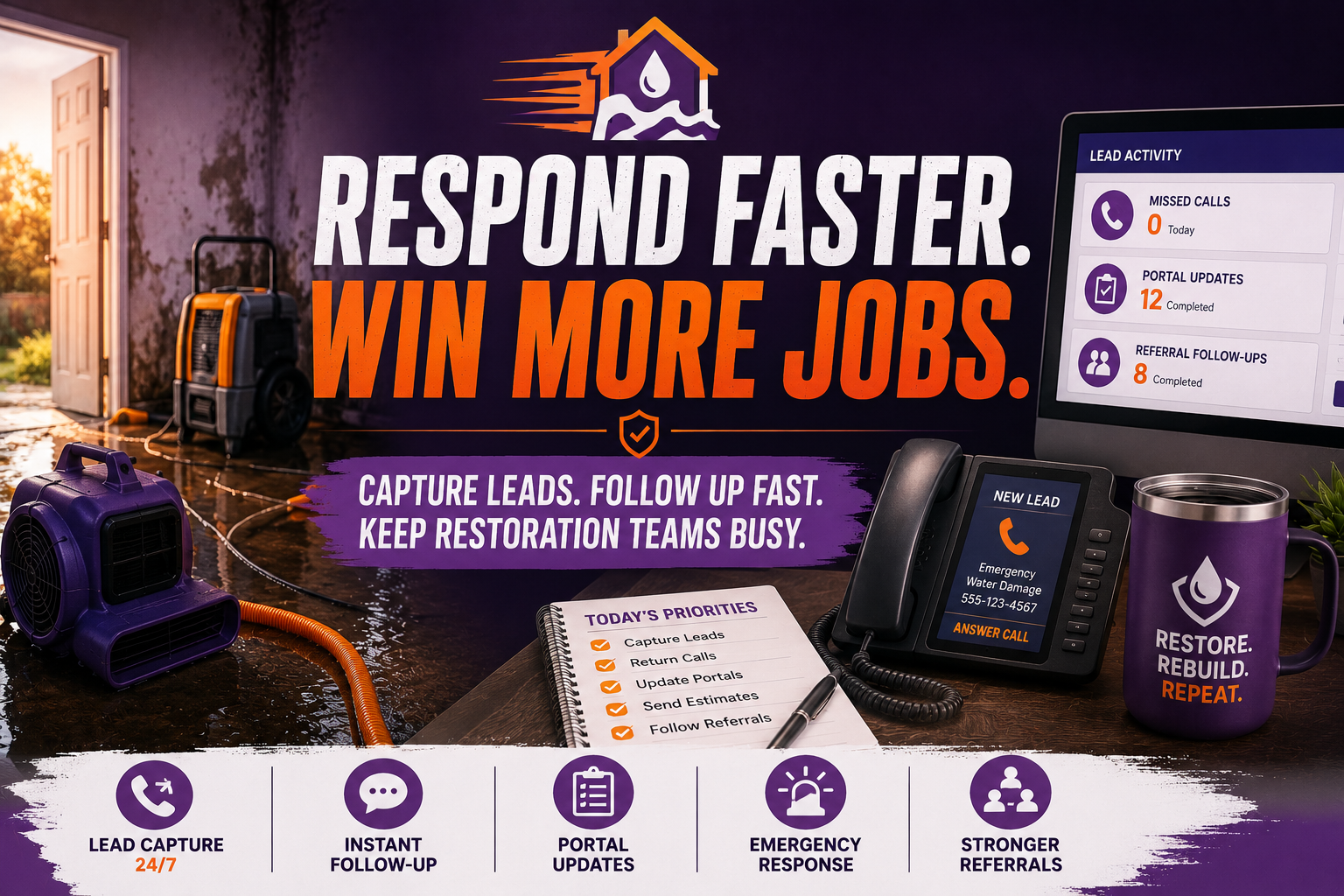
A pipe bursts in a Texas home at 2:00 a.m. The homeowner calls three restoration companies. One answers immediately. One returns the call after breakfast. One never responds. The first company earns the inspection because it created confidence before discussing price.
That is where a restoration virtual assistant becomes more than an office resource. The right assistant protects the first contact, records the assignment correctly, follows the required communication path, and keeps the relationship warm after the emergency ends.
For a water, fire, mold, or storm restoration company, lead response is not only a marketing issue. It affects crew utilization, insurance referrals, TPA standing, customer reviews, and revenue predictability.
The Five Lead Sources That Decide Restoration Revenue
Insurance referrals and carrier programs
Carrier and managed-repair programs send work to contractors who meet their credentialing, geographic, communication, and performance requirements. Your team must accept assignments, contact the policyholder, document status changes, and follow each program’s service-level agreement.
A restoration virtual assistant can monitor assignment notifications, confirm receipt, capture claim and policy details, and escalate urgent jobs to the right field manager. Keep technical decisions with qualified restoration professionals. Give the field team a complete intake summary before dispatch.
Review your last 20 insurance assignments. Identify where acceptance, first contact, authorization, or status updates slowed down.
TPA networks
Third-party administrators such as Contractor Connection, Alacrity, Sedgwick, and Crawford manage vendor networks for insurance-related property claims. Their requirements vary, so never treat one portal or scorecard as universal.
Your assistant can maintain a TPA-specific requirements register. Track portal credentials, service areas, assignment windows, required photos, estimate deadlines, customer updates, and closeout documents. Use the RIA TPA Scorecard resources to understand how contractors evaluate program value, administrative demands, claims processes, and support.
Protect your score by documenting every meaningful event, not only the final invoice.
Emergency dispatch and restoration platforms
Direct emergency calls, web forms, Google Business Profile messages, and restoration platforms create high-intent opportunities. The person who answers must sound calm, gather the facts, and move the caller toward the next safe step.
A virtual assistant can monitor the main line, emergency inbox, web forms, and assignment feeds. Capture the loss type, address, occupancy, visible hazards, water source, affected areas, insurance details, and best contact method. Escalate safety concerns immediately. Do not provide technical advice beyond your approved script.
Adjuster and public-adjuster relationships
Adjusters, public adjusters, property managers, plumbers, roofers, and facility managers can become repeat referral sources. Relationships fade when follow-ups depend on memory.
Build a contact record for every referral partner. Record territory, specialties, preferred communication method, recent jobs, open questions, and the last meaningful interaction. Send useful updates, not generic sales messages. Share service-area changes, certification updates, completed project summaries, or capacity notices.
Ask your assistant to prepare a monthly relationship report that shows who referred work, who needs follow-up, and which partnerships have gone quiet.
Local and online demand
Homeowners search for “water damage restoration company,” “emergency restoration services,” and “mold remediation near me” when the situation feels urgent. Your Google Business Profile, website, reviews, phone coverage, and response process must work together.
A virtual assistant can monitor new reviews, route calls, update lead records, request legitimate feedback after completed work, and flag inaccurate business information. Follow Google’s guidance for business reviews. Never offer incentives for reviews or pressure customers to remove honest criticism.
The Response-Time Math
Response speed works because emergencies create uncertainty. A homeowner wants to know three things: Did someone receive the call? Does this company understand the situation? What happens next?
A fast first contact answers those questions before anxiety pushes the customer toward another provider. A fast callback also gives you a chance to capture accurate information while the details are fresh.
For insurance and TPA assignments, the mechanism is slightly different. The assignment may already belong to your company, but slow acceptance, incomplete notes, or missed updates can affect trust and future allocation. Track three separate moments: assignment receipt, first human contact, and mitigation or inspection start.
Do not promise a universal five-minute or two-hour standard. Check each carrier, TPA, and local operating requirement. Then staff your desk around the most demanding window you actually serve.
The Referral Relationship Desk
Capture begins when a call, form, review, email, or portal assignment arrives. Your assistant identifies the source, creates or updates the record, and checks for duplicates.
Respond means acknowledging the opportunity, using the approved intake language, and escalating safety, access, or high-severity concerns. Keep the customer informed without making coverage, pricing, or technical promises.
Document means time-stamping contact attempts, recording claim identifiers, attaching photos or forms received, and noting who owns the next action. Align water-loss workflows with the ANSI/IICRC S500 standard where applicable, while leaving technical judgments to trained personnel.
Follow up means contacting the policyholder, adjuster, TPA, or referral partner at the agreed interval. Chase missing authorizations, portal updates, inspection confirmations, and customer feedback before they become bottlenecks.
Report means showing response time, acceptance rate, contact completion, assignment source, open follow-ups, review trends, and referral activity. Give owners a weekly view of where revenue is entering and where it is stalling.
An anonymous case study illustrates the value. A P&C restoration contractor in Texas received 46 monthly emergency inquiries but had no dedicated after-hours desk. After a Virtual Nexgen Solutions assistant organized calls, web forms, and referral follow-ups, the company recorded 39 completed first contacts in the first month, up from 24, and reduced unassigned leads from 11 to 3.
A second anonymized case involved a mold remediation company serving Colorado and Arizona. Its assistant maintained TPA deadlines and adjuster follow-ups across two locations. In 60 days, overdue relationship tasks fell from 31 to 7, while completed referral-partner conversations increased from 8 to 26 per month. Results vary by market, staffing, lead quality, and program rules.
Industry Software Your Assistant Can Support
Use the systems you already own. A restoration virtual assistant can update Jobber, ServiceTitan, DASH, or iRestore; monitor approved carrier and TPA portals; maintain Google Business Profile information; organize review-platform activity; prepare DocuSign authorization packets; and manage Google Workspace inboxes, calendars, folders, and reporting files.
Where your team uses Xactimate, give the assistant a coordination role around estimate status, missing documents, submission dates, and follow-up. Do not delegate scope judgment or technical estimating authority without appropriate training and supervision.
$8/hr Versus an In-House Coordinator
Virtual Nexgen Solutions provides VA support at $8 per hour. A 160-hour month equals $1,280 before any agreed service adjustments, or $15,360 across twelve months.
An in-house marketing or office coordinator may cost approximately $45,000 to $60,000 in salary before payroll taxes, benefits, equipment, recruiting, training, and coverage during absences. BLS wage data and SHRM workforce research show why total staffing cost extends beyond the advertised salary.
Compare both options against the revenue value of answered calls, cleaner assignments, stronger relationships, and fewer missed follow-ups. Keep licensed, technical, and final operational decisions with your internal team.
Build the Desk in 30 Days
Days 1–5: Map every lead source, emergency number, referral channel, portal, territory, and escalation contact.
Days 6–12: Configure intake fields, approved scripts, contact tags, response expectations, folder rules, and handoff notes.
Days 13–20: Begin live monitoring for selected channels. Review every record for accuracy, response time, and next-action ownership.
Days 21–30: Add referral reporting, review tracking, TPA deadline checks, and a weekly owner dashboard. Adjust coverage based on actual call volume and assignment patterns.
FAQ
What is a restoration virtual assistant?
A restoration virtual assistant is a remote professional who supports restoration company operations by handling lead intake, scheduling coordination, CRM updates, TPA portal follow-up, referral tracking, review monitoring, and documentation requests. The assistant supports your office and field team while licensed and technical decisions remain with qualified personnel.
How can a virtual assistant help a restoration company get more leads?
A virtual assistant helps you capture more existing demand by answering or routing calls, monitoring web forms, tracking Google Business Profile messages, recording referral sources, and following up with adjusters and property managers. The role improves lead handling and relationship consistency rather than replacing your restoration marketing strategy.
How do restoration companies get insurance leads?
Restoration companies get insurance leads through carrier programs, third-party administrator networks, adjuster relationships, property managers, plumbers, roofers, local search, referrals, and direct emergency calls. Your eligibility depends on geography, credentials, capacity, documentation quality, customer service, and each program’s participation requirements.
How do restoration companies get TPA leads?
Restoration companies get TPA leads by applying to approved vendor networks and meeting requirements for licensing, insurance, certifications, service areas, response capacity, documentation, and customer satisfaction. A virtual assistant can support portal monitoring, assignment acceptance, status updates, and deadline tracking after approval.
How fast should a restoration company respond to a lead?
A restoration company should respond as quickly as its approved staffing and service commitments allow, especially for active water, fire, mold, and storm losses. Set separate internal targets for call pickup, callback, assignment acceptance, inspection, and mitigation start. Always follow the applicable carrier, TPA, and local requirements.
What software do restoration virtual assistants use?
Restoration virtual assistants can work inside Jobber, ServiceTitan, DASH, iRestore, Google Workspace, DocuSign, Google Business Profile, review platforms, and approved carrier or TPA portals. Access should be limited to necessary functions, documented, secured, and reviewed by your management team.
How much does a restoration virtual assistant cost?
Virtual Nexgen Solutions’ restoration virtual assistant rate is $8 per hour. At 160 hours per month, that equals $1,280 before any agreed adjustments. Compare that cost with an in-house coordinator’s approximate $45,000–$60,000 salary, plus benefits, payroll costs, recruiting, equipment, and training.
Can a virtual assistant work with restoration company CRM and TPA portals?
Yes. A trained assistant can update your restoration CRM, monitor approved TPA portals, track assignment deadlines, prepare follow-up notes, organize documents, and report exceptions. Give the assistant role-based access and require management approval for coverage decisions, technical judgments, pricing, estimates, and final claim submissions.