
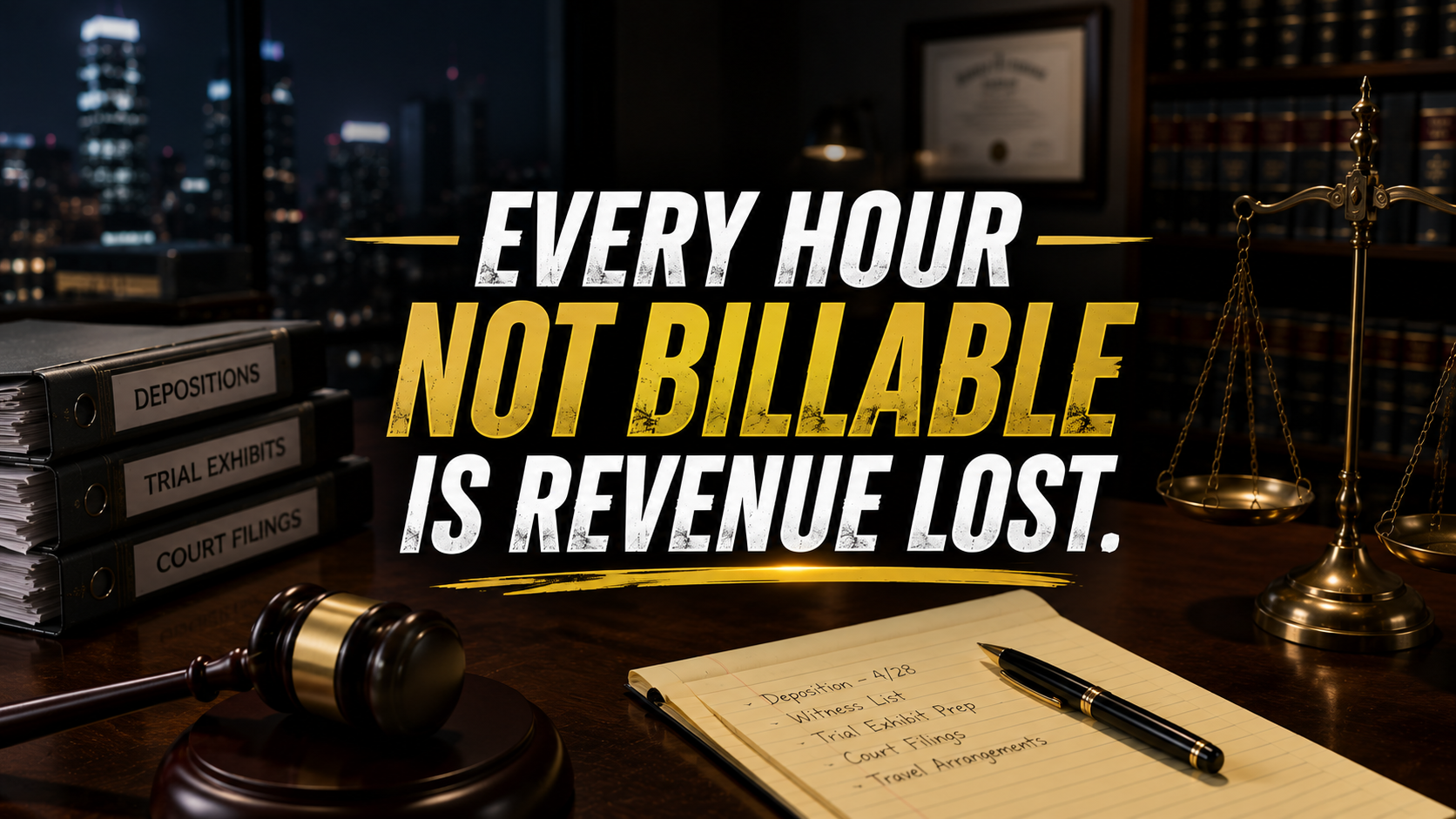
It is 2:00 AM. You are three days out from a major trial. Instead of refining your opening statement or identifying the fatal flaw in the opposing counsel's expert testimony, you are hunched over a heavy-duty stapler. You are frantically cross-referencing exhibit numbers, chasing down a missing medical record that was supposed to be in Volume 3, and wondering why the court reporter for Thursday’s deposition just sent a cancellation notice.
This is the "Trial Prep Fire Drill." It is a silent epidemic in litigation firms across the United States. While your billable rate might be $400, $600, or $900 per hour, you are currently performing $15-an-hour administrative labor. This isn't just exhausting; it is a massive drain on your firm’s profitability. When a senior partner spends ten hours a week on trial logistics, that is $5,000 in lost revenue every single week. Over a year, that is $250,000 in pure profit that vanished because of "Admin Debt."
At Virtual Nexgen Solutions, we see this pattern in every high-stakes litigation firm we audit. The problem isn't your legal talent; it's your operational engine. You are asking thoroughbreds to pull a plow. By integrating a specialized law firm virtual assistant into your trial lifecycle, you reclaim those hours, eliminate the 2 AM binder scrambles, and ensure that every deposition, expert witness, and exhibit is managed with surgical precision for just $8 per hour.
The Invisible Cost of Trial Prep Logistics
Most litigation partners underestimate the "coordination tax" required to move a case from discovery to verdict. You see the big milestones: the depositions, the hearings, the trial itself. What you don't see are the hundreds of micro-tasks that keep those milestones from collapsing.
Industry Problems: The Weight of Admin Debt
Admin Debt is the accumulation of necessary but non-billable tasks that pile up during a case. In a law firm, this debt is usually "paid" by the highest earners. If you don't have a dedicated system for logistics, you are likely suffering from:
- The Scheduling Cascade: One expert witness changes their availability, and suddenly you spend three hours re-coordinating the videographer, the court reporter, the opposing counsel, and the conference room booking.
- The Version Control Nightmare: You are at trial, and the exhibit in your binder doesn't match the digital version filed with the court because a last-minute redaction wasn't synced across all platforms.
- The Expert Witness Black Hole: Experts are notoriously busy. Chasing their CVs, fee schedules, and availability for prep calls can take 5 to 8 touchpoints per expert.
Industry Statistics: The Reality of Profit Leakage
The data is staggering. According to recent industry reports from Bloomberg Law and Clio, the average attorney works approximately 48 hours per week but only bills 36 of them. This means 12 hours a week, roughly 600 hours per year, are lost to non-billable administrative work.
For a litigation partner, the "logistics tax" is even higher. During active trial months, non-billable prep time can spike by 40%.
- $150,000+: The average amount of unrealized billable time per attorney, per year, due to administrative friction.
- $2,000 - $5,000: The typical cost of a last-minute court reporter or expert witness cancellation when you factor in the lost time and rescheduling chaos.
- 60%: The percentage of litigation attorneys who cite "trial prep logistics" as their primary source of burnout.
Revenue Leaks: Where Your Firm is Losing Cash
If you are not using a law firm virtual assistant, your firm is leaking revenue in three specific areas:
- Partner Opportunity Cost: Every hour a partner spends on a trial binder is an hour they aren't spent on business development or high-level strategy. If your billable rate is $500/hr and you spend 5 hours a week on logistics, you are losing $2,500 in potential revenue.
- Paralegal Overload: Paralegals are skilled professionals meant for substantive legal work like drafting motions and performing legal research. When they are relegated to scheduling depositions and Bates numbering, they become a bottleneck, delaying the billable work that actually moves the needle.
- Communication Chu : In the absence of a dedicated logistics coordinator, information lives in email threads and sticky notes. The time spent asking "Who booked the videographer?" or "Did the expert get the latest medical records?" is pure profit leakage.
Operational and Staffing Challenges
Many firms try to solve this by hiring more in-house staff. However, a full-time, high-level administrative assistant in a major US city costs upwards of $60,000 per year plus benefits, office space, and taxes. This overhead often negates the efficiency gains.
Furthermore, trial work is cyclical. You might have three trials in one month and none the next. An in-house hire is a fixed cost that doesn't scale with your caseload. A Virtual Nexgen Solutions VA provides the flexibility you need at an $8/hour rate, allowing you to scale up during trial season and maintain lean operations during quiet periods.
The Industry Shift: From Chaos to Logistics Mastery
The most successful litigation firms in the country are no longer treating trial prep as a "scramble." They are treating it as a supply chain problem. They use specialized software like Clio, Filevine, MyCase, Nextpoint, and Relativity to manage the data, but they use law firm virtual assistants to run the workflows.
Industry Software and VA Integration
A specialized VA from Virtual Nexgen Solutions doesn't just "help"; they own the technical workflows within your existing tech stack. Here is how they integrate:
- Filevine/Clio: They manage the task flow, ensuring no deadline is missed and every document is correctly filed in the matter folder.
- Logikcull/Relativity: They handle the initial upload and organization of discovery documents, tagging files for easier retrieval during trial.
- Adobe Acrobat Pro: They perform the heavy lifting of Bates numbering, redactions, and hyperlinking exhibit lists.
- Zoom/Microsoft Teams: They manage the technical logistics of remote depositions, including breakout rooms and exhibit sharing.
5 Actionable SOPs for a "Deposition-to-Verdict" Workflow
To stop the $50K profit leak, you must move away from ad-hoc tasking. Implement these five Standard Operating Procedures (SOPs) with your Virtual Nexgen Solutions VA to systematize your trial prep.
SOP 1: Deposition Scheduling & Court Reporter Coordination
The goal of this SOP is to ensure that every deposition is confirmed, staffed, and documented without a single attorney touchpoint.
- The Intake: When a deposition is noticed, the VA receives the case name, witness name, and preferred date range.
- Multi-Party Coordination: The VA contacts opposing counsel to clear dates and coordinates with the client or witness.
- Vendor Booking: Once a date is set, the VA books the court reporter, videographer, and (if necessary) an interpreter.
- Confirmation Loop: The VA sends a calendar invite to all parties and performs a "48-hour check" to ensure no last-minute cancellations occur.
- Exhibit Preparation: The VA assembles the digital exhibit folder for the attorney 24 hours before the deposition starts.
SOP 2: Expert Witness Management & Scheduling
Expert witnesses are the backbone of litigation, but they are often the hardest to manage. This SOP ensures they have what they need to succeed.
- Vetting & Engagement: The VA sends the initial conflict check and engagement letter, following up until it is signed.
- The "Expert Feed": The VA maintains a specific folder for each expert and ensures every new discovery document relevant to their testimony is uploaded and the expert is notified.
- Deadline Tracking: The VA monitors the scheduling order and ensures the expert's report is received 5 days before the court deadline for internal review.
- Prep Session Logistics: The VA schedules the necessary prep calls between the attorney and the expert, managing the calendar across multiple time zones.
SOP 3: Exhibit List Assembly & Bates Numbering
Manual Bates numbering is the fastest way to burn billable hours. Your VA can systematize this in Adobe Acrobat or specialized software.
- Document Selection: The attorney tags documents in the case management system.
- Digital Processing: The VA extracts these documents, cleans them (removes blank pages, fixes orientation), and applies the correct Bates stamp sequence.
- Exhibit Log: The VA creates a master Excel or Google Sheets log that maps the Bates range to the exhibit number, witness, and description.
- Redaction Workflow: If documents need redactions, the VA performs the initial pass based on the attorney’s guidelines, leaving them in "draft" for final approval.
SOP 4: Trial Binder Preparation & Document Organization
Whether physical or digital, your trial binders must be foolproof.
- The Master Index: The VA builds a hyperlinked index for digital binders (using Adobe or Nextpoint) or a physical table of contents.
- Witness Folders: Every witness gets a folder containing their deposition transcript, prior statements, and every exhibit they are expected to authenticate or discuss.
- The "War Room" Setup: For physical trials, the VA coordinates the printing, tabbing, and shipping of binders to the local counsel or the trial site. For digital trials, they ensure all documents are available offline on the trial laptop.
SOP 5: Trial Calendar Management & Deadline Tracking
A missed deadline in litigation is a malpractice risk. This SOP removes the burden of tracking from the attorney.
- Scheduling Order Integration: As soon as a scheduling order is issued, the VA maps every deadline into the firm’s central calendar.
- Back-Counting: The VA creates "internal deadlines" (e.g., 7 days before the court filing) and assigns tasks to the relevant team members.
- The Daily Huddle Prep: Every evening, the VA sends a "Next Day Logistics" email to the trial team, listing all deadlines, hearings, and tasks due in the next 24 hours.
Case Studies: Real ROI from Virtual Nexgen Solutions
Case Study 1: Litigation Firm in Chicago
The Scenario: A 4-partner litigation firm in Chicago was managing 15 active cases simultaneously. Partners were spending an average of 12 hours per week on deposition scheduling and document organization. They were experiencing frequent court reporter scheduling errors and missing witness prep sessions.
The Solution: We assigned a specialized law firm virtual assistant to own SOP #1 and SOP #5. The VA took over all court reporter bookings and established a master "Trial Dashboard" in Clio.
The Impact:
- Billable Recovery: Partners reclaimed 10 hours per week each, totaling 40 hours of "new" billable capacity for the firm.
- Revenue Growth: At an average rate of $400/hr, the firm realized an additional $16,000 in monthly billable potential.
- Operational Peace: Cancellation errors dropped to zero within the first 60 days.
Case Study 2: Personal Injury Firm in Texas
The Scenario: A high-volume personal injury firm was struggling with trial binder organization. Their paralegals were so overwhelmed with Bates numbering and exhibit logs that they were failing to file motions on time, resulting in thousands of dollars in sanctions and lost opportunities.
The Solution: Virtual Nexgen Solutions implemented SOP #3 and SOP #4. A dedicated VA handled all document processing, Bates numbering, and trial binder assembly.
The Impact:
- Administrative Savings: The firm avoided hiring a second in-house paralegal (saving $65k/year).
- Speed to Trial: The time required to prepare a full trial binder dropped from 15 days to 3 days.
- Accuracy: The firm reported a 100% accuracy rate in exhibit numbering across three consecutive trials, eliminating the "Version Control Nightmare."
Cost and ROI Comparison: In-House vs. Virtual Nexgen Solutions
When evaluating how to manage your trial logistics, the numbers speak for themselves.
Option A: The In-House Admin/Paralegal
- Salary: $60,000/year (National average for a skilled legal assistant).
- Benefits & Taxes: $15,000/year.
- Office Space & Equipment: $5,000/year.
- Total Cost: $80,000 per year.
- Hourly Rate: ~$38.46 per hour.
- Risk: Fixed cost regardless of caseload; requires management and training.
Option B: The Virtual Nexgen Solutions VA
- Rate: $8 per hour.
- Benefits & Taxes: Included in the rate.
- Office Space & Equipment: Provided by Virtual Nexgen Solutions.
- Total Cost (Full Time): $16,640 per year.
- Hourly Rate: $8 per hour.
- Risk: Scalable; VAs are already trained in legal software and SOPs.
The ROI Reality: By choosing a specialized law firm virtual assistant, you save over $63,000 per year in overhead alone. More importantly, you empower your attorneys to bill more hours. If a VA frees up just 5 hours of a partner’s time per week, that VA has paid for their entire year’s salary in less than two months.
Future Trends: The Logistics-First Law Firm
The legal industry is moving toward a model where the "back office" is entirely decoupled from the "front office." In the next three years, we predict:
- The Rise of the Virtual Trial Room: As more hearings and depositions remain remote or hybrid, the need for a "Technical VA" to manage digital exhibits in real-time will become standard.
- Pre-emptive Logistics Management: Instead of reacting to deadlines, firms will use VAs to predict potential bottlenecks (e.g., expert witness holiday schedules) months in advance.
- Global Talent Integration: US law firms will increasingly rely on specialized, overseas administrative hubs that offer 24/7 document processing, allowing a Texas lawyer to request a trial binder at 5 PM and have it waiting in their inbox at 8 AM.
Tips and Tricks for Trial Prep Efficiency
- The 48-Hour Confirmation Rule: Never assume a court reporter or expert is showing up. Have your VA confirm every appointment 48 hours in advance via both email and a phone call.
- Standardize Exhibit Naming: Use a strict naming convention (e.g., YYYY-MM-DD - [Exhibit #] - [Description]) from the first day of discovery to make the final trial binder assembly a "drag-and-drop" process.
- The "Shadow" Calendar: Have your VA maintain a calendar that includes not just the court deadlines, but the logistical deadlines (e.g., "Last day to ship binders to Chicago").
- Use a Court Reporter Script: Provide your VA with a specific script for booking vendors that includes your firm's requirements for transcript turnaround time, digital file formats, and billing procedures.
- Digital Bates Stamping: Use the "Action Wizard" in Adobe Acrobat to systematize the Bates numbering process across multiple folders at once.
Frequently Asked Questions
1. Is a virtual assistant safe for handling sensitive legal documents?
rnYes. Virtual Nexgen Solutions prioritizes data security. Our VAs use secure, encrypted connections and are trained in strict confidentiality protocols. We sign comprehensive NDAs and can work within your firm's existing secure environment (e.g., Citrix, secure cloud folders).
2. How do I communicate with my VA during a fast-moving trial?
rnCommunication is streamlined through tools like Slack, Microsoft Teams, or your case management system. During a trial, most firms establish a "War Room" channel where the attorney can drop quick requests and the VA can provide instant updates.
3. Does the VA understand legal terminology?
rnOur specialized law firm virtual assistants are trained in the basics of the US legal system, including discovery documents, the litigation lifecycle, and common forms. While they do not provide legal advice, they are highly proficient in legal administrative workflows.
4. Can a VA work in my specific case management software?
rnAbsolutely. Our VAs are experienced in major platforms like Clio, Filevine, MyCase, and PracticePanther. They can manage tasks, upload documents, and track deadlines directly within your chosen system.
5. How quickly can a VA start helping with a trial?
rnWe can typically onboard a VA and integrate them into your workflow within 48 to 72 hours. However, for complex trial prep, we recommend bringing them on at least 30 days before the trial date to ensure they are fully familiar with the case files.
6. What happens if I have multiple trials at once?
rnVirtual Nexgen Solutions allows you to scale. You can add additional VAs to your team during peak periods and return to a single VA when your caseload lightens.
7. Who manages the VA’s daily tasks?
rnWhile you provide the specific legal direction, Virtual Nexgen Solutions handles the administrative management, payroll, and performance monitoring of the VA, ensuring they are consistently meeting your firm’s standards.
8. Is the $8/hour rate fixed?
rnYes, our rate for specialized virtual assistant solutions is $8 per hour. This transparent pricing allows you to predict your administrative costs accurately.
9. Can a VA help with e-filing?
rnYes. Our VAs can prepare documents for e-filing according to court-specific rules, ensuring that all PDFs are OCRed, under the size limit, and correctly named before they are submitted.
Conclusion: Stop the Burn and Start Scaling
Your trial prep shouldn't be a source of burnout, and it certainly shouldn't be a source of profit leakage. By shifting the logistical burden from high-value attorneys to a specialized law firm virtual assistant, you are doing more than just saving money. You are reclaiming your time, your focus, and your competitive edge.
The "Trial Prep Fire Drill" ends the moment you decide to treat your firm's logistics as a professional operation. Let Virtual Nexgen Solutions provide the administrative engine that allows your litigation team to focus on winning cases, not stapling binders.
Work With Virtual Nexgen Solutions
If your business needs dependable virtual assistant support, Virtual Nexgen Solutions can provide support around your existing workflow. Book a discovery call today.
Get in Touch Now!