

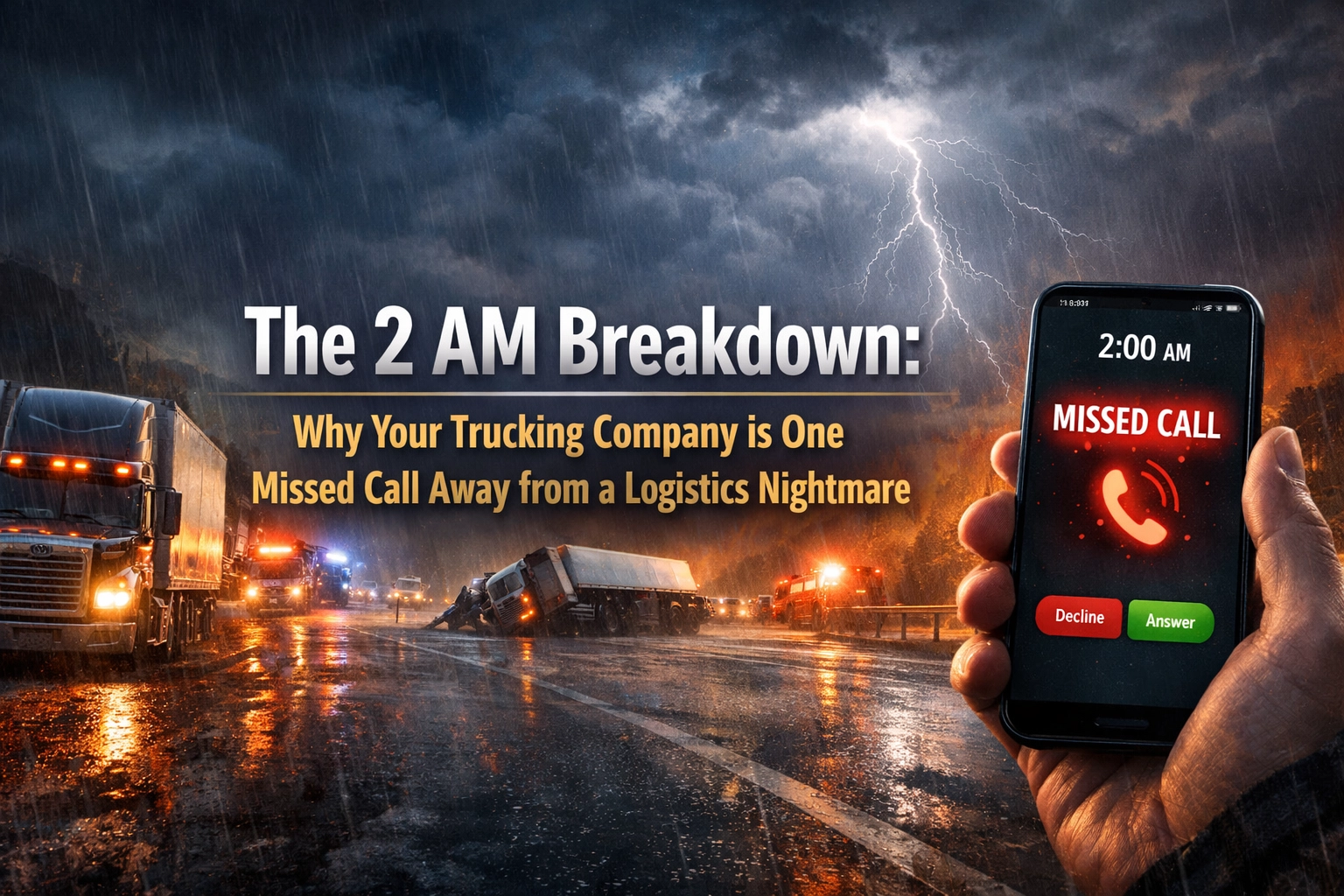
It's 2:47 AM on a Tuesday. Your driver calls: the rig just threw a code outside Memphis. He's got a high-value load due in Atlanta by 8 AM, and the shipper has a no-tolerance policy on delays.
Who answers that call?
If the answer is "voicemail" or "my dispatcher who's been awake for 19 hours," you're not running a trucking company: you're running a logistics time bomb. And every missed call, every delayed response, every exhausted dispatcher mistake is costing you thousands in revenue you'll never recover.
The 24/7 Reality Nobody Talks About: Trucking Never Sleeps, But Your Office Does
The trucking industry operates in a parallel universe where the clock doesn't matter. Freight moves at midnight. Breakdowns happen at dawn. Load confirmations come in during dinner. Yet most trucking companies are still operating with a 9-to-5 mindset that's bleeding money after hours.
Here's the uncomfortable truth: While your competitors are awake, handling night calls, and keeping their trucks moving, you're losing loads to voicemail. A Trucking Dispatch VA isn't a luxury: it's the difference between a company that scales and one that's constantly firefighting yesterday's problems.
The traditional dispatch model works like this: Your in-house dispatcher arrives at 7 AM already underwater with overnight messages. By noon, they're juggling driver check-ins, broker calls, and routing issues. By 5 PM, they're running on fumes. By midnight? They're either ignoring their phone or making mistakes that trigger Department of Transportation violations.
The Hidden Cost of Dispatcher Burnout
Dispatcher turnover in the trucking industry averages 25-35% annually: and it's not hard to see why. The job demands perfect execution under constant pressure, with zero margin for error. When your dispatcher is managing 30+ drivers across multiple states, handling emergency breakdowns, negotiating rates with brokers, and coordinating equipment swaps, something breaks. Usually, it's the human.
And when that dispatcher quits? You're looking at:
- 4-6 weeks to hire and train a replacement
- $15,000-$25,000 in recruitment and onboarding costs
- Lost loads during the transition period
- Relationship damage with drivers and brokers
But the real cost isn't the money you spend: it's the revenue you never capture because there's nobody answering the phone when opportunity calls.
The $50,000 Missed Load: Revenue Theft Happens While You Sleep
Let's calculate what one missed overnight call actually costs. Not in theory: in real dollars disappearing from your bottom line.
Scenario: A broker calls at 11:30 PM with a high-priority load: automotive parts from Detroit to Dallas, paying $4,200 with quick-pay terms. It's a lane you run regularly, and you've got a driver deadheading back from Cleveland who could grab it.
Your phone rings. Nobody answers.
The broker moves down their list. By 11:45 PM, your competitor has the load.
Immediate loss: $4,200 in revenue.
Ripple effect:
- Your driver deadheads 400 empty miles home instead of running loaded miles (lost revenue: $800)
- The driver loses a day of productive work, reducing weekly income
- The broker builds a relationship with your competitor on what could have been your lane
- You're now competing harder for the next load in that corridor
Total 30-day impact from that single missed call: Approximately $12,000-$18,000 in lost revenue and increased costs.
Now multiply that by how many calls your company misses per month. Most trucking companies with 10-20 trucks are losing $35,000-$75,000 annually in missed night and weekend opportunities alone: not because they can't handle the work, but because nobody was there to answer the phone.
The Compliance Catastrophe: What Happens When Dispatch Misses Critical Updates
The financial losses from missed loads are obvious. The liability exposure from missed driver communications is terrifying.
When your driver encounters a breakdown, weather emergency, or hours-of-service issue at 2 AM and can't reach dispatch, they're forced into impossible decisions:
- Push through fatigue to make up time (DOT violation, accident risk)
- Park in an unsafe location when hours run out (theft risk, driver safety risk)
- Skip mandatory rest breaks to recover schedule (federal violation, potential $16,000 fine per incident)
According to Federal Motor Carrier Safety Administration data, fatigued driving contributes to 13% of commercial truck accidents. And when that accident happens because your driver couldn't reach anyone at 2 AM? Your company owns the liability.
One serious accident can trigger:
- $500,000-$2,000,000+ in legal settlements
- DOT audit and compliance review
- Insurance premium increases of 40-60%
- Damaged reputation that costs contracts
A Logistics Virtual Assistant who's trained in Hours of Service regulations and DOT compliance isn't just answering phones: they're protecting your company from catastrophic liability.
Why Your "Regular" VA Solution Is Making the Problem Worse
You might be thinking: "I'll just hire a virtual assistant from one of those big offshore platforms. Problem solved, right?"
Wrong. Here's why generic VAs fail in trucking logistics:
1. Time Zone Roulette
Most offshore VAs work during their local business hours: which means your 2 AM breakdown in Tennessee is hitting their desk at 2 PM their time, after they've logged off. You're back to voicemail.
2. Zero Industry Knowledge
Trucking has its own language. A generic VA doesn't know the difference between a reefer breakdown and a dry van delay. They can't identify when a driver is approaching hours-of-service limits. They don't understand rate negotiations, accessorial charges, or detention fees.
When a broker calls with a hot load and asks about your availability on a specific lane, your VA either fumbles the call (and you lose the load) or commits to something your operation can't handle (and you lose the broker relationship).
3. No Scalability During Crisis
When your truck breaks down at 2 AM and you need coordinated support: tow truck dispatch, backup driver routing, shipper notification, and broker communication: a single VA handling five other clients can't deliver. You need a dedicated Trucking Dispatch VA who's embedded in your operation.
The Virtual Nexgen Solution: Specialized Human Dispatchers Who Know Your Lanes
Here's what separates Virtual Nexgen Solutions from every other "we'll get you a VA" service: We don't provide generic assistants. We provide trucking-specialized virtual dispatchers who understand your industry and operate as an extension of your team.
What Our Trucking Dispatch VAs Actually Do
24/7 Call Coverage & Load Booking
- Answer broker and shipper calls around the clock
- Qualify loads based on your lane preferences and rate requirements
- Coordinate driver assignments and equipment availability
- Handle load confirmations and rate negotiations
Driver Communication & Support
- Monitor driver check-ins and location updates
- Respond to breakdown and emergency calls immediately
- Coordinate towing, repairs, and backup equipment
- Track Hours of Service and prevent violations
Back-Office Dispatch Operations
- Maintain TMS (Transportation Management System) updates
- Process rate confirmations and accessorial charges
- Handle detention and layover documentation
- Coordinate with brokers on delivery appointments
Compliance & Documentation
- Track and file trip documents and BOLs (Bills of Lading)
- Monitor driver logs and Hours of Service compliance
- Maintain IFTA and fuel tax records
- Prepare for DOT audits and safety reviews
Real-World Results: The Difference Professional Support Makes
One of our clients: a 15-truck operation running reefer freight in the Southeast: was losing an estimated $60,000 annually to missed night calls and dispatcher burnout turnover. Their lead dispatcher quit after three years, and they were facing another expensive hiring cycle.
Instead, they partnered with Virtual Nexgen Solutions for dedicated Logistics Virtual Assistant coverage. Within 90 days:
- Night and weekend load capture increased 43% (previously unanswered calls converted to booked freight)
- Dispatcher stress reduced dramatically (in-house team handles strategic work, VAs handle routine coordination)
- Zero compliance violations during the transition period (VAs trained in DOT regulations caught Hours of Service issues before they became problems)
- Driver satisfaction improved (someone always available when they need support)
The cost of our VA service? Less than half of what they were spending on turnover and missed opportunities.
Why Human Expertise Beats Generic Offshore Labor
Look, we understand the appeal of the $5/hour VA from a freelance platform. It seems like an easy fix. But trucking logistics isn't data entry: it's a specialized skill that requires industry knowledge, real-time decision-making, and the ability to handle high-pressure situations.
Our Trucking Dispatch VAs receive extensive training in:
- Trucking industry terminology and operations
- DOT regulations and Hours of Service compliance
- TMS platforms and load boards (DAT, Truckstop, etc.)
- Rate negotiation and freight brokerage communication
- Crisis management and breakdown coordination
They're not "cheap labor": they're professional dispatchers who happen to work remotely. And they're available when your in-house team needs rest.
Stop Losing Revenue to Voicemail: Book Your Free Operations Leak Audit
Here's what we know about your operation (even if we've never spoken): You're losing money to missed opportunities, and you know it. The question isn't whether you need better dispatch coverage: it's whether you'll fix it before your competitors eat your lunch.
Virtual Nexgen Solutions offers a complimentary Operations Leak Audit for trucking companies with 5+ trucks. We'll analyze your after-hours call volume, identify missed revenue opportunities, and calculate exactly how much money is slipping through the cracks while your office is closed.
No sales pitch. No obligation. Just hard numbers that show you what better coverage is worth.
Schedule your free audit here and let's stop the bleeding.
The 2 AM breakdown is coming. The only question is whether someone will be there to handle it professionally: or whether you'll be scrambling to clean up the mess in the morning.
Your trucks don't sleep. Your dispatch coverage shouldn't either.