

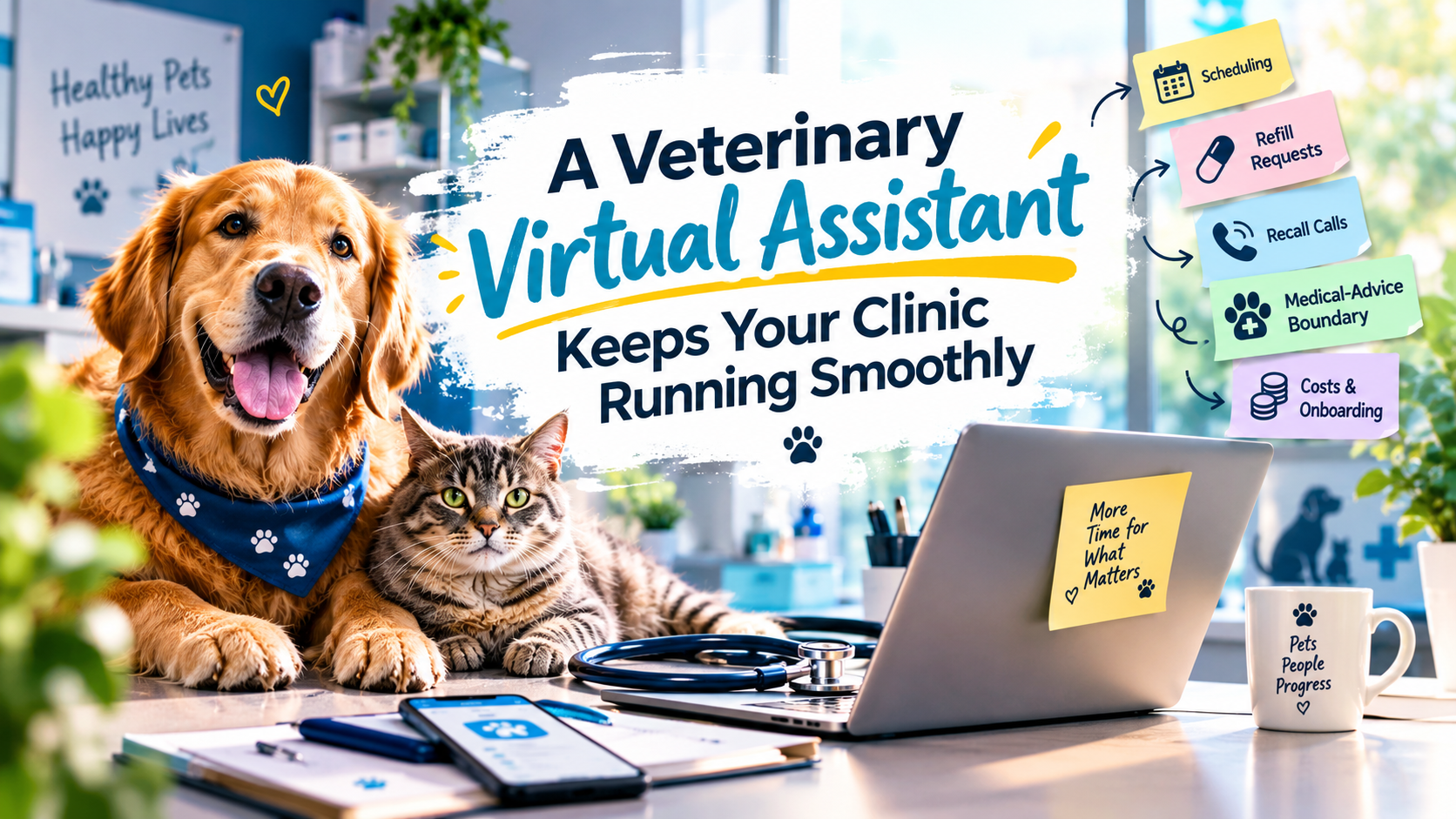
A veterinary virtual assistant gives your clinic a reliable front-office layer for scheduling, confirmations, refill-request intake, client updates, recalls and records organization, so your licensed team can focus on patient care. The VA follows your clinic’s approved workflows and escalates clinical questions; they do not diagnose, provide medical advice or make treatment decisions.
If phone coverage, routine follow-ups and admin queues are stretching your team, a dedicated administrative support VA from Virtual Nexgen Solutions may be one way to add capacity without asking clinical staff to absorb every front-desk task.
Why veterinary clinics add virtual front-desk support
The front desk is not “just admin.” It connects clients, appointments, records and clinical staff. When calls go unanswered or follow-ups are delayed, your team may spend valuable time catching up rather than serving the next client.
The staffing pressure is not limited to veterinary practices. MGMA Stat reported on November 3, 2026, that about four in five medical groups have open administrative positions, with front-office roles among the hardest to fill. That is medical-groups data, not a veterinary-specific statistic, but it reflects a wider challenge in healthcare-adjacent operations.
Privacy is another consideration when adding staff or technology. Weave’s August 2026 Pulse Survey found that 60% of surveyed practices remained concerned about data privacy. The survey included veterinary practices alongside other healthcare settings. That concern is a reason to establish clear access rules and workflows, not a reason to skip useful support. (Weave survey release)
A virtual assistant for veterinary clinics can help take on repeatable work such as scheduling, confirmations, reminder calls and request logging. Your clinic sets the process, permissions and escalation rules.
What a veterinary virtual assistant can handle
A vet clinic virtual assistant is most useful when you assign clear, repeatable tasks and define who handles exceptions. Common responsibilities include:
- Scheduling and confirmations: Book, confirm or reschedule appointments using your clinic’s rules for visit types, appointment lengths and availability.
- Refill request intake: Record the request details, check that required information is present and route it to the appropriate veterinary staff member for review.
- Recall and wellness-plan follow-up: Contact clients using approved scripts about upcoming appointments, routine reminders or overdue follow-ups.
- Client status communication: Share approved updates, such as whether a request has been received or when a team member expects to follow up.
- Records and invoice organization: File information, update permitted administrative fields and help organize invoice or payment follow-up.
- Review requests: Send a neutral request for feedback using your clinic’s approved timing and wording.
- Boarding and grooming coordination: Schedule or confirm services according to the clinic’s stated policies and availability.
The scope should be specific. For example, a VA may log a prescription refill request and route it to an authorized team member. They should not approve or deny the refill, change dosage instructions, recommend medication or decide whether an exam is required.
Keep medical advice and emergency judgment with licensed staff
A virtual assistant can follow a script, collect information and connect a client to the right person. They should not assess symptoms or decide how urgently an animal needs care.
Medical advice, triage, dosage questions and emergency judgment must stay with licensed veterinary staff. Build escalation instructions for calls or messages involving symptoms, possible emergencies, medication reactions, treatment questions or requests outside clinic policy. The VA should know whom to contact and what approved language to use while transferring the concern, not attempt to resolve it independently.
Your clinic should provide written instructions covering:
- Which topics the VA can answer with an approved script.
- Which requests must be routed to a veterinarian or authorized staff member.
- Who is responsible for urgent escalations during and outside clinic hours.
- What the VA should say if they cannot reach the designated person immediately.
This boundary protects the client relationship and keeps clinical decisions with the people qualified and authorized to make them.
How to protect client and clinic information
Before granting access, decide what information the VA needs for their assigned tasks, and what they do not need. Use named user accounts, limited permissions, secure authentication and clinic-approved tools. Avoid shared passwords, and remove access promptly when someone changes roles or leaves.
Document expectations for confidentiality, appropriate device use, handling information in messages and reporting a possible privacy incident. Also review the privacy, veterinary-record, payment and contract requirements that apply to your clinic and location. Do not assume a particular legal framework applies automatically; confirm obligations with your own compliance or legal adviser where necessary.
Hire in-house or outsource the front-desk work?
An in-house hire may be a better fit when you need someone physically present to support visitors, coordinate the waiting room or perform duties that require on-site access. Outsourcing may suit work that can be completed remotely through approved systems and documented procedures, such as confirmations, recall outreach, client-message routing and administrative record organization.
Before choosing, list the tasks creating the most disruption, estimate how many hours they take, and identify which work must happen onsite. Then compare the full costs of each option (including recruitment, training, supervision, tools and coverage) rather than comparing wages alone.
A practical 30-day onboarding plan
A veterinary virtual assistant should learn your clinic’s processes before taking on a full task queue. Use a phased handoff with an accountable clinic owner.
- Days 1–5: Define the role. Select initial tasks, document what is in scope and out of scope, name escalation contacts, and agree on approved scripts and response expectations.
- Days 6–10: Set up access and training. Provide only the necessary system permissions. Train the VA on your scheduling rules, record-handling procedures, communication standards and privacy expectations.
- Days 11–15: Practice with supervision. Use sample scenarios or a small, supervised batch. Test routine bookings, reschedules, refill-request intake and urgent-message escalation.
- Days 16–22: Start a controlled handoff. Assign a defined portion of the live workload. Have a clinic lead review accuracy, completeness and escalation decisions regularly.
- Days 23–30: Adjust and expand carefully. Resolve recurring questions, update procedures and expand responsibilities only when results meet the clinic’s standards.
Virtual Nexgen Solutions provides dedicated, one-on-one industry-trained VAs, with a structured five-step onboarding and quality assurance process. The clinic remains responsible for defining clinical boundaries, approving scripts and supervising work that affects its operations.
Measure whether support is helping
Set a baseline before the VA begins. Review a small set of practical measures weekly, and agree which person at the clinic owns the review.
- Call answer rate: How often calls receive an answer or are handled according to the clinic’s callback process.
- Refill-request turnaround: Time from request receipt to handoff to the appropriate reviewer. This measures intake and routing, not clinical approval.
- Recall completion: The share of assigned recall contacts completed and recorded.
- No-show rate: Track changes over time alongside confirmation activity; do not assume one factor alone caused a change.
- Hours returned: Estimate clinic staff time freed from the specific tasks assigned to the VA.
These metrics help you spot bottlenecks, refine the task list and determine whether the arrangement is useful. Start with a manageable scope, then expand based on documented performance.
Frequently asked questions
What does a veterinary virtual assistant do?
A veterinary virtual assistant handles defined administrative work such as appointment scheduling and confirmations, reminder and recall outreach, refill-request logging, client status messages and records organization. The clinic sets the procedures and supervises work within its scope.
Can a veterinary virtual assistant give medical advice?
No. Medical advice, triage, dosage guidance, diagnosis and emergency decisions must remain with licensed veterinary staff. The VA should follow approved scripts and escalate clinical questions.
How much does a veterinary virtual assistant cost?
Costs vary based on location, hours, task complexity, service model, training and the level of supervision required. Ask providers for a written quote that explains setup, ongoing service, software or phone costs, and coverage. Compare that total with the cost of hiring and managing the work in-house.
Can a veterinary virtual assistant handle refill requests?
They can receive and document requests, collect the information your clinic requires and route the request for review. They should not authorize a refill, change medication directions or advise a client about treatment.
How is client data protected?
Use individual accounts, least-privilege permissions, secure authentication, clinic-approved systems and written confidentiality procedures. Train the VA on your data-handling rules and confirm the requirements that apply to your practice and location.
How fast can one start?
Timing depends on role scope, access setup, training materials and staff availability for review. A phased 30-day plan gives the clinic time to test workflows and correct issues before expanding the VA’s responsibilities.
Add front-desk capacity without moving the clinical line
A veterinary virtual assistant can give your clinic more consistent coverage for routine communication and follow-through. Provided the role is clearly defined and clinical questions remain with licensed staff. Focus first on the tasks that repeatedly interrupt your day, set access and escalation rules, then measure whether the handoff is working.
Virtual Nexgen Solutions offers dedicated, one-on-one industry-trained virtual assistants, privacy-first workflows and structured onboarding with quality assurance. Explore administrative support for your clinic or book a 30-minute conversation to discuss a practical starting scope.
Sources: MGMA (MGMA Stat, November 3, 2026; medical-groups data cited above) · Weave 2026 Pulse Survey release
Work With Virtual Nexgen Solutions
If your business needs dependable virtual assistant support, Virtual Nexgen Solutions can provide support around your existing workflow. Book a discovery call today.
Get in Touch Now!