
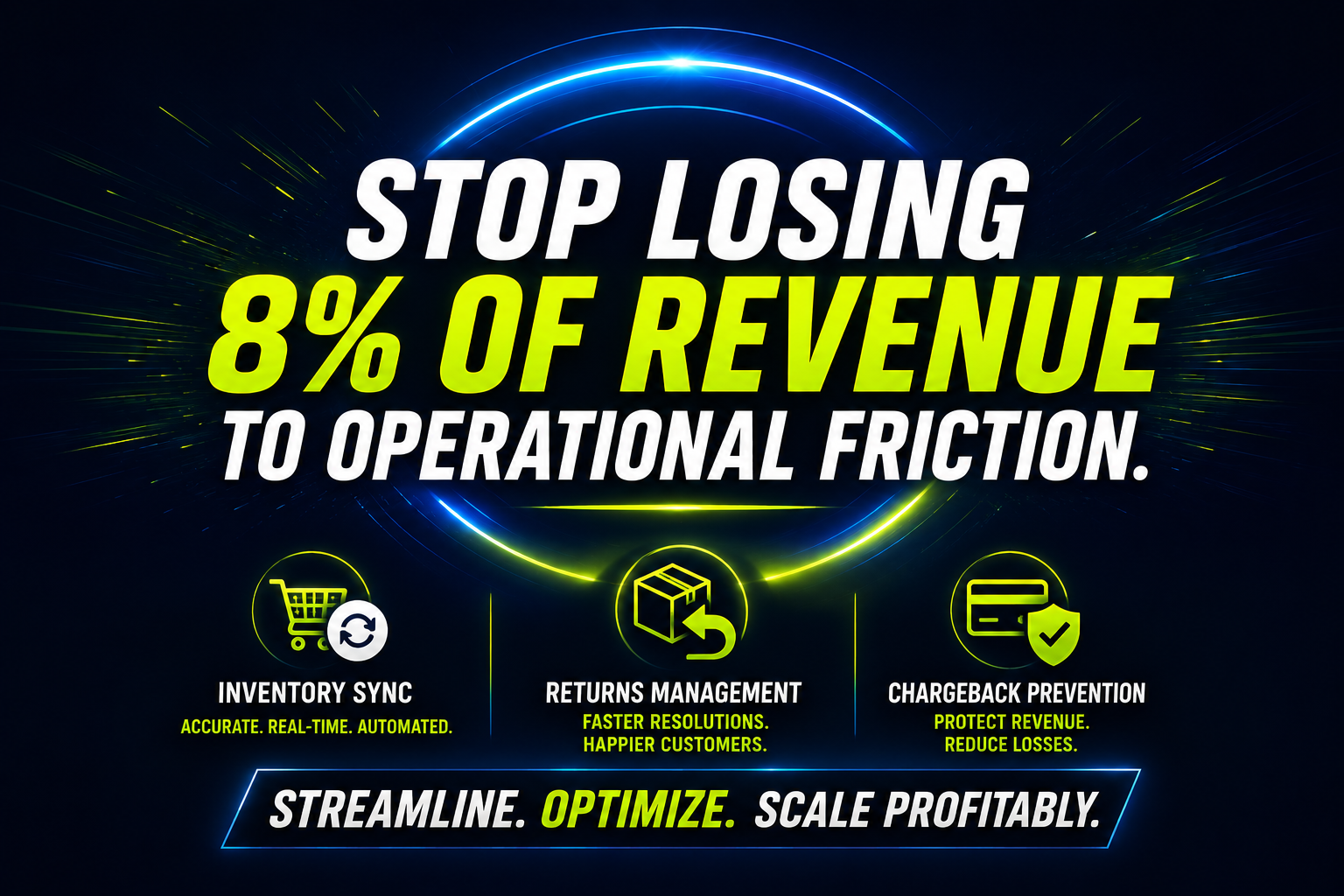
You are likely losing 8% of your top-line revenue every single month, and you might not even realize it. For a $1M brand, that is an $80,000 annual leak, straight out of your pocket and into the void of "Admin Debt." This isn't a problem with your Facebook ads or your product-market fit. This is the "Multi-Channel Order-to-Revenue Gap."
When you sell across Shopify, Amazon Seller Central, eBay, and Etsy, your business is a complex engine of moving parts. Every time a customer returns a shirt on Amazon but your Shopify inventory doesn't update, you risk overselling. Every time a dispute remains unanswered in your PayPal dashboard, money evaporates. Every hour you spend manually reconciling ShipStation labels with QuickBooks entries is an hour you aren't spending on brand strategy or product development.
At Virtual Nexgen Solutions, we see this pattern daily. Growing brands reach a ceiling not because of a lack of demand, but because of operational friction. Your "Admin Debt" is the accumulation of all the tiny, repetitive tasks that have been ignored or handled haphazardly. It is time to systematize your operations and reclaim your profit.
The Invisible Weight of Admin Debt in Ecommerce
Admin Debt in the ecommerce world is the high cost of manual operations. It manifests as unoptimized listings, slow customer response times, and the terrifying "out of stock" notification on a high-performing SKU simply because someone forgot to update the inventory sheet.
Most founders try to solve this by working harder. You stay up until 2:00 AM replying to Zendesk tickets or manually adjusting stock levels across four different marketplaces. But you are an entrepreneur, not a data entry clerk. By the time your business hits mid-six figures or the low seven-figure mark, your time is worth at least $250 to $500 per hour. Spending that time on $8-per-hour tasks is the fastest way to kill your margins and your mental health.
The 2026 Ecommerce Operational Crisis: By the Numbers
The landscape of 2026 has made multi-channel selling mandatory, but the complexity has skyrocketed. Consider these industry-wide benchmarks:
- Revenue Leakage: 5% to 8% of total ecommerce revenue is lost due to operational friction, including inventory errors, unmanaged returns, and lost chargeback disputes.
- Inventory Inaccuracy: Approximately 34% of mid-sized ecommerce businesses struggle with inventory accuracy across multiple channels.
- The Returns Burden: Average return rates now hover between 15% and 30%. Manual processing of these returns often costs an additional 10% to 15% of the item’s total value in wasted labor.
- Conversion Velocity: A customer service response time of under one hour can increase your conversion rate by 7x. Conversely, a 24-hour delay often results in a lost customer for life.
- Growth Barriers: 70% of ecommerce business owners report that administrative tasks are the primary factor limiting their ability to scale to the next revenue tier.
If these numbers feel familiar, you are experiencing the "Order-to-Revenue" gap. The gap between the moment a customer clicks "buy" and the moment that money is reconciled, the product is in their hands, and the inventory is accurately reflected for the next sale.
Revenue Leaks: Where Your Money Is Disappearing
Before you can fix the problem with a virtual assistant for ecommerce business, you must identify where the bleeding starts. In our experience at Virtual Nexgen Solutions, revenue leaks usually congregate in three specific areas:
1. Inventory Mismatches and Overselling
When you sell a unit on Etsy, but your Amazon listing doesn't update for three hours, you are playing a dangerous game. Overselling results in cancelled orders, which leads to marketplace penalties, lowered search rankings, and, eventually, account suspension. The cost of a suspended Amazon account is immeasurable.
2. The "Returns Black Hole"
Returns are a part of life, but slow returns processing is a choice. When a return sits in your warehouse for ten days before being inspected and restocked, that is capital tied up in "dead" inventory. Worse, if the customer doesn't get their refund quickly, they file a chargeback, which costs you additional fees and damages your merchant standing.
3. Unrecovered Disputes and Chargebacks
Most ecommerce owners are too busy to fight every $50 chargeback. Over a year, these "minor" losses add up to thousands of dollars. A specialized virtual assistant for ecommerce business can systematize the dispute process, using pre-written scripts and evidence packages to win back 60% to 80% of those funds.
Staffing Challenges: The Cost of Inaction
Many businesses think they have two choices: do it themselves or hire a full-time, in-house operations manager.
An in-house administrative manager in the United States typically costs around $60,000 per year plus benefits, taxes, and office space. For a brand doing $500,000 in sales, that is over 12% of your gross revenue just for one person. It isn't sustainable.
The alternative is a specialized virtual assistant for ecommerce business from Virtual Nexgen Solutions. At $8 per hour, you get a dedicated professional who is already trained in the systems you use daily, Shopify, Amazon, ShipStation, and more.
Contrast the numbers:
- In-house Admin: $60,000/year + $15,000 in overhead = $75,000 total.
- Virtual Nexgen Solutions VA: $8/hour x 40 hours/week = ~$16,640/year.
By choosing a specialized VA, you save nearly $58,000 annually. That is $58,000 you can pump back into PPC ads, influencer marketing, or new product development.
Industry Trends: The Shift Toward Unified Commerce
In 2026, the trend is moving away from "Multi-Channel" (having many channels that don't talk to each other) toward "Unified Commerce" (one single source of truth for all data).
A virtual assistant for ecommerce business is the human bridge that ensures your software speaks the same language. While tools like Inventory Planner or TradeGecko are powerful, they are not "set it and forget it." They require daily oversight, reconciliation, and manual overrides when suppliers fail to deliver on time.
5 Essential Order-to-Revenue SOPs for Your Ecommerce VA
To stop the 8% revenue leak, your virtual assistant for ecommerce business needs a clear roadmap. We have developed these five Standard Operating Procedures (SOPs) to turn your chaotic operations into a streamlined revenue engine.
SOP 1: Multi-Channel Order Reconciliation & Inventory Sync
This is the heartbeat of your operation. Your VA must ensure that your physical stock matches your digital stock across every marketplace.
The Workflow:
- Daily Morning Audit: Every morning at 8:00 AM EST, the VA logs into Shopify, Amazon Seller Central, eBay, and Etsy.
- The "Truth" Check: Compare the "Total Units Available" in your inventory management software (e.g., TradeGecko or Finale Inventory) against the actual quantities listed on each platform.
- Manual Adjustments: If a sale occurred on eBay that didn't automatically sync to Amazon, the VA manually updates the Amazon stock level immediately.
- Discrepancy Reporting: If a major mismatch is found (more than 5 units), the VA investigates the cause (e.g., a return not restocked or a lost shipment) and flags it to the warehouse.
- Low Stock Alerts: The VA maintains a "Reorder Point" spreadsheet and notifies the owner when a SKU drops below 14 days of inventory.
SOP 2: Customer Service Ticketing & Returns Processing
Customer service isn't just about answering questions; it's about protecting your brand's reputation and search ranking.
The Workflow:
- Triage: The VA monitors Gorgias or Zendesk and categorizes tickets into: "Where is my order?", "Damaged Product," and "Pre-Sale Questions."
- The 60-Minute Rule: All pre-sale questions and tracking inquiries are answered within 60 minutes using approved brand templates.
- Return Authorization: When a return is requested, the VA validates it against your policy, issues a return label via ShipStation, and logs the return in a "Returns Tracker."
- Warehouse Liaison: Once the warehouse confirms receipt of the returned item, the VA inspects the photos, determines if the item can be restocked, and processes the refund or exchange immediately.
- Recovery: For "Damaged Product" tickets, the VA offers a 15% discount code for a future purchase alongside the replacement to ensure the customer remains loyal.
SOP 3: Product Listing Optimization & Content Updates
Static listings are dying listings. Your VA ensures your products are always optimized for the latest search trends.
The Workflow:
- Monthly Keyword Refresh: The VA uses tools like Helium 10 (for Amazon) or SEMRush to identify trending keywords and integrates them into product titles and bullet points.
- Visual Audit: Ensure that all 7 images are present and that A+ Content (Amazon) or Enhanced Brand Content (Shopify) is displaying correctly.
- Price Monitoring: The VA monitors competitors' prices weekly and adjusts your pricing within pre-approved guardrails to maintain your "Buy Box" status.
- FAQ Updates: Every time a customer asks a unique question in a support ticket, the VA adds that question and answer to the product page's FAQ section to reduce future friction.
SOP 4: Supplier Coordination & Purchase Order Management
Stockouts are the ultimate revenue killers. Your VA manages the relationship with your manufacturers so you never run dry.
The Workflow:
- PO Generation: When the Inventory Tracker hits a reorder point, the VA drafts a Purchase Order (PO) and sends it to the owner for approval.
- Supplier Communication: Once approved, the VA sends the PO to the supplier and tracks the production timeline.
- Logistics Coordination: The VA communicates with freight forwarders, ensuring that all customs documentation is in order and that the "Estimated Time of Arrival" (ETA) is updated in your internal systems.
- Invoice Verification: The VA compares the supplier's final invoice against the original PO to ensure there are no overcharges or hidden fees.
SOP 5: Accounts Receivable, Dispute Resolution & Reconciliation
Stop letting small fees bleed your business dry. Your VA acts as your financial watchdog.
The Workflow:
- Payment Gateway Reconciliation: Weekly, the VA matches Shopify Payments, PayPal, and Amazon Payouts against the bank deposits in QuickBooks.
- Dispute Management: When a chargeback or dispute is filed, the VA gathers the tracking number, proof of delivery, and customer communication logs to submit a formal rebuttal.
- Fee Auditing: The VA reviews Amazon "FBA Fees" and "Referral Fees" monthly to ensure you aren't being overcharged for weight or size categories.
- Sales Tax Reporting: The VA pulls monthly reports from TaxJar or Avalara to ensure your tax liabilities are documented and ready for your accountant.
Actionable Tips & Tricks for Efficiency
- The Daily Order Reconciliation Cadence: Have your VA perform a "Closing of the Books" every evening at 5:00 PM. This involves a final check of all orders placed that day versus those marked as "shipped" in ShipStation. This prevents the "forgotten order" syndrome.
- Inventory Sync Checklist: Create a "Sync Log" where the VA records every manual adjustment made. This helps you identify which software integrations are failing most often so you can seek technical support.
- Returns Processing SLA: Set a Service Level Agreement (SLA) for your returns. No return should take longer than 48 hours to be processed from the moment it arrives at your facility.
- Chargeback Dispute Script: Develop a "Dispute Evidence Pack." This should be a pre-formatted PDF containing your Terms of Service, a screenshot of the delivery confirmation, and the customer's signed order confirmation. Having this ready allows your VA to respond to disputes in under 10 minutes.
Industry Software Your VA Must Master
At Virtual Nexgen Solutions, we don't just provide "general help." We provide specialists who are fluent in the technical tools that run modern commerce. Your VA will operate within:
- Marketplaces: Amazon Seller Central, eBay Hub, Etsy Shop Manager, Walmart Seller Center.
- E-commerce Platforms: Shopify (and Liquid-based apps), BigCommerce, WooCommerce.
- Shipping & Logistics: ShipStation, ShippingEasy, Flexport, Deliverr.
- Customer Support: Gorgias, Zendesk, Help Scout, Re:amaze.
- Inventory & Operations: Inventory Planner, TradeGecko (QuickBooks Commerce), Finale Inventory, Skubana.
- Finance & Analytics: QuickBooks Online, Xero, TaxJar, Google Analytics 4.
Case Study 1: Resolving the Inventory "Drowning" in a Multi-Channel Brand
The Scenario: A high-growth home goods brand based in California was selling across Shopify, Amazon, and Walmart. They were doing $150,000 in monthly revenue but were losing nearly $9,000 every month in cancelled orders due to overselling. Their inventory was managed on a Google Sheet that was updated once a week.
The Solution: Virtual Nexgen Solutions placed a specialized virtual assistant for ecommerce business who implemented SOP #1 (Daily Sync). The VA migrated the brand from manual sheets to Finale Inventory and set up real-time API connections between all three stores.
The Results:
- Overselling Incidents: Dropped from 45 per month to zero within 30 days.
- Revenue Recovery: The $9,000 in monthly "Lost Revenue" was reclaimed, leading to a 6% increase in net profit.
- Account Health: Their Amazon "Order Defect Rate" dropped by 80%, moving them from "At Risk" to "Healthy."
Case Study 2: Solving Returns Paralysis for a DTC Fashion Brand
The Scenario: A Direct-to-Consumer (DTC) apparel brand in Florida was struggling with a 25% return rate. Because the founder was busy with marketing, returns sat in boxes at the warehouse for weeks. Customers were getting angry, filing chargebacks, and leaving 1-star reviews.
The Solution: The brand hired a Virtual Nexgen Solutions VA dedicated to SOP #2 (Returns & Customer Service). The VA took over the returns queue, integrated Gorgias with ShipStation, and established a 24-hour refund policy.
The Results:
- Processing Time: Reduced from 14 days to under 24 hours.
- Chargeback Rate: Decreased by 65% as customers received their money back before they felt the need to dispute.
- Customer Retention: Re-purchase rate among customers who had a "Smooth Return" increased by 15%.
ROI Comparison: The Real Cost of Doing It Yourself
Let’s look at the cold, hard numbers. If you are an ecommerce founder doing $1M per year, your time is your most valuable asset.
The Founder-Led Model:
- Time spent on admin: 20 hours per week.
- Founder's effective hourly rate: $250.
- Opportunity Cost: $5,000 per week / $260,000 per year.
- Result: Burnout, stagnant growth, and an 8% revenue leak ($80,000). Total "Waste": $340,000.
The Virtual Nexgen Solutions Model:
- VA Cost: $8 per hour x 40 hours = $320/week.
- Annual Investment: $16,640.
- Result: 20 hours of founder time reclaimed to focus on growth. Revenue leak recovered ($80,000).
- Net Gain: $323,360 in value.
The choice isn't just about saving money; it's about the massive ROI generated by freeing the founder to work on the business rather than in the business.
Future Trends: What’s Next for Ecommerce Operations?
As we look toward 2027 and beyond, the "Order-to-Revenue" lifecycle will become even tighter.
- Hyper-Personalization in Support: VAs will move beyond templates to use detailed customer purchase histories to provide personalized upsell offers during support interactions.
- Social Commerce Expansion: The "Multi-Channel" landscape will expand to include TikTok Shop and Instagram Shopping as primary drivers. Your virtual assistant for ecommerce business will need to manage these native checkouts just as they do Amazon or Shopify.
- Sustainable Logistics: There is an increasing demand for "Carbon Neutral" shipping. VAs will be responsible for selecting green shipping options and communicating these values to the customer base.
Frequently Asked Questions (FAQ)
1. What specific tasks can a virtual assistant for ecommerce business handle?
rnA specialized VA from Virtual Nexgen Solutions handles order reconciliation across multiple channels, inventory synchronization, customer service ticket management, returns processing, product listing updates, and supplier coordination. They act as the operational engine of your store.
2. How do you ensure my inventory stays accurate across Shopify and Amazon?
rnWe implement a strict SOP where the VA performs daily audits between your "Source of Truth" (like TradeGecko or Finale Inventory) and the active listings on Shopify and Amazon. Any discrepancies are manually corrected immediately to prevent overselling.
3. Can an $8/hr VA really handle technical software like ShipStation or Gorgias?
rnYes. At Virtual Nexgen Solutions, we don't hire generalists. We provide VAs who are already familiar with the ecommerce tech stack. They are trained to navigate the backends of these platforms to execute technical tasks accurately.
4. How does a VA help reduce my returns rate?
rnWhile a VA can't change a product's quality, they significantly reduce the cost of returns by processing them within 24 hours. They also identify "repeat return" patterns (e.g., a specific SKU that always fits too small) and update the product descriptions to set better customer expectations.
5. Is it safe to give a virtual assistant access to my Amazon Seller Central?
rnAbsolutely. We use "User Permissions" within Amazon, Shopify, and PayPal. This allows you to grant the VA access only to the specific sections they need (like "Orders" or "Inventory") without giving them access to your banking information or the ability to change critical account settings.
6. Will my customer service quality drop if I use a VA?
rnOn the contrary, it usually improves. By having a dedicated VA, your response times drop from 12-24 hours to under 60 minutes. We use your brand voice and pre-approved templates to ensure every interaction feels authentic and high-quality.
7. How do I track the performance of my ecommerce VA?
rnWe recommend tracking three key metrics: Response Time (for support), Accuracy Rate (for inventory), and Processing Time (for returns). Your VA will provide a daily or weekly report summarizing these KPIs.
8. What if I only need help for 10 or 20 hours a week?
rnVirtual Nexgen Solutions offers flexible scaling. While many of our clients see the best results with a full-time 40-hour VA, we can tailor a solution that fits your current volume and grows as your brand scales.
9. How do I start the process of hiring a specialized VA?
rnSimply book a consultation through our website. We will analyze your current "Admin Debt," identify your revenue leaks, and match you with a VA who is an expert in your specific software and niche.
Conclusion: Stop Paying the "Ignorance Tax"
In ecommerce, ignorance isn't bliss: it's expensive. Every day you operate without standardized "Order-to-Revenue" SOPs, you are paying a tax in the form of lost revenue, frustrated customers, and your own personal burnout.
The 8% revenue leak is optional. You can choose to systematize your backend today. By integrating a specialized virtual assistant for ecommerce business into your team, you aren't just "hiring help": you are installing a profit-recovery system.
Reclaim your time. Reclaim your margins. Scale your brand to the seven-figure level and beyond with the reliability and expertise of Virtual Nexgen Solutions.
Work With Virtual Nexgen Solutions
If your business needs dependable virtual assistant support, Virtual Nexgen Solutions can provide support around your existing workflow. Book a discovery call today.
Get in Touch Now!