
When call volume rises, your technicians are on jobs, your dispatcher is juggling schedule changes, and a customer with a heating or cooling problem reaches voicemail. An HVAC answering service can help you respond, but the right option depends on whether you need someone to take a message, book the job, or manage the next steps. Virtual Nexgen Solutions’ HVAC virtual assistants provide dedicated support for customer calls, scheduling, dispatch coordination, and follow-up.
Why HVAC calls are hard to cover consistently
Seasonal demand can bring a sudden wave of calls. After-hours issues may need a prompt response, while daytime calls compete with dispatching, customer updates, and the work already in progress. Even a well-run office can struggle to give every inquiry timely attention.
The cost is not just a missed ring. If a caller leaves an incomplete message, someone still has to call back, confirm the address and issue, find an appointment window, and update the schedule. That gap between answering the call and completing the customer’s next step is where work can pile up.
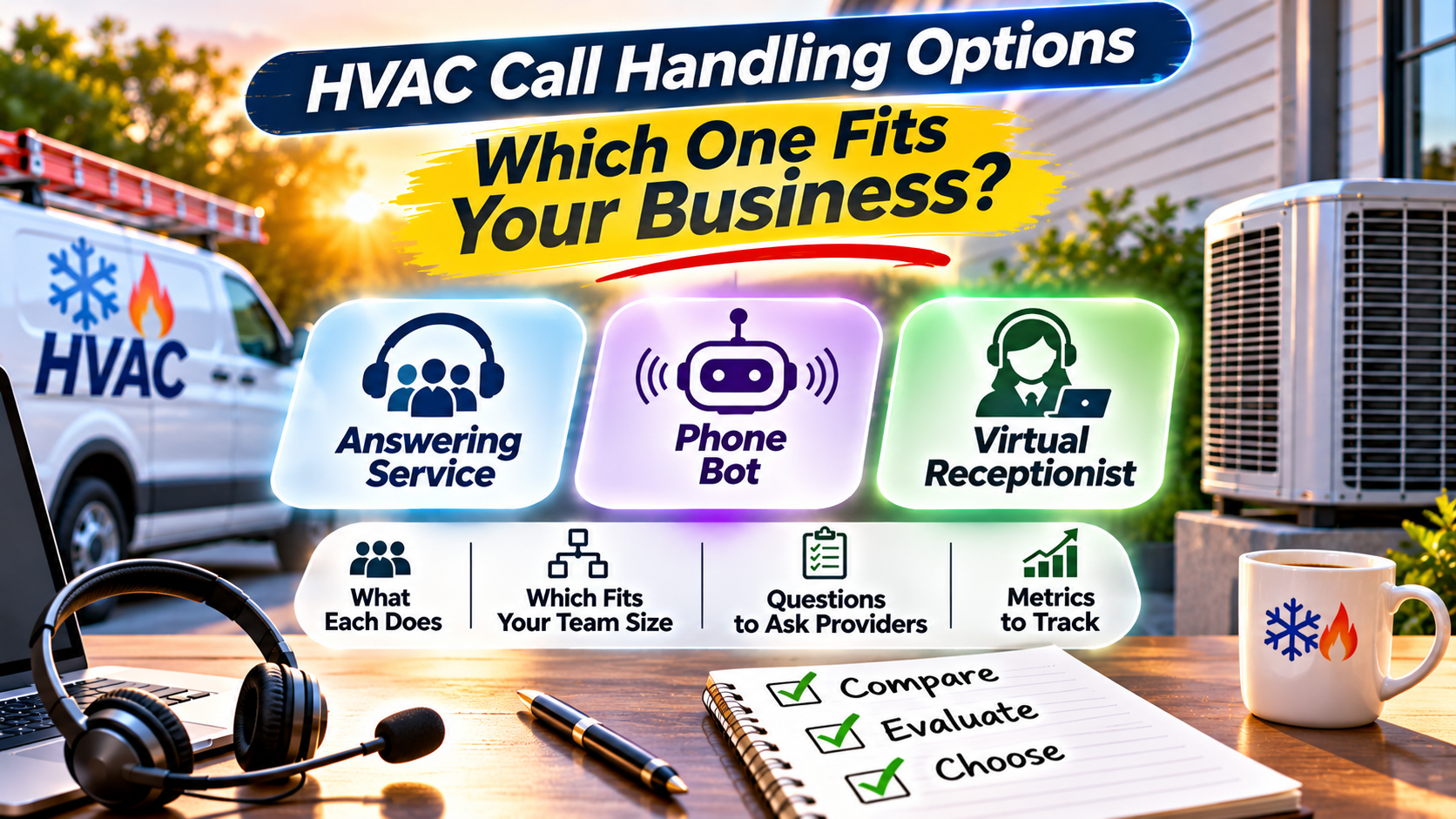
Three ways to answer HVAC calls
Automated phone bots: efficient for predictable calls
An automated phone bot can answer at any hour, collect basic details, route callers through menus, or handle routine appointment requests. It can be useful when your calls follow clear patterns and you have standardized booking rules.
The trade-off is that callers may have unusual requests, describe equipment in unexpected terms, or need to explain a complicated situation. A bot may not handle those conversations as well as a person. Before relying on automation, test common and difficult scenarios, confirm what happens when it cannot understand a caller, and set up a clear route to a human.
A bot should not diagnose equipment problems or improvise safety advice. Make sure calls involving potential danger reach the appropriate local emergency guidance or a person trained to follow your approved escalation procedure.
Shared answering services: coverage without a dedicated receptionist
A shared call-center answering service uses agents who answer calls for multiple businesses. Depending on the provider and your agreement, agents may take messages, capture caller details, transfer calls, or relay urgent requests to an on-call technician. This can be a practical way to add overnight, weekend, or overflow coverage.
The limitation is that answering and acting are different jobs. A service may not be set up to book appointments in your field-service software, follow every part of your scheduling process, or track whether your team completed a callback. Agents also have to rely on the scripts and information you provide. Ask how they will handle unusual calls, call surges, and requests that fall outside the script.
Dedicated virtual receptionists: more continuity and follow-through
A dedicated virtual receptionist or HVAC virtual assistant can learn your service area, call scripts, booking rules, and software workflow. Depending on the agreed scope and permissions, they may do more than take a message: they can enter service requests, book approved appointment types, send confirmations, and track callbacks.
This model is a stronger fit when your office needs someone to understand your process and take action within it. It still requires clear procedures, training, and manager oversight. Coverage hours, backup arrangements, and escalation responsibilities should be agreed in advance.
For more on the role itself, see our guide to the HVAC virtual receptionist. For support beyond the front desk, our article on HVAC virtual assistant dispatching covers coordination tasks in more detail.
What an HVAC answering service typically does, and may not do
An answering service for HVAC companies commonly handles basic call coverage: greeting callers, taking messages, recording contact and service details, and relaying after-hours requests. Some services may offer appointment scheduling or call transfers, but the exact work depends on the provider’s capabilities and your contract.
Do not assume a call answering service will also:
- Book a confirmed appointment in your scheduling or field-service system.
- Follow your complete scheduling and escalation procedures.
- Make sure a callback, quote follow-up, or customer update is completed.
- Decide whether a technician should be dispatched or what repair is needed.
Those tasks need to be explicitly included, assigned, and tested. If the provider only passes along a message, your team still owns the follow-through.
Which option fits your HVAC business?
For a solo operator, a shared answering service may be a reasonable starting point if the main need is to capture calls while you are working. Set clear rules for what qualifies as urgent, who gets called, and what happens if you do not answer. If customers also need appointments booked or callbacks tracked, consider coverage that can take those actions.
For a small team, call volume and office workload matter more than the number of technicians alone. A shared service can absorb overflow or after-hours calls, while a dedicated receptionist may be more useful if booking, rescheduling, and follow-up are repeatedly taking time away from the person managing the office.
For a multi-truck operation, calls may involve job status, schedule changes, service agreements, and coordination across technicians. A dedicated virtual receptionist or VA can provide more continuity and help close the loop in your systems. You may still choose a shared service for nights, weekends, or sudden call spikes.
A practical hybrid can work well: use a shared answering service for after-hours and overflow coverage, then assign a dedicated virtual receptionist to handle daytime booking, customer updates, and follow-through. The handoff needs to be clear: what information is collected, where it is recorded, who reviews it, and how urgent calls are escalated.
Questions to ask before you choose a provider
Before signing up for an HVAC call answering service or virtual receptionist, ask:
- How is pricing calculated? Is it a monthly fee, per call, per minute, or a combination? What happens when seasonal volume increases, and are there extra charges?
- What HVAC experience do agents have? How are they trained on service terminology, appointment types, and customer expectations?
- Can we customize scripts? Can you set rules for service areas, hours, emergency calls, pricing questions, and appointment availability?
- How are urgent calls escalated? Is there a backup contact if the primary technician does not answer? Can you review the process and test it?
- What systems can you use? Can the provider update your CRM or field-service platform, or will you receive messages to enter yourself?
- How is customer information protected? Ask who can access call records, how recordings and transcripts are stored, when they are deleted, whether subcontractors are involved, and how the provider notifies you of an incident. Ordinary HVAC calls are not automatically subject to HIPAA; still, customer data deserves careful handling.
- What are the contract terms? Confirm coverage hours, cancellation terms, service limits, and what happens when a call falls outside the agreed scope.
If calls are recorded or monitored, check the rules that apply where you and your customers are located. Requirements can vary by jurisdiction.
Set a clear safety escalation rule
Your provider should never diagnose an HVAC fault over the phone. Gas smells, carbon-monoxide (CO) alarms, smoke, or other immediate hazards require a safety response, not ordinary appointment booking.
Write an escalation script that tells the call handler to follow your locally reviewed guidance and connect callers to the appropriate emergency services or utility provider. For example, Indiana’s Utility Regulatory Commission guidance on gas leaks advises people who suspect a leak to leave the area and contact authorities from a safe location. The U.S. Consumer Product Safety Commission’s CO guidance says that when a CO alarm sounds, occupants should move outside to fresh air and contact emergency services; they should not re-enter until responders say it is safe.
Your call handler should not troubleshoot, diagnose, or tell someone to wait for an HVAC technician when there may be immediate danger. Adapt procedures to local guidance in each area you serve, and test the escalation chain regularly.
Measure more than call answer rate
A provider can answer every call and still leave you with an overloaded office. Track a short set of measures to see whether the process is working:
- Answer rate: What share of calls are answered or routed through your backup plan?
- Booking conversion: How many eligible inquiries become confirmed appointments?
- After-hours capture: Are out-of-hours requests recorded and directed as intended?
- Callback speed: How quickly does a customer who needs follow-up hear back?
- Follow-through: Were appointments, callbacks, and customer updates completed?
Review the results with your provider and office manager. If messages are complete but bookings are still delayed, you may need more than call coverage.
Add follow-through with Virtual Nexgen Solutions
Virtual Nexgen Solutions provides dedicated, 1-on-1 virtual assistants trained to support HVAC workflows. With structured onboarding and quality assurance, a VA can learn your scripts, scheduling rules, software, and escalation process. Privacy-first workflows and task-appropriate access help you manage customer information responsibly.
The company’s stated goals include reducing administrative workload by up to 60% and increasing operational capacity up to 3x. These are goals, not guaranteed outcomes; results depend on your workflow, call volume, scope, and implementation.
If an answer-only service is leaving your team to chase messages, book calls, and complete callbacks, book a 30-minute consultation with Virtual Nexgen Solutions. You can discuss whether a dedicated virtual receptionist, after-hours coverage, or a hybrid setup best fits your operation.
Frequently asked questions
What is the difference between an HVAC answering service and a virtual receptionist?
An answering service often focuses on answering calls, capturing details, and relaying messages. A virtual receptionist may also follow your specific procedures and take approved actions, such as booking appointments or updating your system. Confirm the exact scope with any provider.
Can an answering service book HVAC appointments?
Some providers may offer booking, but availability depends on the service and your software setup. Ask whether appointments are entered and confirmed in your system, and how the provider handles schedule conflicts.
Does an HVAC business need 24/7 answering?
Not every business does. Consider after-hours coverage if you receive urgent requests outside business hours or want a reliable way to capture calls when your office is closed. Define exactly how emergencies are escalated before enabling coverage.
Should I use a shared service and a dedicated virtual receptionist together?
That can be a useful arrangement: a shared service handles after-hours calls or overflow, while a dedicated receptionist manages daytime booking and follow-up. It works best when both parties follow the same scripts, record calls in a consistent place, and know who owns each next step.
Work With Virtual Nexgen Solutions
If your business needs dependable virtual assistant support, Virtual Nexgen Solutions can provide support around your existing workflow. Book a discovery call today.
Get in Touch Now!