
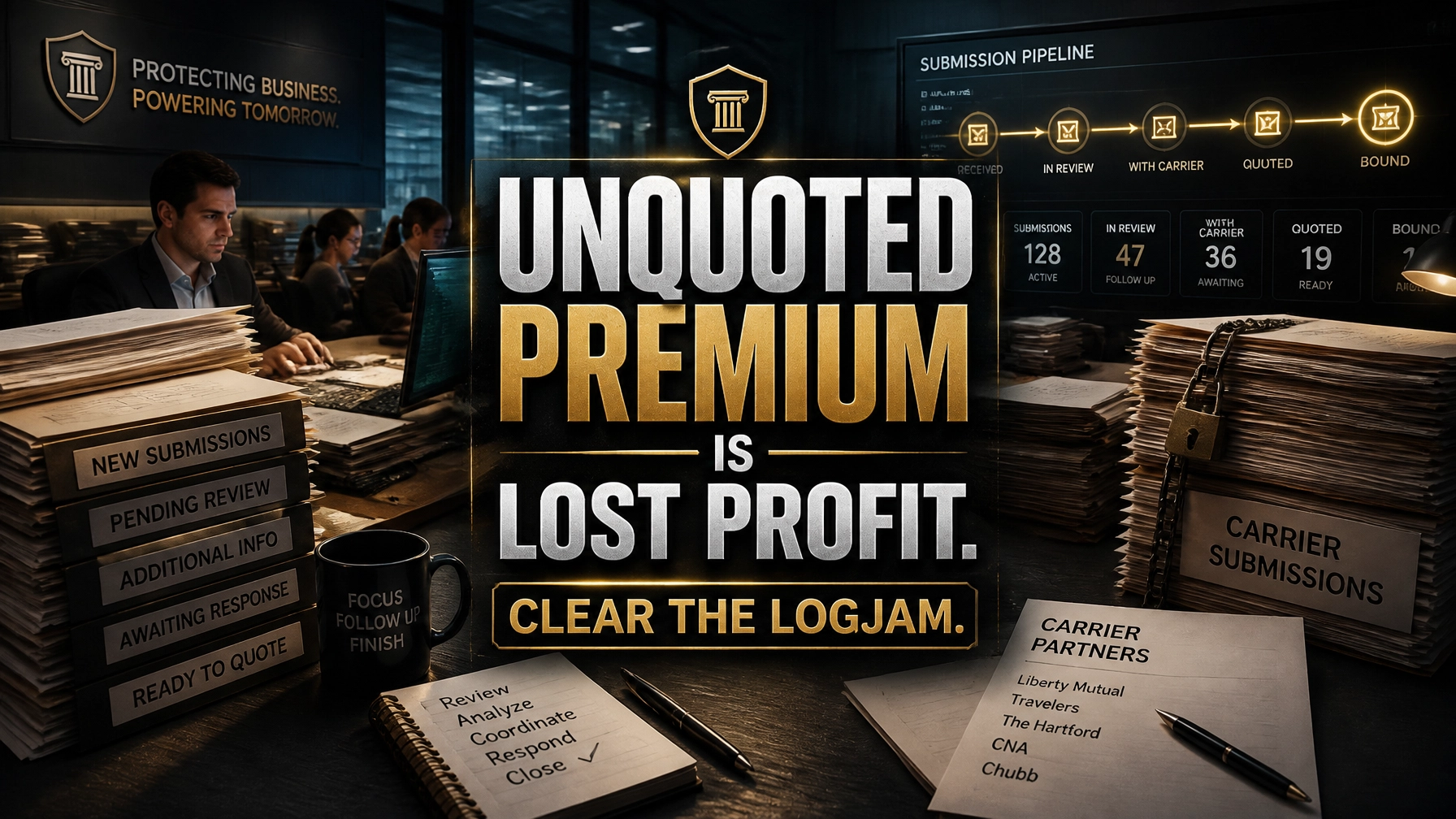
The silence in your agency isn’t peace, it’s the sound of profit leakage. Every hour a submission sits on a desk, every day a carrier request goes unanswered, and every moment a producer spends manually entering data into an Agency Management System (AMS) is a moment your premium is walking out the door.
In the world of independent insurance agencies, MGAs, and high-volume brokers, speed is the only currency that matters. When a prospect requests a quote, they aren't just looking for a price; they are looking for a solution to a problem. If your agency experiences "The Submission Stall", that agonizing gap between lead intake and a bound policy, you are losing business to faster, leaner competitors.
This friction isn't just a carrier problem; it’s an administrative problem. You are likely drowning in "Admin Debt," the accumulated weight of unfinished paperwork, unfiled endorsements, and stalled submissions that prevents your producers from doing what they do best: selling.
The Real Cost of Admin Debt
Admin Debt is the silent killer of the modern insurance agency. It happens when you prioritize the "fire of the day" over the systems required to scale. For many agency owners, especially those running Farmers Insurance agencies or independent shops using Applied Epic and EZLynx, the solution has traditionally been to hire more in-house staff.
However, hiring an in-house administrative assistant in the US often costs upwards of $60,000 per year when you factor in salary, taxes, benefits, and office space. This high overhead creates a new kind of friction: the financial inability to scale your support staff at the same rate as your lead flow.
When you systematize your operations with an Insurance Virtual Assistant, you shift the math. At $8 per hour, a specialized VA allows you to clear the logjam without the crushing weight of high-ticket payroll. Instead of a $60,000-a-year expense, you gain a scalable engine that standardizes your workflow for a fraction of the cost.
Underwriting Friction: The Invisible Barrier
Carrier friction often stems from "incomplete data" or "missing information" requests. When a submission is sent to a carrier through AMS360 or HawkSoft without the necessary ACORD forms, loss runs, or supplemental applications, the underwriter pushes it to the bottom of the pile. This is underwriting friction.
Underwriters prefer to work on "In Good Order" (IGO) submissions. If your agency consistently sends "Not In Good Order" (NIGO) files, you develop a reputation with your carriers as an agency that wastes their time. They respond slower, they quote less aggressively, and your "Submission Stall" worsens.
An Insurance Virtual Assistant acts as your quality control officer. They ensure that every submission sent to your carriers is complete, accurate, and ready for immediate review. This streamlines the carrier’s job, which in turn, accelerates your quote turnaround time.
Systematizing the Submission Engine
To eliminate the stall, you must move away from "manual" and toward "standardized." Whether you are using Applied Epic, AMS360, HawkSoft, or EZLynx, your processes must be documented and repeatable.
A Virtual Assistant doesn't just "help with paperwork"; they run your submission engine. They handle the data entry, they pull the MVRs and CLUE reports, and they follow up with carriers every 24 hours until a quote is delivered. This removes the administrative burden from your producers, allowing them to focus on high-value client advisory and closing deals.
For Farmers Insurance agencies, this is particularly critical. The requirement to maintain high activity levels while managing strict carrier guidelines means your internal team is often stretched thin. A VA can bridge the gap, ensuring that every lead is processed according to brand standards while you focus on growing your book of business.
Tactical SOP: The Carrier Submission Workflow
To stop the leak, you need a rigid Standard Operating Procedure (SOP). Use the following workflow to empower your Insurance Virtual Assistant to clear the submission logjam.
Step 1: Data Verification and ACORD Preparation
Upon receiving a lead, the VA immediately checks for data completeness. They verify the FEIN, address, and prior coverage details. They then pre-populate the necessary ACORD forms (125, 126, 131, etc.) within your AMS, ensuring no fields are left blank.
Step 2: Market Selection and Submission
The VA logs into the carrier portals or utilizes your integrated rater (like EZLynx) to upload the data. They attach all required supplemental documents, loss runs for the last three to five years, and the completed ACORD forms.
Step 3: The Underwriter Reach-Out
Once the submission is live, the VA sends a professional, standardized email to the underwriter. This email includes the submission number, a brief summary of the risk, and a request for an estimated turnaround time.
Step 4: The 24-Hour Follow-Up
If a quote is not received within 24 hours, the VA follows up via phone or email. They document every interaction in the AMS notes, ensuring the producer has full visibility into the status without having to pick up the phone.
Tactical SOP: Multi-Touch Quote Tracking
The "Submission Stall" often continues even after the carrier provides a quote. If that quote sits in an inbox for three days before reaching the client, the prospect has already signed with a competitor.
Step 1: Quote Retrieval and Formatting
As soon as a quote is issued, the VA retrieves it from the carrier portal. They format it into your agency’s branded proposal template, highlighting the key coverages and premium savings.
Step 2: Accuracy Audit
The VA compares the issued quote against the initial application to ensure all requested endorsements and limits were included. Any discrepancies are flagged to the underwriter immediately for correction.
Step 3: Client Notification
The VA notifies the producer that the "ready-to-present" proposal is in the system. If authorized, the VA can also send a "Status Update" email to the client, letting them know their custom quote is finalized and the agent will be calling shortly to review.
Step 4: Unquoted Premium Tracking
Every Friday, the VA generates a "Pipeline Report" from HawkSoft or Applied Epic. This report lists all pending submissions that haven't been quoted or bound. This ensures no lead is ever forgotten or left to rot in "Admin Debt."
Streamlining Renewals to Prevent Profit Leakage
Profit leakage isn't just about new business; it’s about the "Backdoor Leak" of lost renewals. When your staff is overwhelmed by new submissions, they often neglect the renewal process until it’s too late to re-market a declining risk.
An Insurance Virtual Assistant can standardize your renewal review process. 90 days before expiration, the VA can pull the renewal list, check for significant rate increases, and proactively gather updated information from the client. If a re-market is needed, they initiate the submission workflow described above before the client even realizes their rate has changed.
This proactive approach transforms your agency from a reactive "firefighting" shop into a proactive, systematized growth engine. You can learn more about how systematizing support roles can help you scale on our about page.
The Strategic Shift: $8/Hour vs. $60,000/Year
Consider the math. If you hire an in-house admin, you are paying for their commute, their coffee breaks, and their health insurance. If they are sick, your submissions stop. If they quit, your agency grinds to a halt while you spend months recruiting and training a replacement.
By partnering with Virtual Nexgen Solutions, you gain access to trained Insurance Virtual Assistants who understand the nuances of the US insurance market. For $8/hour, you get a dedicated professional who is already familiar with systems like Applied Epic and AMS360. You aren't just hiring a person; you are implementing a system that prevents premium loss.
This allows your producers to focus on high-ticket commercial lines or complex personal lines packages. When your producers are free from the "Submission Stall," their morale improves, their closing ratios climb, and your agency’s valuation increases.
Clearing the Logjam Today
The "Submission Stall" is a choice. You can choose to continue operating with high-friction, manual processes that lead to Admin Debt and profit leakage. Or, you can choose to systematize your agency with specialized support that scales with you.
Don't let unquoted premium become your competitor’s profit. Standardize your workflows, clear your desk of administrative tasks, and put your producers back on the frontline.
If you are ready to eliminate the friction in your agency, it’s time to look at a specialized administrative solution. Whether you are a small independent agent or a large MGA, the path to $10M+ in premium starts with the systems you put in place today.
Frequently Asked Questions
1. Can a Virtual Assistant work directly in my Applied Epic or AMS360?
Yes. Our Insurance Virtual Assistants are trained to work directly within your Agency Management Systems. They can handle data entry, document scanning, policy downloading, and certificate issuance just like an in-house employee, following your specific agency's security protocols.
2. How do you ensure the security of my client’s PII data?
Security is our highest priority. We implement strict data protection standards and can work within your agency’s existing VPN or secure remote desktop environments. We ensure that all VAs follow best practices for handling Personally Identifiable Information (PII) as required by state insurance regulations.
3. Is an $8/hour VA actually capable of handling complex insurance forms?
Absolutely. We specialize in providing VAs who understand the insurance industry. They are trained on ACORD forms, supplemental applications, and the general terminology of the industry. Because they focus specifically on administrative tasks, they often become more efficient at these processes than generalist in-house staff.
4. Can a VA help with my Farmers Insurance agency’s specific requirements?
Yes. We have experience working with Farmers Insurance agencies and understand the specific systems and compliance requirements unique to that brand. We help you maintain your activity levels and follow-up standards without burning out your local team.
5. How long does it take to get a VA up and running in my agency?
We pride ourselves on speed. Because our VAs are already familiar with the insurance landscape and systems like EZLynx and HawkSoft, the onboarding process is streamlined. You can often have a VA integrated into your workflow within a few days.
6. Can a VA handle carrier follow-ups and underwriter communication?
Yes, this is one of their most valuable functions. By standardizing the follow-up process, VAs ensure that your submissions stay at the top of the underwriter's pile, significantly reducing the "Submission Stall."
7. What happens if I need to scale my agency quickly?
That is the beauty of the VA model. Unlike hiring in-house, which involves a lengthy and expensive recruiting process, you can add additional VA support hours or staff members through Virtual Nexgen Solutions as your lead volume increases, allowing you to scale without increasing your fixed overhead significantly.
8. Do they handle renewals and endorsements as well?
Yes. VAs are excellent for managing the entire policy lifecycle. They can handle the administrative side of endorsements, cancellations, and proactive renewal reviews, ensuring your "Backdoor" is closed and your retention rates remain high.
Next Steps for Your Agency
Stop losing premium to the logjam of carrier friction. Every minute you wait is another lead that goes cold. Systematize your submission process today and reclaim your time to focus on growth.
Clear the logjam and start scaling.
Schedule your 30-minute Agency Strategy Session here to see how an Insurance Virtual Assistant can transform your bottom line.