
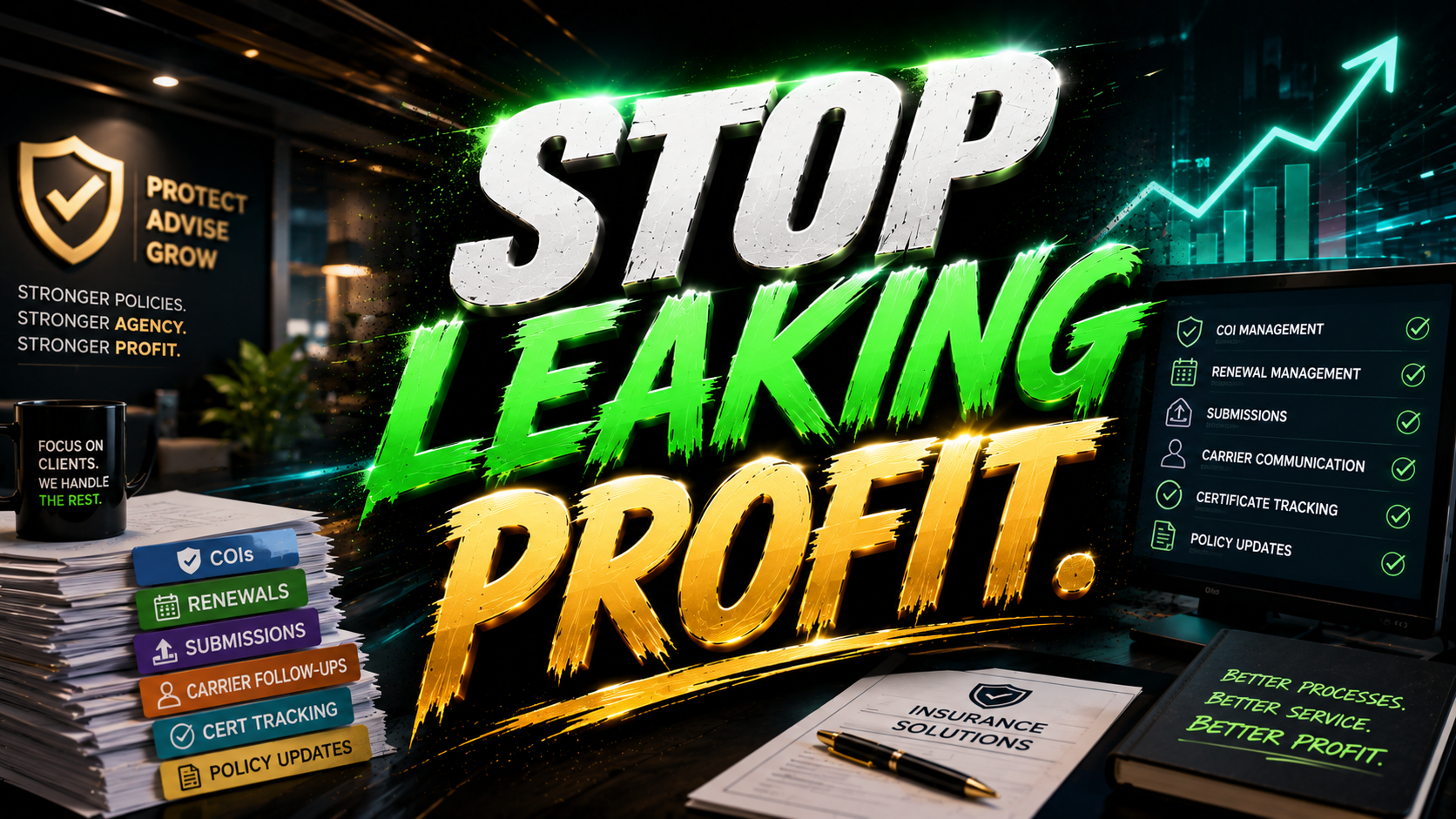
The independent insurance agency landscape in 2026 is no longer a battle of who has the best carrier appointments; it is a battle of who has the leanest operations. If you are running a Personal Lines or Commercial Lines agency, you are likely intimately familiar with "Admin Debt", the compounding weight of unfiled COIs, pending endorsements, and the 90-day renewal backlog that keeps your high-commission producers stuck in data entry hell.
When your $150,000-a-year lead producer is spending three hours a day typing VIN numbers into EZLynx or chasing down loss runs for a BOP submission, you aren't just losing time. You are suffering from "Profit Leakage." Every minute spent on a $15/hour task by a six-figure employee is a direct hit to your EBITDA.
According to industry data from Sonant in 2026, agencies that implement documented Standard Operating Procedures (SOPs) and delegate them to specialized support see an average of 26.1% higher EBITDA. The logic is simple: by shifting the administrative engine to a specialized Personal Lines Insurance Virtual Assistant or a Commercial Lines Insurance Virtual Assistant, you reclaim your advisory time.
Virtual Nexgen Solutions provides these specialized assistants at a flat rate of $8 per hour, allowing you to systematize your growth without the $60,000 annual overhead of an in-house administrative hire. This guide provides the exact blueprints, the SOPs, that transform a chaotic agency into a high-margin machine.
The Crushing Cost of Admin Debt in P&C Agencies
Before diving into the technical "how-to," you must acknowledge the severity of the operational hurdles facing today’s agencies. The "Admin Debt" crisis is often invisible until it manifests as a missed renewal or an Errors and Omissions (E&O) claim.
In a Personal Lines context, the sheer volume is the enemy. A single auto policy might only take 20 to 30 minutes to process from end-to-end, but when you multiply that by 500 renewals a month, your staff is buried. In Commercial Lines, the complexity is the killer. A single Business Owners Policy (BOP) submission can take 45 to 60 minutes of intensive data gathering, ACORD form preparation, and portal navigation.
If your staff is reacting to the loudest fire instead of following a proactive system, you are leaking revenue. You are losing the "cross-sell" opportunity because no one has the time to mention an umbrella policy. You are losing the "retention" battle because your 90-60-30 day renewal cycle is non-existent.
Industry Statistics: The Reality of Modern Staffing
The data is clear: the old model of "hiring another body" to solve the paperwork problem is dead.
- EBITDA Growth: Documented SOPs combined with specialized delegation lead to a 26.1% increase in profitability.
- Retention Lift: Moving from a reactive renewal process to a structured 90-60-30 day cycle reduces non-renewal rates from 12% down to 4%.
- E&O Risk: 65% of agency E&O claims are rooted in documentation errors and missed follow-ups, tasks that a dedicated VA manages with 100% focus.
- Cost Comparison: An in-house admin costs roughly $60,000/year (including taxes and benefits), whereas a Virtual Nexgen Solutions VA costs approximately $16,000/year for full-time support at $8/hr.
The Industry Software Engine
To successfully integrate a Virtual Assistant, your agency management system (AMS) must be the "Source of Truth." Our VAs are experts in the technical workflows of the industry’s leading platforms. Whether you use Applied Epic, AMS360, HawkSoft, EZLynx, PL Rating, Indio, Canopy Connect, QQCatalyst, or NowCerts, our team operates within your existing environment to streamline your day-to-day.
SOP 1: New Business Submission (Personal Lines Auto/Home)
Goal: To move a prospect from "Lead" to "Quoted" within 4 hours with 100% data accuracy.
Tools Needed: AMS (e.g., EZLynx, HawkSoft), Comparative Rater (PL Rating), Canopy Connect (for prior policy retrieval), Carrier Portals.
Step-by-Step Process:
- Lead Intake: The VA receives the lead via your CRM or email. They verify all basic contact information.
- Data Extraction: Use Canopy Connect to pull the prospect’s current dec pages. The VA extracts drivers, vehicles, VINs, and current coverage limits.
- Rating Input: The VA enters the data into the comparative rater. They ensure all "hidden" discounts (good student, telematics, multi-policy) are checked.
- Carrier Portal Bridge: For top-tier carriers that don’t bridge perfectly, the VA manually enters the data into the carrier portal to ensure price accuracy.
- Proposal Assembly: The VA creates a side-by-side comparison of current vs. proposed coverage and saves it in the AMS.
- Producer Hand-off: The VA notifies the producer that the "Quote is Ready for Review" via a task in the AMS.
Exception Handling:
- Missing VIN: VA sends a templated text/email to the client immediately.
- Ineligible Risk: If the driver has a recent DUI or major violation, the VA flags the file for "High-Risk Market" instead of the standard rater.
SOP 2: New Business Submission (Commercial Lines BOP/WC)
Goal: Complete a full submission packet for underwriters that requires zero back-and-forth "clarification" emails.
Tools Needed: AMS (Applied Epic/AMS360), Indio (for applications), Carrier Portals, RiskReport.
Step-by-Step Process:
- Application Prep: The VA populates ACORD 125, 126, and 130 using data from the initial discovery call notes.
- Loss Run Procurement: VA sends formal requests to prior carriers for 3-5 years of loss runs. They follow up every 48 hours until received.
- Supplemental Forms: Based on the SIC/NAICS code, the VA identifies and prepares required supplemental applications (e.g., Roofers Supplement, Cyber Questionnaire).
- Submission Upload: VA uploads the full "Submission Jacket" to carrier portals or emails it to the appointed underwriters.
- Diary Management: The VA sets a 3-day diary to follow up with the underwriter for a status update.
Exception Handling:
- Declination: If a carrier declines, the VA logs the reason in the AMS and pivots to the next carrier on the pre-approved appetite list.
SOP 3: The 90-60-30 Day Renewal Cycle
Goal: Proactively manage renewals to eliminate "sticker shock" and prevent non-renewals.
Tools Needed: AMS Reports, Email Templates, VOIP System.
Step-by-Step Process:
- 90 Days Out (The Audit): The VA runs a renewal report. They check the file for accuracy. Is the address still correct? Are there new drivers?
- 60 Days Out (The Marketing Decision): If the renewal premium increases by more than 10%, the VA automatically starts the "Remarket" workflow (refer back to SOP #1 or #2).
- 45 Days Out (Client Touchpoint): VA sends a proactive "Renewal Review" email or text. "We are reviewing your upcoming renewal to ensure you still have the best rate."
- 30 Days Out (The Confirmation): VA confirms the renewal is bound or the new policy is issued. They update the AMS status.
Exception Handling:
- Non-Renewal Notice: If the carrier issues a non-renewal notice, the VA immediately escalates the file to the lead producer for emergency remarketing.
SOP 4: Certificate of Insurance (COI) Issuance & Tracking
Goal: Issue standard COIs within 30 minutes of request to keep your commercial clients on the job site.
Tools Needed: AMS (Certificates module), Client Contract/Requirements.
Step-by-Step Process:
- Request Intake: VA receives a COI request from the client or a third-party certificate holder.
- Requirement Review: VA reviews the contract provided by the certificate holder. They check for "Additional Insured" or "Waiver of Subrogation" requirements.
- Coverage Verification: VA checks the current policy in the AMS to ensure the required limits (e.g., $1M/$2M) are met.
- Drafting: VA creates the COI in the AMS.
- Review & Send: For standard requests, the VA issues the COI and emails it to all parties. For non-standard requests (manuscript forms), they flag it for the Account Manager.
- Log: The COI is saved as an activity in the AMS.
Exception Handling:
- Insufficient Limits: If the contract requires $2M but the client has $1M, the VA contacts the client to discuss a mid-term limit increase or an umbrella policy.
SOP 5: Endorsement Processing & Policy Change Management
Goal: Accurate processing of policy changes within 24 hours of the request.
Tools Needed: Carrier Portals, AMS, E-signature tools (DocuSign/HelloSign).
Step-by-Step Process:
- Change Intake: VA receives a request (e.g., "Add a 2024 Ford F-150").
- Quote the Change: VA goes to the carrier portal to see the premium impact.
- Client Approval: VA emails the client: "Adding this vehicle will increase your monthly premium by $42. Please sign this change request form to proceed."
- Processing: Once signed, the VA processes the change in the carrier portal and updates the AMS.
- Verification: VA sets a 7-day diary to check that the carrier issued the endorsement correctly.
Exception Handling:
- Underwriting Hold: If the carrier puts the change on hold (e.g., needs a vehicle inspection), the VA manages the follow-up with the client to get the required photos.
SOP 6: First Notice of Loss (FNOL) Intake
Goal: To provide an empathetic, structured claims intake that reduces client anxiety and ensures data completeness.
Tools Needed: Claims Intake Form, AMS, Carrier Claims Portal.
Step-by-Step Process:
- Intake: VA takes the call or receives the email. They follow a specific empathy script.
- Data Capture: VA gathers the "Who, What, Where, When." They ask for photos of the damage and police report numbers.
- Submission: VA enters the claim into the carrier's portal and the AMS simultaneously.
- Client Guidance: VA provides the client with the claim number and the adjuster’s contact info (if available immediately).
- Follow-up: VA sets a 48-hour task to check if an adjuster has contacted the client.
Exception Handling:
- Catastrophic Loss: If the claim involves a fatality or total property loss, the VA immediately transfers the call to the Agency Principal.
Case Study Examples: ROI in Action
Case Study 1: The Personal Lines "Renewal Rescue"
The Scenario: A P&C agency in Florida, heavy on personal auto and homeowners, was facing a 15% non-renewal rate. Their account managers were so overwhelmed with new leads that they only looked at renewals when a client called to complain about a rate hike.
The Solution: They hired a Virtual Nexgen Solutions VA specifically to handle SOP #3 (The 90-60-30 Day Cycle).
The Result: Within six months, the non-renewal rate dropped to 5%. The VA identified over $400,000 in "at-risk" premium that needed remarketing before the client even knew their rate was going up. The agency owners saw a direct correlation between the VA's $8/hr cost and the retention of $25,000 in annual commissions that would have otherwise walked out the door.
Case Study 2: The Commercial "Certificate Bottleneck"
The Scenario: A commercial lines brokerage in Texas specializing in construction was losing clients. Contractors were complaining that they couldn't get onto job sites because COIs were taking 48 hours to be issued. The Account Managers were too busy with marketing and underwriting.
The Solution: The agency implemented SOP #4 and delegated all COI requests to a specialized Virtual Assistant.
The Result: COI turnaround time dropped from 48 hours to 22 minutes. Client satisfaction scores skyrocketed, and the Account Managers reclaimed 12 hours per week each, time they used to move an additional $1.2M in new business premium through the pipeline in a single year.
Cost Comparison: The $8/hr Engine vs. The $60k Overhead
When you hire an in-house Administrative Assistant in the United States, you aren't just paying a salary. You are paying for:
- Base Salary: $45,000 - $55,000
- Payroll Taxes: 15% ($7,500)
- Benefits & Health Insurance: $5,000+
- Office Space & Equipment: $2,000
- Training & Turnover Risk: Variable but high.
Total Annual Cost: ~$60,000 - $70,000.
In contrast, a specialized Insurance Virtual Assistant from Virtual Nexgen Solutions costs:
- Hourly Rate: $8/hour
- Annual Cost (Full Time): ~$16,640
- Overhead: $0 (We handle the equipment and management).
By choosing the virtual model, you save over $40,000 per year per seat. That is $40,000 that goes directly into your EBITDA.
Tips & Tricks for Agency Principals
- Record Your Screen: Before hiring a VA, use a tool like Loom to record yourself performing a task in your AMS. This "Video SOP" is the fastest way to train your virtual partner.
- The "End of Day" Report: Require your VA to send a daily summary of: Tasks Completed, Tasks Pending, and "Need From You" items. This ensures accountability.
- Audit for E&O: Periodically review the "Activity Notes" in your AMS to ensure the VA is documenting every client interaction with precision. Documentation is your best defense against E&O claims.
- Empower, Don't Micromanage: Once the VA has mastered the SOP, let them own the process. If they are handling COIs, let them own the COI inbox.
- Use Templated Communication: Create a library of approved email and text templates for your VA to use. This ensures a consistent brand voice for your agency.
Industry Trends: The Shift to "Fractional Support"
As we move through 2026, the most successful agencies are shifting toward a "Hub and Spoke" model. The "Hub" is your licensed, local expertise, the producers and advisors who build relationships. The "Spokes" are the specialized virtual assistants who handle the technical, repetitive execution.
This model allows for infinite scalability. If you want to grow your commercial book by 30%, you don't need to find another $100k Account Manager; you simply need to increase your virtual support capacity to handle the additional submissions and COIs.
Frequently Asked Questions
1. Can a Virtual Assistant handle sensitive client data like Social Security numbers?
Yes. Our VAs operate within your secure Agency Management System (AMS) environment. We follow strict data security protocols, and most agencies provide VAs with a secure remote login or a company-specific email and password to ensure all data stays within your controlled systems.
2. Do I need to license my Virtual Assistant?
In most cases, no. Our VAs handle administrative, non-discretionary tasks that do not require a license, such as data entry, document preparation, and scheduling. If a task requires "explaining coverage" or "recommending limits" in a way that constitutes solicitation, that remains the responsibility of your licensed in-house staff.
3. Which Agency Management Systems (AMS) are your VAs familiar with?
Our team is proficient in the leading industry platforms, including Applied Epic, AMS360, HawkSoft, EZLynx, PL Rating, and QQCatalyst. Because we focus on the insurance industry, our VAs understand the logic behind these systems.
4. How do I communicate with my VA throughout the day?
Most of our clients use tools like Slack, Microsoft Teams, or direct email. We recommend a quick 5-minute "huddle" or a daily end-of-day report to keep projects on track and ensure priorities are aligned.
5. What is the typical turnaround time for a new business quote?
While this depends on the complexity of the risk, our Personal Lines VAs typically complete the data entry and initial rating for an auto/home quote within 1 to 2 hours of receiving the lead.
6. Can a VA help with marketing my agency?
Absolutely. Beyond administrative tasks, our VAs can assist with social media management, email newsletters, and coordinating outbound lead-generation campaigns to help you build a stronger brand.
7. Is there a long-term contract required?
Virtual Nexgen Solutions offers flexible solutions tailored to your business needs. Our goal is to grow with you, providing reliable support that scales as your agency scales.
8. How do you ensure the quality of work and prevent E&O issues?
Quality control is built into our SOPs. By following a step-by-step checklist and documenting every action in your AMS, we create a clear audit trail. We also recommend that agency principals perform periodic spot-checks to ensure compliance with their specific standards.
9. Can your VAs handle Commercial Lines Certificates of Insurance (COIs)?
Yes, this is one of our most requested services. Our VAs can manage the intake, verification of requirements, and issuance of COIs, allowing your commercial account managers to focus on high-value renewal negotiations.
Conclusion: Systematize or Stagnate
The difference between an agency that struggles to stay afloat and one that dominates its market is the quality of its systems. By implementing these 6 SOPs and delegating the administrative engine to a specialized Insurance Virtual Assistant, you are choosing to scale the engine, not the overhead.
Profit Leakage and Admin Debt are the silent killers of the independent agency. Reclaim your time, protect your EBITDA, and focus on what you do best: advising your clients and growing your book.