

Your remodeling projects are leaking $120,000 a year, and the culprit isn’t your craftsmanship, your crew, or your subs. It is your change order process. In the high-stakes world of residential remodeling, where a single kitchen renovation can involve over 200 individual selections and a dozen trade partners, administrative friction is not just a nuisance; it is a financial catastrophe.
Every time a client asks for a different backsplash tile on-site and your lead carpenter says "no problem" without a signed document, you lose money. Every hour you spend chasing a homeowner for their faucet selection is an hour you aren't bidding on a $500,000 whole-home remodel. This is the reality of Admin Debt, the accumulated cost of manual, inefficient processes that eventually come due in the form of shrunken margins and project delays.
At Virtual Nexgen Solutions, we see this pattern across the United States. Remodeling contractors are excellent at building beautiful spaces, but they are drowning in the "Selection Coordination Tax" and the "Change Order Crisis." By the time you realize a change order wasn't billed, the drywall is up, the client is happy, and your profit is gone.
The $120,000 Change Order Crisis: By the Numbers
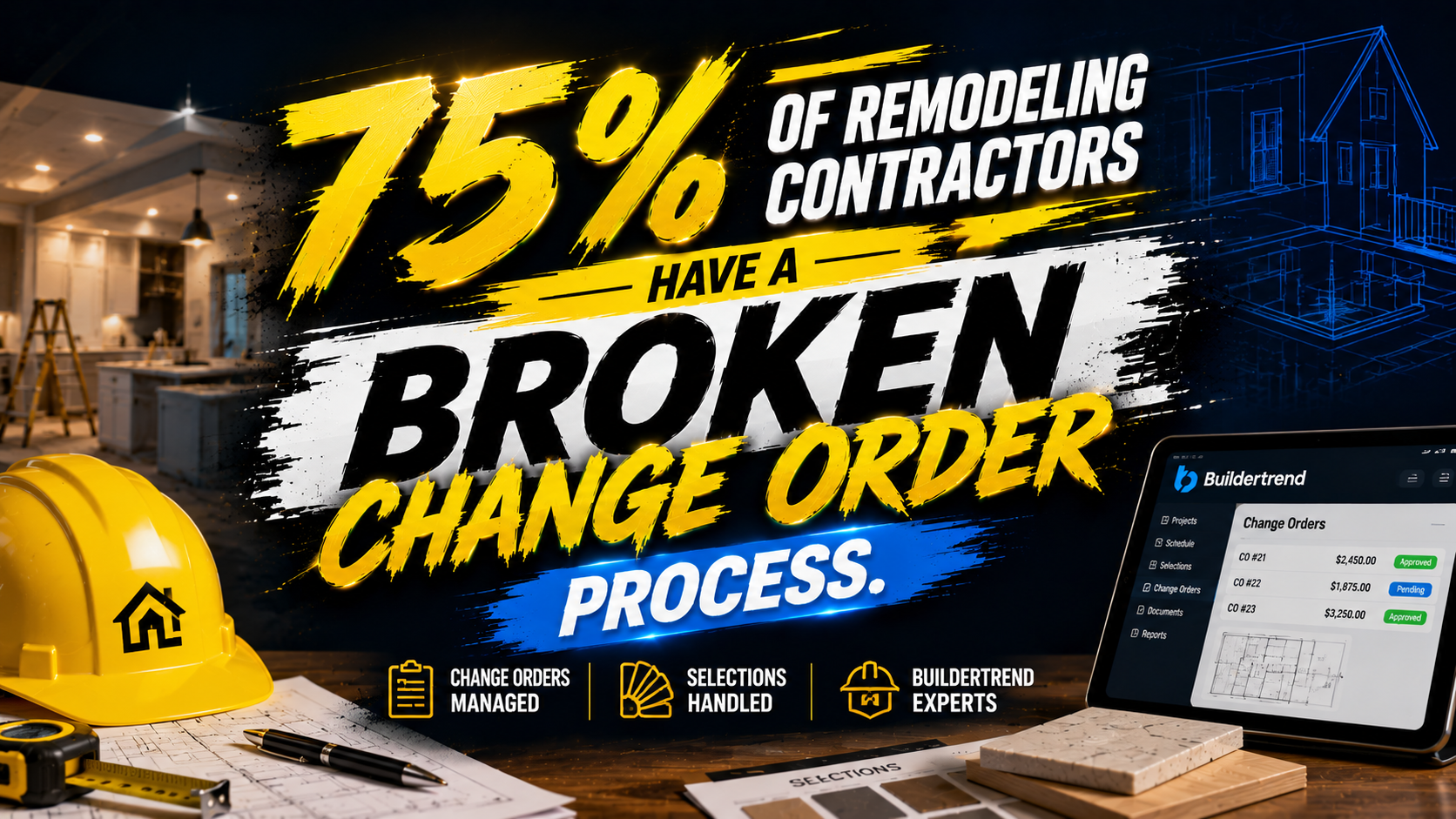
The scale of this problem is staggering. Recent 2026 industry research from Clearstory reveals that 75% of contractors admit their change order process is fundamentally broken. They are performing work before approvals are signed, communicating changes via text message, and failing to capture the full cost of labor and material escalations.
For a mid-sized remodeling firm generating $2 million in annual revenue, uncollected or under-billed change orders typically cost between 3% and 8% of total revenue. That is a leak of $60,000 to $160,000 every single year. When you factor in the 2026 reality of material price volatility, where tariffs and supply chain shifts have pushed costs up by an average of 6%, failing to document a scope change is no longer a minor oversight; it is a direct hit to your company's solvency.
Only 1 in 3 contractors believe their current system for managing scope changes actually works. The rest are relying on "squaring up at the end," a strategy that almost always results in the contractor eating the cost to avoid a confrontation with the client at the finish line.
The Selection Coordination Tax: The 20-Hour Drain
Beyond the direct loss of unbilled work lies the Selection Coordination Tax. A typical high-end kitchen or bath remodel requires the client to make dozens of decisions: cabinet door styles, finish hardware, grout colors, appliance specs, and lighting layouts.
Left unmanaged, this process burns 15 to 20 hours of professional time per project. If you, the business owner, are the one sending the emails, scheduling the showroom visits, and updating the finish schedule, you are paying yourself the equivalent of $200/hour to do $20/hour work. Worse, if these selections are not finalized before the sledgehammers hit the walls, you face "Decision Fatigue Delays." When a client stalls on a tile choice, your tile sub moves to another job, your schedule slides by two weeks, and your overhead continues to burn.
Operational Challenges: Why Scaling Feels Impossible
Most remodeling contractors hit a "complexity ceiling" around $1.5 million in revenue. To grow beyond that, you need more than just more crews; you need a robust administrative engine. However, the staffing challenges in the current US market make this difficult:
- The High Cost of In-House Staff: Hiring a dedicated Project Coordinator or Office Manager in a major US metro area costs roughly $65,000 per year plus benefits, taxes, and office space. This is a massive fixed overhead for a growing firm.
- The Training Burden: Training a general admin person on the nuances of construction, the difference between a rough-in and a trim-out, or how to read a cabinet elevation, takes months of your personal time.
- The Recruitment Gap: High-quality administrative professionals with construction experience are rare and often recruited by large commercial firms, leaving residential remodelers struggling with high turnover.
Industry Trends: The Shift to Design-Build and the 2026 Landscape
The remodeling industry is shifting rapidly toward a design-build model where the contractor takes full responsibility for the project's outcome. This shift requires even higher levels of documentation. In states like California, the 2026 SB 440 Fair Payment Act has introduced strict timelines for change order responses, making formal documentation a legal necessity for protecting your right to payment.
Furthermore, the rise of "Client Experience" as a primary differentiator means that homeowners now expect a digital-first interaction. They want to see their selections, their budget, and their schedule updated in real-time. If you are still using paper folders and messy email chains, you are losing the trust of the high-net-worth clients you want to serve.
The Specialized Solution: An $8/hr Remodeling Virtual Assistant
Virtual Nexgen Solutions provides a bridge between the "do-it-all" business owner and the expensive $65k/year in-house hire. For just $8 per hour, you gain a specialized Remodeling Virtual Assistant who understands the construction lifecycle and is trained in the industry's leading software.
Our VAs do not just "help out"; they own specific technical workflows that plug your revenue leaks and eliminate your Admin Debt.
Mastering Your Industry Software
A specialized VA from Virtual Nexgen Solutions arrives ready to work within your existing tech stack. We specialize in the software that runs the remodeling world:
- Buildertrend & CoConstruct: Your VA manages the entire "Selections" module, uploading photos, tracking client approvals, and ensuring that every selection has a corresponding cost. They handle the "Change Order" lifecycle, drafting the document, sending it via the portal, and following up until it is digitally signed.
- JobTread: We use JobTread’s powerful budgeting tools to track actual vs. estimated costs in real-time. Your VA inputs vendor invoices and subcontractor bills, flagging any variances immediately so you can issue a change order before the margin erodes.
- Projul & Houzz Pro: Your VA manages the lead pipeline, ensuring that every inquiry is screened and scheduled, and that estimates are followed up on within 24 hours.
- CompanyCam: We organize your job site photos, tagging them by project and phase so you have a visual record of every "extra" requested on-site.
11-Task Checklist for Your Remodeling VA
Implement this workflow immediately to see an instant ROI from your specialized assistant:
- Draft Change Orders: Every time a scope change is identified, the VA drafts the formal document in your project management software, including labor, material, and markup.
- Selection Coordination: The VA sends selection reminders to clients, gathers their choices, and updates the Master Finish Schedule.
- Vendor Quote Requests: When a client changes a fixture or finish, the VA contacts the vendor for updated pricing and lead times.
- Permit Tracking: They handle the tedious task of checking municipal portals for permit status and coordinating with city clerks.
- Subcontractor Scheduling: The VA confirms schedules with your plumbers, electricians, and HVAC subs 48 hours before they are needed on-site.
- Daily Log Management: They take the notes and photos your lead carpenter uploads and turn them into professional client-facing daily logs.
- Lien Waiver Collection: The VA ensures every sub has signed a lien waiver before their check is released.
- Showroom Appointment Scheduling: They coordinate the calendar between the client and the design center.
- Lead Screening: The VA qualifies incoming calls based on your project minimums, saving you from wasting time on "tire kickers."
- Aged Receivable Follow-up: They politely follow up on outstanding invoices to keep your cash flow positive.
- Close-out Manuals: At the end of the project, the VA compiles all warranties, paint colors, and appliance manuals into a digital "Owner's Manual."
Case Study: From Chaos to $1.8M in the Pacific Northwest
Consider a high-end kitchen and bath remodeling firm in Seattle, Washington. Before partnering with Virtual Nexgen Solutions, the owner was working 70 hours a week. He was brilliant at design but terrible at the "paperwork tax." He had $45,000 in unbilled change orders from three concurrent projects because he "didn't want to slow down the crew" by waiting for signed paperwork.
We implemented a specialized VA at $8/hr. The mandate was simple: No sub starts a change until the VA confirms the digital signature in Buildertrend.
Within six months:
- Revenue Capture: The firm captured an additional $72,000 in change order revenue that would have previously been "absorbed."
- Time Savings: The owner reclaimed 15 hours per week previously spent on selection emails and vendor follow-ups.
- Growth: Using that reclaimed time, the owner landed two whole-home renovations, pushing his annual revenue from $1.2M to $1.8M without adding a single in-house admin.
The cost of the VA was roughly $1,300 per month. The ROI on the captured change orders alone was over 400%.
The Hard Math: $8/hr VA vs. $65k/year In-House
When you look at the economics, the decision becomes clear.
In-House Project Coordinator:
- Salary: $65,000/year
- Taxes & Benefits (20%): $13,000
- Overhead (Desk, Computer, Software): $5,000
- Total Annual Cost: $83,000
- The Risk: If business slows down, you are stuck with a high fixed salary.
Virtual Nexgen Solutions VA:
- Rate: $8/hour
- Annual Cost (40 hrs/week): $16,640
- Taxes & Benefits: $0 (Managed by us)
- Overhead: $0 (They use their own equipment)
- Total Annual Cost: $16,640
- The Benefit: You save over $66,000 per year while getting specialized expertise.
This $66,000 difference represents pure profit that stays in your business. It is the capital you need to buy a new truck, invest in better marketing, or simply take a well-deserved vacation.
Future Trends: The Professionalization of the Remodeler
As we move toward 2027, the gap between the "Chuck in a truck" and the "Professional Remodeler" is widening. Homeowners are increasingly wary of contractors who lack systems. They are looking for firms that provide transparency, documented budgets, and seamless communication.
By delegating your administrative tasks to a specialized assistant, you aren't just saving money; you are building a brand. You are creating a business that is "system-dependent" rather than "owner-dependent." This is the only way to build a company that has actual resale value in the future.
Frequently Asked Questions (FAQ)
1. How does a Virtual Assistant handle physical samples or showroom visits?
Your VA coordinates the logistics. They contact showrooms to verify that specific samples are in stock, schedule the appointment for your client, and then follow up with the showroom consultant to receive the selection sheet. They act as the "air traffic controller" for the physical process.
2. Can an $8/hr VA really understand complex construction software like Buildertrend?
Yes. At Virtual Nexgen Solutions, we recruit VAs who already have experience in the construction industry and provide them with specific training on the technical workflows required for remodeling. They aren't generalists; they are specialists.
3. What happens if the VA makes a mistake on a change order?
Our VAs follow a strict "Draft and Approve" workflow. They prepare the change order based on your inputs or project notes, and you (or your Lead PM) give a final 30-second review before it is sent to the client. This ensures 100% accuracy while removing 95% of the work from your plate.
4. How do I communicate with my VA throughout the day?
Most of our remodeling clients use Slack, Microsoft Teams, or WhatsApp for quick communication. For project-specific tasks, all communication happens directly inside your project management software (like JobTread or CoConstruct) so there is a permanent record.
5. Is there a long-term contract?
No. We believe in earning your business every day. Our goal is to become an indispensable part of your operations, but we provide the flexibility you need to scale your support up or down based on your project volume.
6. Can they help with my subcontractor insurance and COIs?
Absolutely. One of the most common tasks for our VAs is "Compliance Management." They track subcontractor insurance expiration dates, request updated COIs, and ensure no sub is on your job site with expired coverage.
7. How do I know the VA is actually working?
We use transparent time-tracking software that provides activity reports and screenshots. However, our clients usually measure success by the results: the number of signed change orders, the up-to-date finish schedules, and the hours they get back in their day.
8. Do they work in my time zone?
Yes. We align our specialized VAs to work within your specific US time zone: whether you are on the East Coast, West Coast, or anywhere in between: ensuring they are available when your crews and clients are active.
Conclusion: Stop Paying the Admin Debt Tax
The "Change Order Crisis" is only a crisis if you don't have the systems to handle it. You can continue to lose 5% of your margin to unbilled work and 20 hours a week to selection coordination, or you can systematize your business for $8 per hour.
The most successful remodeling firms in the United States aren't those with the best tools or the biggest crews; they are the ones with the best administrative engine. They understand that their time is better spent on high-level strategy and client relationships than on updating spreadsheets and chasing tile specs.
Partner with Virtual Nexgen Solutions today. Let us provide the specialized administrative support you need to stop the profit leaks, eliminate your Admin Debt, and finally scale your remodeling business to its full potential.Book Your FREE Consultation.