

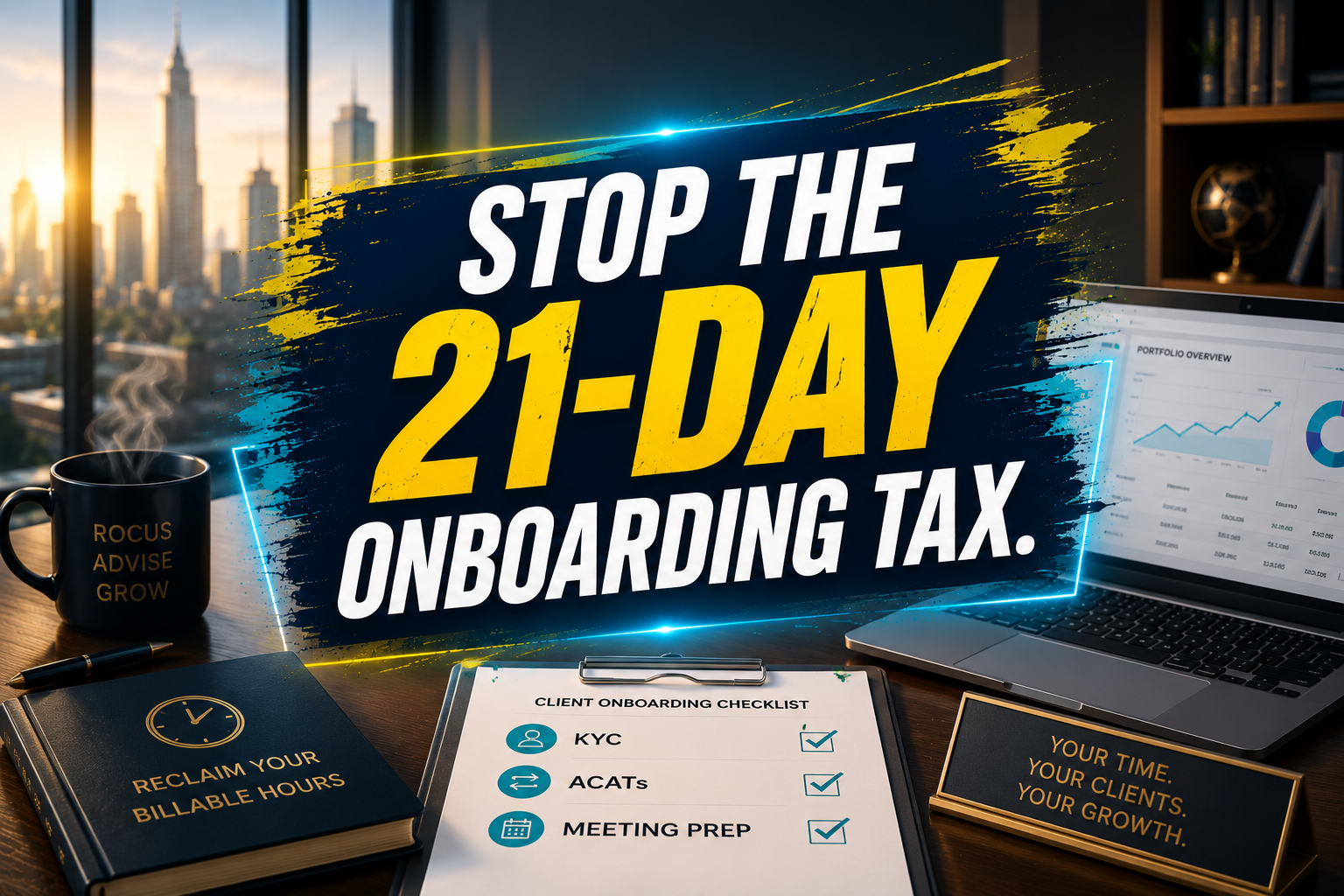
The average financial advisor is currently drowning in a silent crisis of "Admin Debt." Every time a new client signs an advisory agreement, a clock starts ticking. In a perfect world, that client’s assets would move seamlessly, their data would populate perfectly in your CRM, and their first quarterly review would be a celebration of progress. In reality, the "Onboarding Tax" consumes between 15 and 21 days of back-and-forth communication, manual document chasing, and custodian-induced headaches.
This delay is not just an inconvenience; it is a massive profit leak. When a client spends three weeks in "onboarding limbo," their trust in your firm wavers. When you spend eight hours a week pulling reports from Orion or Black Diamond for a meeting that should have been prepared by a specialist, you are effectively paying yourself $8 an hour for $500-an-hour work.
A specialized virtual assistant for financial advisor is the solution to this systemic inefficiency. By implementing rigid, high-performance Standard Operating Procedures (SOPs), Virtual Nexgen Solutions helps you reclaim your time, eliminate administrative friction, and scale your AUM without increasing your overhead.
The Massive Burden of Financial Admin Debt
Financial advisors are often told that "scaling" requires more technology. However, adding more software without a specialized operator only increases the complexity. You end up with a "Franken-stack" of tools, Redtail, eMoney, Holistiplan, and DocuSign, that don't talk to each other effectively. This creates a data silo problem that leads to "Admin Debt", the accumulated weight of unfinished tasks, messy CRM records, and unfiled compliance documents.
The Onboarding Tax: 21 Days of Lost Momentum
Industry data suggests that the average lead time to fully onboard a wealth management client is 22 days. For complex high-net-worth (HNW) cases, this can stretch to months. During this period, the advisor is often the one performing the following tasks:
- Reminding the client to upload their 1040s or trust documents.
- Calling the custodian (Schwab, Fidelity, or Pershing) to ask why an ACAT transfer is stalled.
- Manually entering client beneficiaries and contact info into the CRM.
This manual labor accounts for roughly 43 days of lost productivity per year per advisor. At a standard advisory rate, that is over $100,000 in lost revenue potential.
The Meeting Prep Crisis
Quarterly and annual reviews are the lifeblood of client retention. Yet, preparing for these meetings is often a weekend-consuming nightmare. Gathering performance reports, updating financial plans in MoneyGuidePro, and creating a cohesive agenda takes 5–8 hours per week. If you have 100 clients, you are spending hundreds of hours a year on "prep" instead of "prospecting."
Industry Statistics: The Cost of Inaction
The numbers behind the administrative burden in the financial services sector are staggering. To understand why a virtual assistant for financial advisor is a necessity, you must look at the operational reality of the modern RIA:
- Client Abandonment: 70% of financial institutions lost potential clients in the last year specifically due to slow or complex onboarding processes.
- Onboarding Dropout: Cold leads have a 50% dropout rate during the paperwork phase, while warm leads still see a 25% attrition rate if the process is friction-heavy.
- Resource Intensity: Advisors spend an average of 13 hours per case just on administrative onboarding tasks.
- Asset Delays: 27% of onboarding delays are caused by ACAT (Automated Customer Account Transfer) processing issues, often due to minor data mismatches that go unnoticed for days.
- The Profit Leak: For every hour an advisor spends on $8/hr administrative work, they lose the opportunity to generate $500+ in value through estate planning, tax strategy, or business development.
Operational Challenges: Why Most Advisors Struggle to Scale
The primary challenge in a wealth management firm is not a lack of leads; it is an "Operational Bottleneck." As you grow, the weight of your existing client base increases. Each new client adds a layer of recurring tasks: RMD tracking, beneficiary updates, compliance audits, and meeting prep.
Staffing Hurdles: The "Full-Time" Trap
Many advisors believe the only way to solve this is to hire a full-time, in-house Operations Manager or Client Service Associate (CSA). However, in the US, a qualified CSA costs upwards of $60,000 to $80,000 per year plus benefits, taxes, and office space. For a solo advisor or a small team, this overhead can crush profit margins.
Furthermore, training an in-house hire takes months of the advisor's time. By contrast, a specialized virtual assistant for financial advisor from Virtual Nexgen Solutions comes with an understanding of industry software and high-level SOPs, costing only $8 per hour.
The Compliance Documentation Gap
In a post-Reg BI world, documentation is everything. If it isn't in the CRM, it didn't happen. Most advisors are excellent at the "planning" part but struggle with the "contemporaneous notes" part. This creates a massive liability during an SEC or FINRA audit. A VA ensures that every interaction, every change in risk tolerance, and every signed disclosure is filed and logged in real-time.
Industry Trends: The Shift to Specialized Delegation
The wealth management industry is shifting toward a "Hub and Spoke" model. The advisor is the "Hub", the visionary who handles the relationship and the high-level strategy. The "Spokes" are specialized support teams that handle the technical execution.
- Virtual Family Offices: Even smaller RIAs are now mimicking the "Family Office" model by using specialized VAs to coordinate with a client’s CPA and attorney.
- Systematized Client Experience (CX): Clients no longer compare you to other advisors; they compare you to Amazon and Uber. They expect a seamless, digital, and fast onboarding experience.
- Data-Driven Retention: Firms are using CRMs like Salesforce Financial Cloud to track "last contact" dates and "client sentiment," but these systems only work if someone is actually managing the data.
Essential Software for the Modern Financial VA
Our specialized VAs are trained to work within the specific software ecosystem of the financial industry. We don't just "learn" these tools; we integrate into them to drive efficiency.
- CRM Systems: Redtail, Salesforce Financial Services Cloud, Wealthbox.
- Portfolio Management & Reporting: Orion, Tamarac, Black Diamond, Morningstar Office.
- Financial Planning: eMoney, MoneyGuidePro, RightCapital.
- Custodian Platforms: Schwab Advisor Center, Fidelity Wealthscape, Pershing NetX360.
- Documentation & Compliance: DocuSign, Holistiplan (for tax prep), XTRAC (for workflow).
5 Actionable SOPs for Your Financial Advisor Virtual Assistant
To reclaim your time, you must stop "delegating tasks" and start "delegating outcomes." Use these five Standard Operating Procedures to turn your back office into a high-efficiency engine.
SOP 1: New Client Onboarding & KYC Documentation Collection
The goal of this SOP is to move a client from "Signed Contract" to "Account Ready" in under 48 hours.
- Initial Trigger: Once the advisor signs a new client, the VA is notified via the CRM.
- Document Audit: The VA reviews the initial meeting notes to identify required documents (e.g., Trust Agreements, prior year tax returns, current brokerage statements).
- The "Welcome Vault" Setup: The VA sets up a secure document folder (e.g., Box or Citrix ShareFile) and sends a personalized link to the client.
- KYC Verification: The VA cross-references the client’s ID and tax documents against the custodian’s requirements to ensure no "NIGO" (Not In Good Order) errors occur.
- E-Signature Management: The VA prepares all DocuSign packets, pre-filling 90% of the data to minimize client effort.
SOP 2: ACAT Transfer Coordination & Custodian Follow-Up
The "ACAT Limbo" is where most client momentum dies. This SOP ensures assets move with urgency.
- Initiation: After signatures are received, the VA submits the transfer request through the custodian portal (e.g., Schwab Advisor Center).
- The 48-Hour Check: If the assets haven't moved within 48 hours, the VA calls the delivering firm’s back office to identify any "rejection codes."
- Client Update: The VA sends a proactive "Status Update" email to the client every Tuesday and Thursday so the client never has to wonder where their money is.
- Cost-Basis Audit: Once assets land, the VA checks for missing cost-basis data and contacts the previous firm to retrieve it.
- Funding Notification: The VA alerts the advisor the moment the account is funded and ready for the initial trade.
SOP 3: Quarterly Meeting Prep & Portfolio Report Assembly
Never spend another Sunday night in a PDF editor.
- The 10-Day Trigger: Ten days before a scheduled review, the VA initiates the prep sequence.
- Report Generation: The VA pulls performance reports from Orion or Black Diamond, ensuring the date ranges and benchmarks are correct.
- Data Scrubbing: The VA checks for any "held-away" assets that need manual price updates.
- Agenda Creation: The VA creates a professional agenda including: current asset allocation, progress toward financial goals (from eMoney), and a list of upcoming RMDs or tax-loss harvesting opportunities.
- The Final Packet: A clean, branded PDF packet is uploaded to the advisor's tablet or printed 24 hours before the meeting.
SOP 4: CRM Data Hygiene & Compliance Document Management
An unorganized CRM is a liability. This SOP keeps you audit-ready.
- Daily Note Scribing: The VA takes recorded dictations or rough notes from the advisor and converts them into professional CRM entries in Redtail.
- Household Linking: The VA ensures all family members, trusts, and corporate entities are correctly linked in the CRM hierarchy.
- Compliance Filing: Every signed disclosure, ADV Part 2, and Privacy Policy acknowledgment is filed in the client’s electronic permanent file.
- Task Audit: The VA reviews all "Open Tasks" in the CRM daily, nudging the advisor on overdue items.
SOP 5: Post-Meeting Follow-Up & Action Item Tracking
Execution is where the "Referral Engine" is built.
- Action Item Extraction: Immediately after a client meeting, the VA reviews the advisor's notes for tasks (e.g., "Increase 401k contribution," "Send estate planning checklist").
- Client Summary Email: The VA drafts a "Thank You & Next Steps" email for the advisor to review and send within 4 hours of the meeting.
- Third-Party Coordination: If the client needs to talk to their CPA, the VA reaches out to the CPA’s office to schedule the call and share necessary tax docs.
- The "Closed Loop" Check: The VA tracks every task until it is marked "Complete," ensuring the client feels perfectly cared for.
Case Study 1: The Illinois RIA in "ACAT Hell"
The Scenario: A mid-sized Registered Investment Advisor (RIA) in Illinois was growing rapidly, adding 4–5 new households per month. However, their internal ops team was overwhelmed. ACAT transfers were taking an average of 18 business days to complete because paperwork was often rejected due to minor address mismatches or missing trust signatures. The lead advisor was spending 10 hours a week on the phone with custodians.
The Solution: Virtual Nexgen Solutions implemented a specialized virtual assistant for financial advisor workflow. We assigned a VA to handle the "Onboarding & Transfer" desk. The VA implemented a "Pre-Submission Audit" (SOP #1) and a "48-Hour Custodian Nudge" (SOP #2).
The Results:
- Onboarding Time: Reduced from 18 days to 6 days.
- NIGO Rate: Decreased from 35% to 2%.
- Advisor Time: The lead advisor reclaimed 40 hours per month, allowing them to focus on high-net-worth prospecting.
- ROI: The firm saved the $70,000 salary of an in-house hire by using a $8/hr VA, while simultaneously increasing their asset-gathering capacity.
Case Study 2: The California Solo Advisor Reclaiming Weekends
The Scenario: A solo practitioner in California with $80M in AUM was working 60-hour weeks. The bulk of this time was spent on "Meeting Prep." For every 1-hour client meeting, the advisor spent 3 hours gathering data from eMoney and Black Diamond and drafting follow-up emails.
The Solution: We integrated a specialized VA into the advisor's Salesforce and Orion systems. The VA took over the entire "Review Lifecycle" (SOP #3 and #5).
The Results:
- Preparation Time: The advisor’s active prep time dropped from 180 minutes to 15 minutes (a quick review of the VA’s prepared packet).
- Client Satisfaction: Clients noted the speed and professionalism of the follow-up emails, leading to 3 new referrals within the first 90 days.
- Work-Life Balance: The advisor eliminated weekend work entirely, maintaining a 40-hour work week while adding $5M in new AUM.
Cost Comparison: In-House CSA vs. Virtual Nexgen Solutions VA
When calculating the cost of your back office, you must look beyond the hourly rate. You must consider "Total Cost of Employment."
- In-House Client Service Associate (CSA):
-
- Salary: $65,000/year
- Taxes, Benefits, 401k: $15,000/year
- Office Space, Tech, Licensing: $10,000/year
- Total: $90,000/year (approx. $45/hour)
- Virtual Nexgen Solutions VA:
-
- Hourly Rate: $8/hour
- Annual Cost (Full Time): ~$16,640
- Benefits/Taxes/Office: $0
- Total: $16,640/year
By choosing a specialized virtual assistant for financial advisor, you save nearly $73,000 per year in overhead. This capital can be reinvested into marketing, lead generation, or directly into your firm’s bottom line.
ROI Comparison: The Opportunity Cost of Admin Debt
The true ROI of a VA isn't just the money saved on salary; it's the revenue generated by the advisor's freed-up time.
- The Admin-Heavy Advisor: Spends 20 hours/week on admin. At 50 weeks/year, that’s 1,000 hours. If their billable advisory rate is $400/hr, they are losing $400,000 in potential revenue.
- The VA-Powered Advisor: Delegates those 20 hours to a $8/hr VA. The cost is $8,000/year. If the advisor uses only 50% of that reclaimed time for prospecting, they can generate an additional $200,000 in revenue.
Net Impact: Switching to a VA-supported model creates a $192,000 positive swing in the firm's revenue potential.
Future Trends: The Evolution of the Advisor Back-Office
The next three years will see a radical shift in how RIAs operate. Those who cling to manual, in-house administration will struggle to remain competitive against "digital-first" firms.
- Systematized Personalization: Using VAs to manage "Surprise and Delight" campaigns, tracking client birthdays, anniversaries, and life events to send personalized gifts or notes.
- Clean Data as a Moat: As financial planning becomes more integrated, the firm with the cleanest CRM data will be able to offer the most sophisticated advice.
- Fractional Operations: Smaller firms will increasingly use "Fractional VAs" to perform high-level tasks that previously required a $100k Operations Director.
Tips and Tricks for Back-Office Efficiency
Maximize the impact of your virtual assistant for financial advisor with these expert strategies:
- The 72-Hour Rule: Ensure all meeting follow-up items are completed within 72 hours. A VA can track this in your CRM and alert you if a task is lagging.
- Standardized Onboarding Checklist: Create a single, master "Onboarding Template" in your CRM (like Redtail’s Workflows) so your VA never misses a single compliance step.
- The ACAT Follow-Up Cadence: Set a rigid schedule for transfer follow-ups: Day 1 (Submit), Day 3 (First Check), Day 5 (Escalation). Consistent pressure on custodians is the only way to speed up asset movement.
- Dictation for Documentation: Use a tool like Copytalk or simply record a voice memo on your phone after every meeting. Send it to your VA to transcribe and log into the CRM. This saves 20 minutes per meeting.
Frequently Asked Questions (FAQ)
1. How does a virtual assistant for financial advisor handle sensitive client data?
At Virtual Nexgen Solutions, security is paramount. Our VAs work within your existing secure environment (Redtail, Salesforce, Box) using encrypted connections. We implement strict NDAs and follow the highest standards of data privacy to ensure your client's PII remains protected.
2. Can a VA really learn my specific custodian’s portal (e.g., Schwab or Fidelity)?
Yes. Our VAs are experienced in navigating the major custodian platforms. They handle the "paperwork" side of Schwab Advisor Center or Fidelity Wealthscape, including checking transfer statuses and pulling reports, so you don't have to.
3. Do I need to provide training for the VA?
While our VAs come with industry-specific knowledge and software experience, every RIA has its own nuances. We recommend a short orientation to your specific "Firm Voice" and internal preferences. Our SOPs provide the framework, and we tailor them to your unique workflow.
4. How does the $8 per hour pricing work?
Our pricing is transparent and straightforward. You pay only for the hours worked by your specialized VA. There are no hidden fees, no employee benefits to pay, and no long-term contracts that lock you into a failing system.
5. What software can a virtual assistant for financial advisor use?
Our VAs are proficient in Redtail, Salesforce Financial Cloud, Wealthbox, Orion, Tamarac, Black Diamond, eMoney, MoneyGuidePro, RightCapital, DocuSign, and more. If you use it, we can manage it.
6. Can a VA help with compliance and audit preparation?
Absolutely. One of the primary roles of our VAs is "CRM Hygiene." They ensure all client communications are logged and all necessary disclosure documents are filed, making your annual compliance review or an SEC audit much less stressful.
7. Is a virtual assistant better than a full-time in-house CSA?
For most small to mid-sized RIAs, yes. A VA provides the same technical execution at a fraction of the cost ($8/hr vs. $45+/hr). This allows you to scale your operations without taking on the massive fixed overhead of a full-time employee.
8. How quickly can a VA start helping me?
We can typically match you with a specialized virtual assistant and begin the integration process within a few business days. Our goal is to stop your profit leakage as quickly as possible.
9. Can a VA handle client communication directly?
Yes, many of our clients have their VAs handle "Client Service" tasks such as scheduling meetings, chasing missing documents, or sending birthday cards. This positions your firm as a high-touch, premium service without requiring your personal time for every interaction.
Conclusion
The "Admin Debt" you are carrying is the single biggest obstacle to your firm’s growth. Every hour you spend on $8/hr tasks like ACAT follow-up or meeting prep is an hour stolen from your highest-value activities: building relationships and managing wealth.
By integrating a specialized virtual assistant for financial advisor into your practice, you aren't just "outsourcing tasks": you are systematizing your success. You are reclaiming 21 days of lost onboarding time, eliminating the weekend meeting-prep crisis, and positioning your firm to scale with a lean, high-efficiency back office.
Don't let manual paperwork be the reason you can't take on that next $5M household. Implement these SOPs, leverage the expertise of Virtual Nexgen Solutions, and start operating like the elite advisor you were meant to be.