

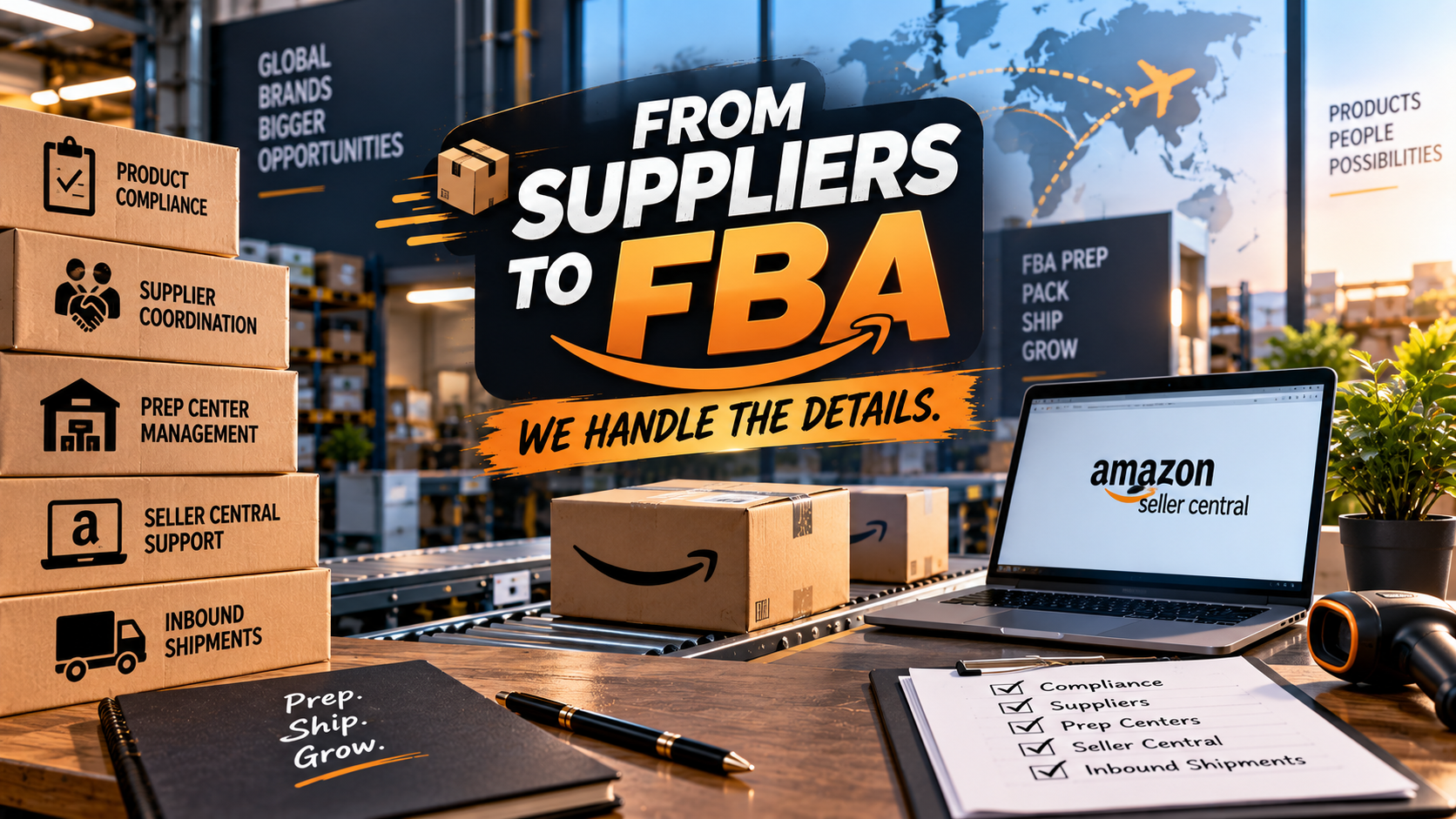
Inventory can reach a prep center and still miss its Amazon delivery window. A carton can carry the wrong label, a shipment plan can contain outdated quantities, or a prep invoice can include fees nobody approved. These small gaps can create rejected inventory, inbound defects, rush charges, and stockouts.
An amazon fba prep service handles the physical work required to make products ready for Amazon fulfillment. The right virtual assistant supports the operational layer between your supplier, prep center, carrier, and Seller Central so every shipment has an owner, a deadline, and a documented status.
What Is an Amazon FBA Prep Service?
An Amazon FBA prep service receives, inspects, labels, packages, bundles, and ships inventory according to Amazon’s fulfillment requirements. It may apply FNSKU labels, poly-bag products, protect fragile units, create cartons, and prepare shipments for an Amazon fulfillment center.
The prep center handles the physical inventory. A virtual assistant handles the coordination around it: shipping plans, supplier communication, status tracking, invoice checks, documentation, and follow-up.
Why FBA Prep Matters More in 2026
Amazon announced that it would stop offering prep and item-labeling services for US FBA shipments beginning January 1, 2026. Review the current Amazon Seller Central FBA preparation guidance before sending inventory because requirements can vary by product type, category, and fulfillment program.
That shift places more responsibility on sellers, suppliers, and third-party prep centers. Every unit may need the correct barcode, protective packaging, suffocation warning, expiration information, or bundle labeling before it reaches an Amazon fulfillment center.
Some industry providers report inbound defect fee ranges of approximately $0.32 to $5.72 per unit in certain situations. Treat those figures as because Amazon charges and enforcement rules can change. The more important risk is clear: Amazon states that shipments created after January 1, 2026, that arrive without proper preparation and labeling may not qualify for reimbursement if inventory is damaged or untraceable.
Protect your margin by controlling the entire handoff, not only the packing bench.
What an Amazon FBA Prep Service Actually Does
A capable prep center may provide the following services:
- Receiving: Accept inventory from your manufacturer, wholesaler, or supplier.
- Inspection: Check quantities, packaging condition, SKU identity, and visible damage.
- FNSKU labeling: Apply the correct Amazon barcode to each sellable unit.
- Poly-bagging: Package products that require dust, moisture, or loose-item protection.
- Bubble wrapping: Protect fragile, sharp, liquid, or breakable products.
- Bundling and kitting: Combine multiple products into one sellable unit.
- Expiration and lot labeling: Handle date-sensitive products where applicable.
- Carton preparation: Pack units into shipping cartons according to the shipment plan.
- Carton labeling: Apply the correct box labels and carrier documentation.
- Shipment handoff: Arrange carrier pickup or delivery to the assigned fulfillment center.
Confirm the exact scope before signing an agreement. “FBA prep” can mean simple labeling with one provider and full inspection, bundling, storage, and shipment management with another.
The Hidden Work: Coordinating the Prep Pipeline
Physical preparation is only one part of the process. The larger operational risk sits between systems and people.
Your supplier may say the order shipped, while the prep center has not received tracking information. The prep center may receive 1,000 units, while Seller Central shows 980. A carrier may collect the cartons, but nobody records the pickup date or confirms delivery.
A coordination-focused VA closes these gaps by maintaining one operating record for each shipment. That record should include:
- Purchase order and SKU details
- Supplier ship date and tracking numbers
- Expected arrival at the prep center
- Quantity received and quantity rejected
- Required prep services
- Seller Central shipment ID
- Carton count and carrier details
- Amazon fulfillment-center destination
- Delivery deadline
- Invoice status
- Defect or shortage documentation
This is where a virtual assistant earns its keep. The VA does not replace the prep center. The VA makes sure the prep center, supplier, carrier, and Seller Central account work from the same information.
How an Amazon FBA Virtual Assistant Runs Prep Coordination
Check shipping plans in Seller Central
Give the VA a controlled Seller Central role with only the permissions required for the work. Require the VA to compare SKU, quantity, destination, shipment ID, prep instructions, and carton requirements before sharing the plan with the prep center.
Make the VA flag discrepancies instead of guessing. Require approval from you or your operations manager before changing quantities, destinations, or shipment contents.
Track inventory from supplier to fulfillment center
Create milestone statuses such as:
- Supplier preparing
- Supplier shipped
- In transit to prep center
- Received by prep center
- Inspection underway
- Prep completed
- Carrier collected
- Delivered to Amazon
- Receiving in progress
- Closed or exception
Require the VA to update the record after each milestone and chase overdue updates. Use Google Sheets, Airtable, ClickUp, Asana, or your existing inventory platform based on your current workflow.
Communicate delays and exceptions
Set a clear escalation rule. For example, require same-day notification when a shipment is short, damaged, late, incorrectly labeled, or likely to miss an Amazon appointment.
Have the VA communicate with suppliers and prep centers using written instructions. Ask for photographs when cartons, labels, or damaged units require verification.
Audit prep invoices against pricing and SLAs
Compare every invoice against the approved service menu. Check unit counts, label charges, poly-bagging fees, storage days, receiving fees, inspection charges, and rush work.
Require the VA to identify unexplained line items before payment. Keep approved pricing, service-level agreements, and exception approvals in one shared folder.
Manage documentation for defect disputes
When an inbound problem occurs, organize the evidence immediately. Include purchase orders, delivery records, carton photographs, prep-center inspection notes, tracking details, and Seller Central correspondence.
A VA can prepare the documentation and maintain the case log. Require a qualified account owner to review and submit any formal claim or dispute.
Keep listing and inventory records clean
Match SKU names, ASINs, FNSKUs, supplier references, bundle components, and carton quantities across your systems. Remove duplicate spreadsheets and outdated shipment templates.
Use the administrative support services from Virtual Nexgen Solutions to support structured data entry, record checks, email follow-up, and recurring operational reporting.
Choosing an Amazon FBA Prep Service
Evaluate every provider against these eight points:
- Turnaround time: Ask how quickly the provider receives, inspects, and dispatches inventory.
- Transparent pricing: Request a complete list of per-unit, storage, receiving, and special-handling fees.
- Inspection standards: Confirm what the team checks and how exceptions are recorded.
- Labeling accuracy: Ask how the provider verifies FNSKU and carton labels.
- Kitting capability: Confirm whether the center can handle bundles, sets, and multipacks.
- Reporting: Require receiving reports, exception reports, and shipment confirmations.
- Seller Central coordination: Confirm whether the provider can work from your approved shipment plans.
- Location and freight options: Compare warehouse location, carrier access, delivery zones, and transit times.
Do not choose on per-unit price alone. A cheaper prep rate can become expensive when the provider gives poor receiving records or misses a shipment deadline.
Red Flags to Avoid
Walk away from a provider that offers:
- Hidden receiving, storage, or rush fees
- A vague or unwritten service-level agreement
- No inspection photographs for damaged inventory
- Shared passwords instead of controlled account access
- Slow responses during inbound exceptions
- No documented chain of custody
- No clear process for shortages or mislabeled cartons
- No support for defect documentation
Protect your account with least-privilege access. Review user permissions regularly and remove access when a contractor or provider no longer needs it.
VA + Prep Service: How They Work Together
Case Study: A US-based private-label seller receives a production update from a supplier in Vietnam. The VA confirms the purchase order, checks the approved SKUs, and prepares the Seller Central shipment plan for review.
The supplier ships the goods and sends tracking details. The VA records the expected arrival date and alerts the prep center. When the prep center receives the shipment, the VA compares the receiving report with the purchase order and asks for photographs of any damaged cartons.
The prep center completes labeling, poly-bagging, and carton preparation. The VA checks the completed unit count, records the carrier handoff, and confirms that the shipment is moving to the assigned fulfillment center. Afterward, the VA audits the invoice against the agreed pricing.
Case Study A growing home-goods seller had supplier updates in email, prep information in a spreadsheet, and Amazon shipment details in Seller Central. The proposed coordination model consolidated those records into one shipment tracker, introduced exception alerts, and added invoice review. The expected result was fewer unanswered handoffs, clearer ownership, and better documentation for inbound investigations. Metrics require validation before publication.
How Fast Can You Go Live?
Use a focused 7–10 day implementation:
- Days 1–2: Map the current supplier-to-prep-center-to-Amazon workflow.
- Days 3–5: Train the VA on Seller Central permissions, shipment records, prep instructions, and escalation rules.
- Days 6–8: Pilot the process on one live shipment.
- Days 9–10: Review exceptions, refine the SOP, and expand to additional shipments.
Do not start with your entire catalog. Use one shipment to test communication, status tracking, invoice review, and documentation.
What Does It Cost?
Virtual Nexgen Solutions provides VA support at $8 per hour. Using 4.33 weeks per month, the monthly labor examples are:
- 10 hours per week: $346.40 per month
- 20 hours per week: $692.80 per month
- 40 hours per week: $1,385.60 per month
Compare that support cost with the expense of inbound defects, rush prep, rework, delayed receiving, and lost sales caused by stockouts. The VA does not eliminate prep-center charges. The VA helps you control the administrative work that determines whether those charges are accurate and whether shipments keep moving.
How to Measure Success in 30, 60, and 90 Days
Track the process before judging the result.
During the first 30 days, measure inbound defect count, shipment tracking completion, prep-center response time, and documentation completeness.
By 60 days, review invoice accuracy, average prep turnaround, supplier communication delays, and the number of shipments with unresolved exceptions.
By 90 days, examine stockout avoidance, recurring prep errors, receiving discrepancies, and the percentage of shipments closed with complete records.
Case Study: A US cosmetics seller struggled with lot information, supplier updates, and prep-center receiving records across several spreadsheets. The proposed VA workflow created a single exception log, required date-code checks before dispatch, and separated routine updates from manager approvals. The expected benefit was improved visibility across replenishment shipments and stronger documentation when inventory did not match the plan. Final performance figures require validation.
Frequently Asked Questions
What does an Amazon FBA prep service do?
An Amazon FBA prep service receives, inspects, labels, packages, bundles, and ships products to meet Amazon’s fulfillment requirements. Services may include FNSKU labeling, poly-bagging, protective packaging, carton labeling, and shipment handoff.
How much does FBA prep cost?
Third-party FBA prep pricing varies by product, volume, packaging complexity, storage, and special handling. Many providers charge per unit and may add receiving, storage, kitting, inspection, or rush fees. Request an all-in quote before sending inventory.
Why did Amazon stop prep in 2026?
Amazon ended its US prep and item-labeling service for shipments created from January 1, 2026. Sellers must prepare inventory themselves, use their supplier, or work with a third-party prep center before sending products to Amazon fulfillment centers.
How do I avoid inbound defect fees?
Follow the current Amazon preparation requirements, verify FNSKU and carton labels, inspect inventory before dispatch, document shipment contents, and track every handoff. Use a VA to maintain records and escalate discrepancies before the shipment leaves the prep center.
Can a VA manage FBA prep coordination?
Yes. A trained VA can check shipping plans, track supplier and prep-center shipments, communicate delays, audit invoices, organize defect documentation, and maintain inventory records. The VA should not guess on shipment changes or make account decisions without your approval.
Move Every Shipment With Clear Ownership
A reliable Amazon FBA prep service protects the physical inventory. A dedicated coordination layer protects the process around it.
Use Virtual Nexgen Solutions to support supplier communication, shipment tracking, prep-center follow-up, invoice review, and Seller Central administration at $8 per hour. Book a 30-minute consultation to review your current FBA prep workflow and identify the handoffs that need stronger ownership.
Work With Virtual Nexgen Solutions
If your business needs dependable virtual assistant support, Virtual Nexgen Solutions can provide support around your existing workflow. Book a discovery call today.
Get in Touch Now!