
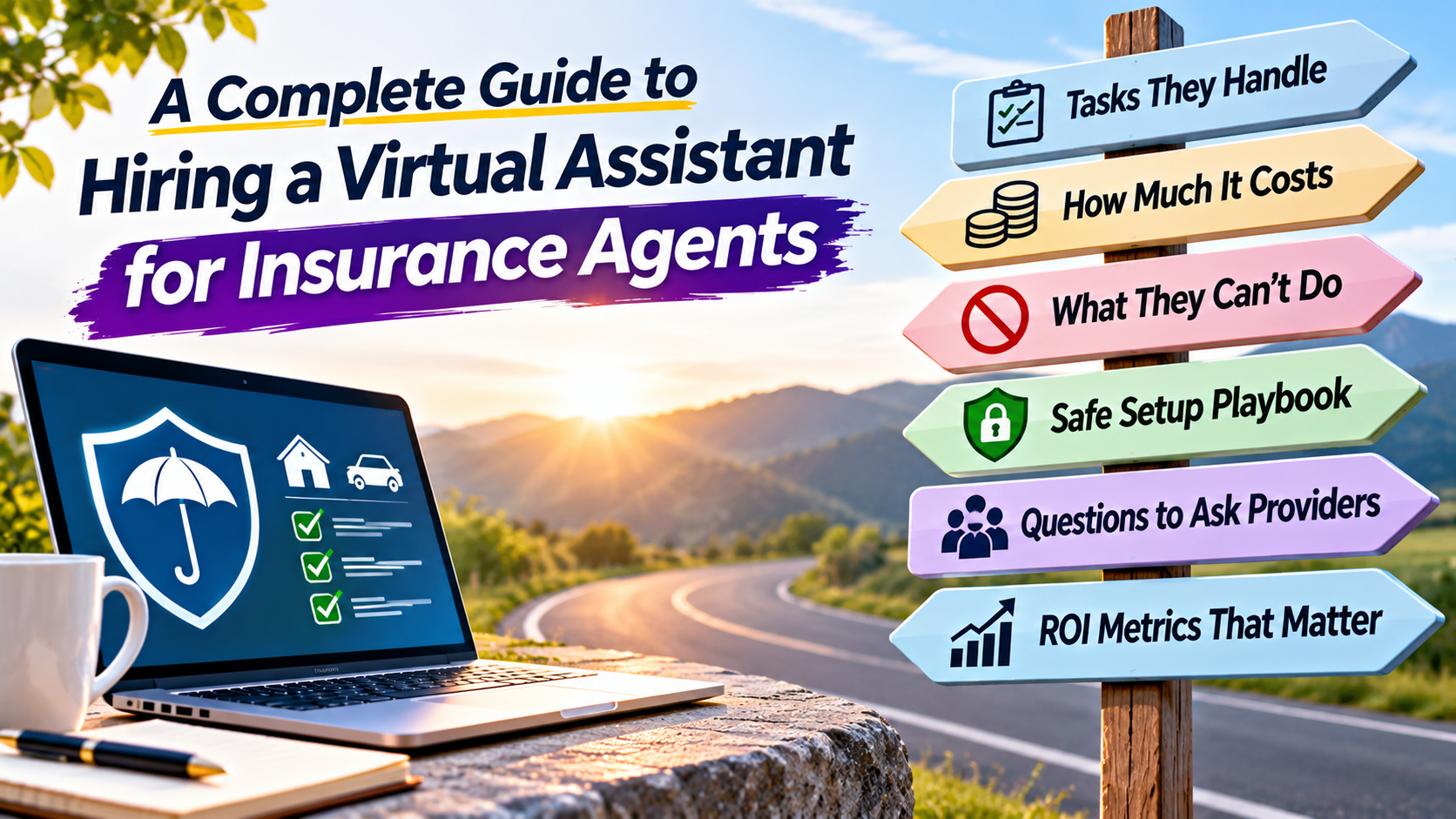
When renewal follow-ups, certificate requests, and CRM updates take over your day, you have less time for clients and new business. A virtual assistant for insurance agents can take on defined administrative workflows: provided you set clear task boundaries, access rules, and review points. Virtual Nexgen Solutions’ insurance virtual assistants provide dedicated support for agency operations, with responsibilities scoped to your processes and authorized access.
A virtual assistant (VA) is a remote worker who supports an insurance agent or agency with administrative and operational tasks. Depending on your procedures, training, system permissions, and applicable rules, an insurance VA may help with lead intake, document collection, renewal reminders, scheduling, and agency-management-system (AMS) updates. A VA should not give coverage advice or perform other activities that require a license unless properly licensed and authorized.
Why do insurance agents hire a virtual assistant?
The problem is not simply that administrative work exists. It is that recurring tasks compete with time for prospect conversations, client reviews, and decisions that require a licensed professional.
The Big “I” and Future One’s 2022 Agency Universe Study examined independent agency operations and challenges. Rather than relying on an unverified claim about the exact share of agents’ time spent on administration, use the practical test for your own agency: track how many hours go to repeatable work that could be documented and delegated.
A simple delegation calculation is:
- Record the weekly hours spent on each recurring task.
- Identify which work can be handled by a trained assistant under your supervision.
- Compare the cost of support with the value of the time and capacity returned.
- Track service outcomes, such as response time and renewal outreach, not just hours delegated.
For a directional cost reference, InSifter’s 2026 guide reports broad market ranges of $5–$12 per hour for Philippines-based assistants, $8–$18 for Latin America, $20–$40 for US-based support, and $2,000–$4,000 per month for specialized insurance VA agencies. These are guide estimates, not audited market averages or quotes; actual rates vary with hours, experience, location, and service model.
What can an insurance agency virtual assistant handle?
Start with repeatable steps that have clear instructions and an obvious escalation point. Your agency’s procedures, state requirements, carrier rules, and the VA’s license status determine the final scope.
Lead response and scheduling: A VA can acknowledge new inquiries using approved scripts, collect basic contact details, log the lead, and schedule a conversation with a licensed team member. Questions about coverage or recommendations should go to that professional.
Quoting preparation: Support may include organizing application information, requesting missing documents, creating a file, and entering client-provided data into approved systems. A licensed professional should review coverage selections, quote options, and any discussion that constitutes solicitation or negotiation.
Policy servicing and certificates: A VA may route service requests, track status, organize documents, and follow approved processes for certificate or endorsement requests. Whether they can issue a certificate or submit a change depends on state rules, carrier authorization, and your agency’s procedures. Do not treat these activities as automatically permissible everywhere.
Renewal and X-date follow-up: Your VA can maintain a renewal queue, request documents, send approved reminders, schedule reviews, and flag accounts for licensed review. A 90-, 60-, and 30-day outreach cadence can be a useful starting workflow, but set timing based on your lines of business, carrier requirements, and agency standards.
Claims communication: Administrative follow-up can include collecting documents, recording status updates, and routing questions to the appropriate licensed professional or carrier contact. Avoid coverage interpretations, liability assessments, or promises about claim outcomes.
AMS, CRM, and office administration: A VA can update records, log activities, organize files, prepare reports, manage calendars, and send approved review requests. AgencyZoom’s AMS360 integration information describes syncing book-of-business information and supporting lead workflows. That does not mean every VA should have unrestricted access: set permissions by task and confirm the integration and access model with your software provider.
For a more detailed task breakdown, see insurance virtual assistant tasks.
Which tasks should stay with licensed staff?
A useful rule is: delegate preparation and process; retain professional judgment and regulated decisions. The NAIC producer-licensing overview explains that producer licensing generally relates to selling, soliciting, or negotiating insurance. The NAIC model law is a model, not automatically the law in every state.
Do not ask an unlicensed VA to recommend coverage, interpret policy terms, negotiate insurance, bind coverage, or present advice as an agent. Other tasks, including quoting support, certificates, endorsements, and claims-related contact, require closer review of the exact activity, state requirements, carrier authorization, and your E&O obligations.
Before delegating a task, write down: what the assistant may do, what they must not do, what requires approval, and who handles exceptions. If you operate across states, verify the workflow for each relevant jurisdiction rather than assuming one rule applies everywhere.
How should you choose the best virtual assistant for insurance agents?
Choose the support model based on how much management you can provide and how specialized the work is, not just the lowest advertised rate.
- Solo agent: Consider part-time help for one or two repeatable workflows, such as lead logging and renewal reminders. A general VA may be appropriate if tasks are administrative and you can provide training.
- Small agency: A dedicated assistant or insurance-focused provider may fit if multiple people need consistent support across servicing, renewals, and AMS workflows.
- Growing agency: Look for defined coverage, quality checks, backup arrangements, and a plan for adding tasks without expanding access unnecessarily.
- MGA or high-volume operation: Compare managed processing or business process outsourcing (BPO) options with dedicated VA staffing. Ask about workflow ownership, service levels, implementation, and auditability.
Published pricing can help with initial screening, but verify it directly and compare equivalent hours and services. For example, Wing’s current insurance service page lists $999 per month for 80 hours and $1,599 per month for 160 hours. XAssure’s 2026 comparison article reports other providers’ figures, including approximately $1,988 monthly for MyOutDesk, $999–$2,419 for InsBOSS, and $2,349 for Agency VA; treat these as secondary-reported prices and confirm current terms with each provider. Provider pages and comparison articles can differ, so ask for a written quote showing hours, fees, supervision, replacement terms, and contract length.
Existing guides often provide task lists and provider comparisons but leave buyers to connect licensing boundaries, system access, and measurable results. Close that gap with a short pilot and written acceptance criteria.
Ask any provider:
- Who supervises the assistant and checks completed work?
- What insurance lines and systems has the assigned person worked with?
- How are licensing-sensitive questions escalated?
- What data security controls, subcontractors, and access locations should we know about?
- What happens if the assistant is unavailable or the match is not right?
- How are fees, working hours, and cancellation terms documented?
Be cautious of guarantees about specific sales or retention outcomes, vague security claims, or promises that an unlicensed assistant can “handle everything.”
How do you set up an insurance VA safely?
Use a controlled rollout rather than handing over every task and login on day one:
- List the recurring work. Record each task, frequency, time required, and current owner.
- Choose a low-risk pilot workflow. Start with a process such as appointment scheduling or document follow-up that has clear steps.
- Create a paid skills test. Use a sample or properly protected data; assess accuracy, communication, and escalation judgment.
- Document procedures. Record short walkthroughs and written checklists, including exceptions and approval steps.
- Set up individual access. Use named accounts, least-privilege permissions, and multifactor authentication (MFA). Avoid shared AMS logins where individual users are available.
- Check carrier portal rules. Ask carriers about authorized sub-user accounts. A password manager does not make prohibited credential sharing permissible.
- Review weekly. Begin with limited hours, check samples of completed work, and expand only when accuracy and escalation are consistent.
Virtual Nexgen describes a process that includes reviewing operations, matching a VA, configuring systems and workflows, and scaling support. You can review its insurance VA service and book a 30-minute conversation to discuss fit and scope.
What security and compliance checks matter?
Insurance agencies handle sensitive personal and financial information. The FTC’s Safeguards Rule guidance explains obligations for covered financial institutions under the FTC’s jurisdiction. Applicability depends on the organization and its regulatory circumstances; do not assume the rule applies identically to every agency. Ask qualified counsel or your compliance adviser how federal and state requirements apply to your business.
At minimum, document confidentiality and data-handling expectations; restrict downloads and local storage; use MFA and unique accounts; review access logs; define incident reporting and offboarding; and confirm whether your carriers permit the proposed portal access. If a provider makes a certification claim, request current evidence and clarify exactly which entity and services it covers.
How do you measure whether the VA is working?
Track a small set of measures before and during the pilot:
- Lead response time: How long before an inquiry receives the approved first response?
- Renewal contact rate: What share of accounts due for outreach received the planned contact?
- Quote-preparation turnaround: How quickly are complete files ready for licensed review?
- Record accuracy: What proportion of sampled CRM or AMS updates meet your checklist?
- Hours returned: How much time did licensed staff actually reclaim?
- Rework and escalation: Are errors or unhandled exceptions increasing?
These measures show whether the workflow is improving, not simply whether tasks are being checked off. Keep final review and accountability with your agency’s licensed leadership.
For the broader overview, see what an insurance virtual assistant is, or read how to hire a virtual assistant for an insurance agency.
Frequently asked questions
What is the best virtual assistant company for insurance agents?
There is no single best provider for every agency. Compare insurance workflow experience, supervision, security controls, system familiarity, pricing, and contract terms. A general VA may work for basic admin; a specialized provider may be a better fit for recurring insurance workflows.
How much does an insurance virtual assistant cost?
InSifter’s 2026 guide gives directional ranges from $5–$12 per hour in the Philippines to $20–$40 per hour in the US, with specialized agencies at $2,000–$4,000 per month. Confirm current rates and compare the same number of hours, tasks, and management support.
What tasks can an insurance VA handle?
Depending on training, permissions, and applicable rules, a VA may support lead intake, scheduling, document collection, renewal reminders, AMS updates, and administrative follow-up. Define approval and escalation steps for each workflow.
Do insurance VAs need to be licensed?
Not for every administrative task. Licensing may be required for activities such as selling, soliciting, or negotiating insurance, and state rules differ. Keep coverage advice and other licensed decisions with appropriately licensed staff unless the VA is properly licensed and authorized.
Can a VA use AMS360 or AgencyZoom?
Potentially, if the agency and software provider authorize the access and configure appropriate user permissions. Confirm the exact integration, role, data access, and audit capabilities before the VA begins work.
How can I measure an insurance VA’s ROI?
Compare the cost of support with measurable changes in time returned, lead response, renewal outreach, turnaround, and rework. Avoid assuming that delegated hours automatically produce new revenue; track the outcomes your agency can verify.
Work With Virtual Nexgen Solutions
If your business needs dependable virtual assistant support, Virtual Nexgen Solutions can provide support around your existing workflow. Book a discovery call today.
Get in Touch Now!