

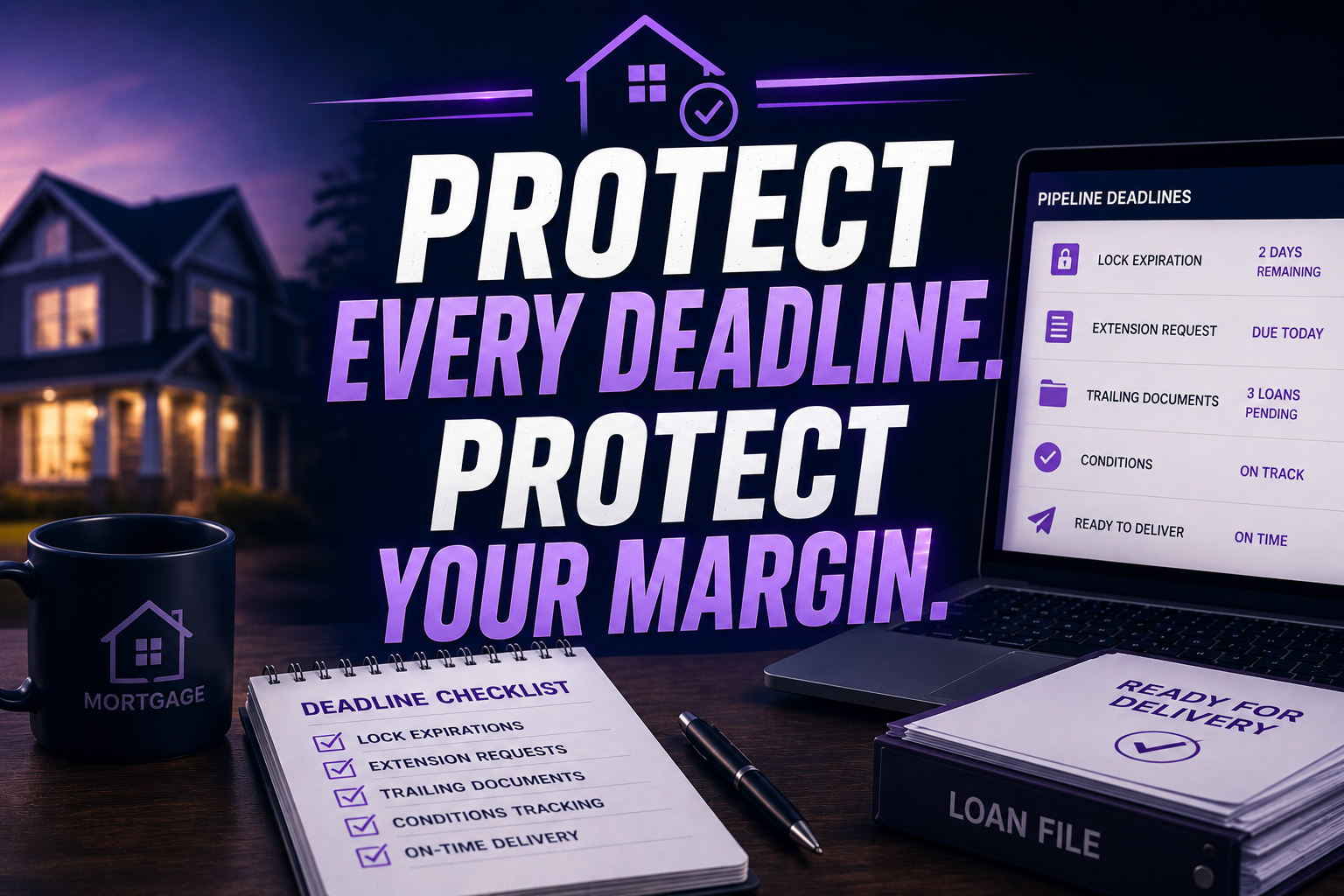
A rate lock expires the day before closing. The borrower is ready, the closing agent is waiting, and your team discovers that a $450 extension fee will erase most of the loan margin. Nobody wants that phone call.
The same pressure continues after funding. A final title policy sits in a title company inbox. A recorded deed of trust has not arrived. An investor condition remains open. Then the delivery deadline passes, and your post-closing team starts chasing documents in panic mode.
A mortgage virtual assistant gives you a dedicated Rate Lock & Post-Closing Delivery Desk. This role tracks expiration dates, prepares extension requests, updates the loan origination system, follows up with third parties, and keeps delivery files moving without making credit, pricing, or lock decisions.
What does the Rate Lock & Post-Closing Delivery Desk handle?
Use the desk to manage the work between “clear to close” and “investor-ready.” Assign these responsibilities to a trained mortgage back-office specialist:
- Rate lock expiration tracking: Record lock date, expiration date, loan number, closing date, and current status.
- Advance alerts: Review the pipeline at 10, 5, 3, and 1 business day before expiration.
- Extension preparation: Gather the facts, calculate the requested period, and prepare the request for approval.
- Renegotiation support: Compile lock details and supporting notes when an operations manager or loan officer reviews alternatives.
- LOS updates: Maintain accurate lock status, extension notes, closing dates, and approval history in Encompass or your approved LOS.
- Trailing document follow-up: Request recorded security instruments, final title policies, riders, assignments, and other required documents.
- Post-closing file preparation: Stack, label, index, and review files before investor delivery or QC review.
- Investor condition tracking: Log each condition, owner, due date, submission date, and cure status.
- Delivery deadline monitoring: Track investor, warehouse, custodian, and internal deadlines in one controlled queue.
- Escalation reporting: Send a daily exception list to the processor, closing manager, or operations leader.
How should you run the desk without giving up control?
Protect decision rights. The VA must never decide whether to extend, renegotiate, relock, or float a rate. The loan officer, secondary-markets lead, or operations manager must approve that decision.
Use this five-evidence workflow:
- Lock evidence: Capture the original lock confirmation, product, pricing, expiration date, and extension terms.
- Closing evidence: Compare the scheduled closing date with the remaining lock period.
- Document evidence: Verify which trailing documents remain outstanding and who controls each one.
- Investor evidence: Check the applicable delivery guide, purchase agreement, or investor portal requirement.
- QC evidence: Confirm that open conditions, missing signatures, data discrepancies, and file exceptions have owners.
Perform a three-way reconciliation each morning. Compare the LOS, the lock confirmation, and the closing calendar. After funding, compare the LOS, the post-closing checklist, and the investor delivery portal. Escalate any mismatch instead of guessing.
Create a simple responsibility matrix:
- VA: Track, prepare, document, follow up, and report.
- Loan processor: Confirm file status and resolve processing-owned conditions.
- Closing team: Confirm signing, funding, and closing package details.
- Loan officer or operations manager: Approve lock actions and borrower-facing decisions.
- Post-closing manager: Approve delivery readiness and investor responses.
Review the Consumer Financial Protection Bureau’s mortgage resources when designing borrower communications. Keep every fee explanation clear, documented, and consistent with your compliance policies.
What does a 30-day rollout look like?
Start with a controlled pilot rather than handing over the entire pipeline.
Days 1–5: Map the workflow. Document your lock policy, escalation rules, investor deadlines, required trailing documents, and approval hierarchy.
Days 6–10: Build the queue. Create fields for loan number, lock expiration, closing date, extension status, document owner, investor deadline, and next action.
Days 11–20: Run a live pilot. Assign the VA a limited group of loans. Require daily exception reporting and manager approval for every lock-related action.
Days 21–30: Measure and refine. Review avoidable extensions, overdue documents, unresolved conditions, LOS accuracy, and time spent by internal staff. Tighten alerts and handoff rules before expanding the desk.
How much does mortgage back-office support cost?
Virtual Nexgen Solutions provides VA support at $8 per hour. A full-time schedule of 160 hours per month equals approximately $1,280 per month, or $15,360 per year, before any optional services.
By comparison, an in-house mortgage processing or administrative assistant may cost approximately $45,000 to $60,000 in annual salary, before payroll taxes, benefits, recruiting, training, equipment, and coverage gaps. Use the lower-cost model when you need a repeatable desk but do not yet need another full-time employee.
Anonymized client example one: A regional mortgage brokerage funded about 42 loans monthly and recorded six avoidable lock extensions during a two-month review. The average extension charge was $450. After a VA introduced 10-, 5-, 3-, and 1-day reviews, avoidable extensions fell to two per month, reducing documented extension costs by about $1,800 monthly.
Anonymized client example two: A mid-sized lender had 19 trailing-document files open after funding, including final title policies and recorded instruments. Within 90 days of assigning a post-closing VA, the open queue fell to four, 95% of files reached the internal delivery target, and the post-closing manager reclaimed approximately 11 hours per week.
Which mortgage software can a VA support?
A trained VA can work inside your approved access controls and documented procedures across:
- ICE Mortgage Technology Encompass: Update milestones, lock notes, document indexes, condition status, and post-closing fields.
- Loan Officer systems: Maintain task queues, appointment notes, status updates, and borrower communication records.
- Floify: Check document requests, identify missing uploads, and organize borrower-submitted files.
- Blend: Review workflow status and flag outstanding items for the responsible team member.
- SimpleNexus: Track closing coordination, document exchange, and status notes.
- Google Workspace: Maintain controlled trackers, shared calendars, escalation logs, and email follow-up.
- DocuSign: Monitor signature status and file completed documents according to your procedures.
Limit access by role. Use separate credentials where possible. Require audit notes for every change. Keep final approval with your licensed or designated mortgage leadership.
CTA PLAN
- Use operational prompts in the article to encourage readers to audit lock expirations, delivery deadlines, and open conditions.
- Present the $8-per-hour model after the workflow explanation to support commercial evaluation.
- Use the two anonymized examples to help readers compare the cost of delay with the cost of dedicated support.
- Reserve the only direct conversion CTA for the end of the post.
FAQ
What does a mortgage virtual assistant do?
A mortgage virtual assistant handles repeatable administrative work such as rate lock tracking, LOS updates, document follow-up, post-closing file preparation, investor condition logs, and deadline reporting. The VA supports your mortgage team but does not approve underwriting, pricing, lock extensions, relocks, or borrower-impacting decisions.
How can a mortgage virtual assistant prevent rate lock expiration?
A mortgage virtual assistant reviews lock dates against scheduled closing dates and sends advance alerts before expiration. The VA prepares the extension or renegotiation request with supporting details, then routes it to the loan officer or operations manager for approval.
Can a mortgage VA request a rate lock extension?
A mortgage VA can prepare and submit a rate lock extension request only under your approved process. The VA must not decide whether an extension is financially appropriate. Give that authority to your loan officer, secondary-markets lead, or operations manager.
What post-closing documents can a mortgage VA track?
A mortgage VA can track recorded mortgages or deeds of trust, final title policies, endorsements, riders, assignments, correction documents, escrow confirmations, and investor-specific trailing documents. Your post-closing manager must define the required document list for each investor and loan product.
Can a mortgage virtual assistant work in Encompass?
Yes. A mortgage virtual assistant can support documented tasks in ICE Mortgage Technology Encompass, including milestone updates, lock notes, document indexing, condition tracking, and delivery status updates. Provide role-based access, written procedures, and review controls before granting system permissions.
How much does a mortgage virtual assistant cost?
Virtual Nexgen Solutions charges $8 per hour for VA support. At 160 hours per month, the approximate annual cost is $15,360. An in-house mortgage administrative assistant may cost $45,000 to $60,000 in salary before benefits, payroll costs, equipment, recruiting, and training.
Does a mortgage VA perform post-closing quality control?
A mortgage VA can prepare files, organize evidence, track conditions, and support the QC queue. A qualified internal manager or approved QC function must define the review scope, make findings, approve cures, and maintain independence where required by investor or company policy.
How quickly can a mortgage team onboard a VA?
Most teams can begin with a focused workflow after documenting access, responsibilities, investor rules, escalation paths, and sample files. Use a 30-day pilot, start with a limited pipeline, review results weekly, and expand responsibilities only after your manager approves the controls.
Protect your loan margins before the next expiration date. Book a 30-minute consultation with Virtual Nexgen Solutions to discuss a rate lock and post-closing support desk at $8 per hour.