

A homeowner receives a $12,000 trenchless sewer lining quote. They say, “We’ll think about it.” Your estimator sends the proposal and moves to the next inspection. Three weeks later, the homeowner still has questions about financing, warranties, access, and timing. Nobody calls. The opportunity goes cold.
Another project fails before it starts. The lining crew arrives, but the permit was never submitted and the utility locate was not scheduled. The crew leaves. Your calendar loses a day, and the customer loses confidence.
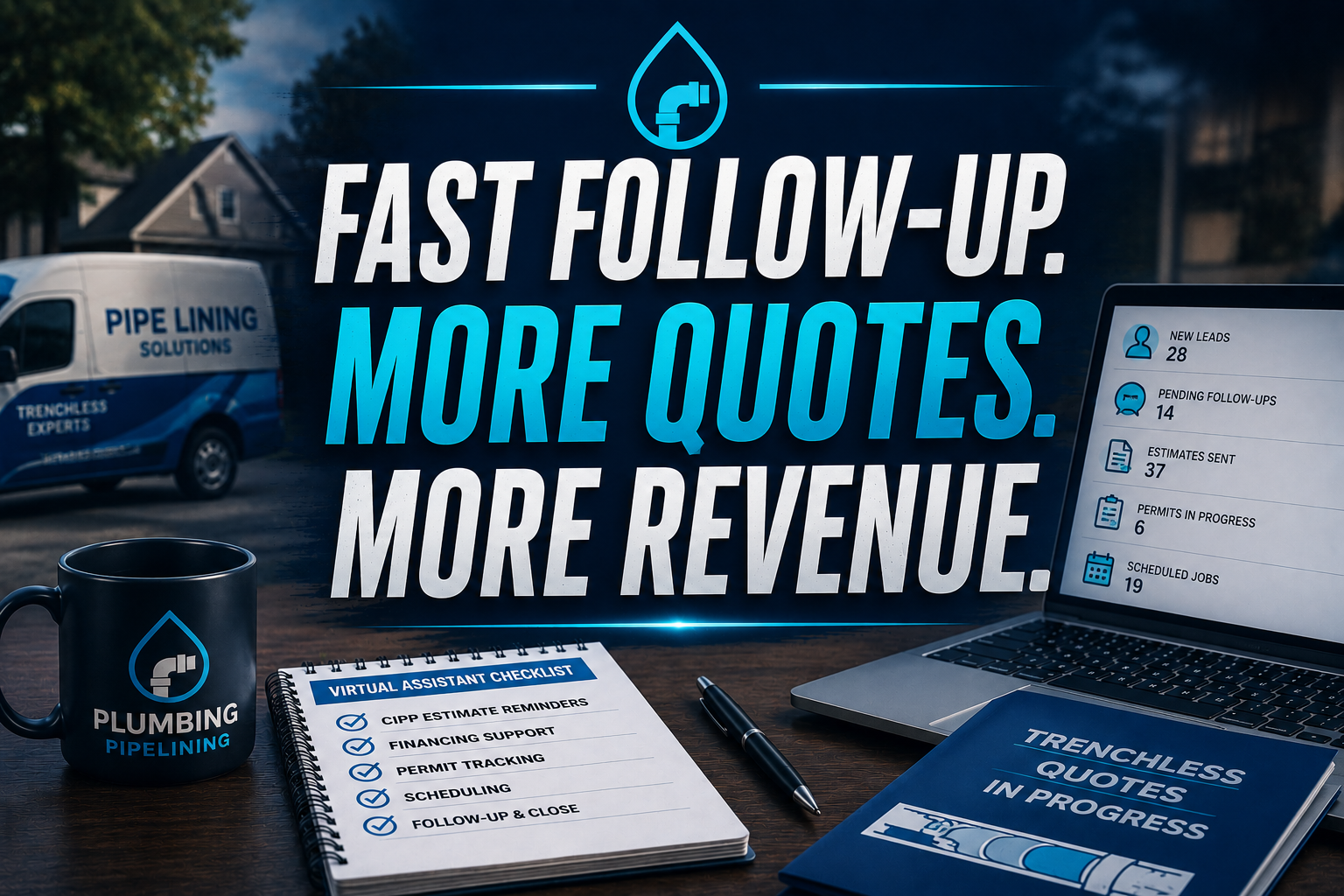
A plumbing virtual assistant gives you a dedicated estimate-to-booking desk. This person keeps every CIPP lining, pipe bursting, and trenchless sewer repair opportunity organized from inspection through warranty follow-up.
10 Core Tasks a Plumbing Virtual Assistant Handles Daily
- Organize sewer camera videos, photos, measurements, and written findings.
- Build customer-ready estimate folders in Google Drive.
- Log quote value, pipe length, diameter, access concerns, and decision stage.
- Send approved estimate follow-up messages by email or phone.
- Track questions about financing, warranties, disruption, and project timing.
- Schedule permits, utility locates, inspections, and HOA approvals.
- Confirm customer access, cleanout locations, parking, and water-use restrictions.
- Coordinate crew availability and tentative lining dates.
- Prepare DocuSign proposal and authorization packets.
- Request warranty confirmations, payment updates, and post-job reviews.
SOPs to Turn Pipelining Estimates Into Bookings
Build the Inspection Evidence Packet
Goal: Give the customer and estimator one clear source of truth.
- Download the sewer camera report and video link.
- Confirm the property address and customer name.
- Record pipe diameter, approximate length, defects, roots, and access points.
- Attach before-and-after cleaning images when available.
- Flag missing information for the estimator.
- Store the packet under the correct job number.
Use NASSCO PACP terminology when your field team provides coded inspection data. PACP condition grades range from 1 to 5, helping organize structural and operational findings.
Run the Five-Evidence Follow-Up
Goal: Answer the questions that delay a high-ticket decision.
- Lead with the documented pipe condition.
- Explain the recommended scope in plain language.
- Address access, excavation avoidance, and expected disruption.
- Present only financing terms approved by the contractor.
- Clarify warranty and scheduling information.
- Record the customer’s next decision date.
Keep the cadence respectful. Follow up shortly after the proposal, again within several days, then weekly while the quote remains active. Stop or adjust contact when the customer requests a different schedule.
Reconcile Estimate, Inspection, and Field Conditions
Goal: Prevent scope errors before the customer approves work.
- Compare the written estimate with the camera report.
- Match pipe length and diameter across both records.
- Check access assumptions against field photographs.
- Flag differences for the estimator or project manager.
- Update the proposal only after approval.
- Save the final revision with a clear date.
This three-way reconciliation protects margin. It also prevents a customer from approving one scope while the crew prepares for another.
Manage the Compliance Desk
Goal: Keep pre-lining requirements from stalling the calendar.
- Identify permit requirements by city and county.
- Submit or prepare permit information for review.
- Request utility locates before the required lead time.
- Check HOA or condominium approval requirements.
- Track inspection dates and expiration windows.
- Escalate missing approvals before scheduling the crew.
Do not promise a start date until the responsible manager confirms the requirements.
Create the Booking Handoff
Goal: Move an approved estimate into a crew-ready job.
- Confirm signed documents and deposit status.
- Verify the approved scope and access notes.
- Check equipment, liner, resin, and crew availability.
- Place the job on the scheduling board.
- Send the customer arrival window and preparation list.
- Notify the field supervisor of changes.
Use a Clear Responsibility Matrix
Goal: Keep technical decisions with licensed professionals.
- Assign the VA to documentation, reminders, and coordination.
- Assign the estimator to pricing and scope recommendations.
- Assign the licensed plumber or project manager to technical approval.
- Assign the owner or operations manager to exceptions and discounts.
- Record every handoff in the CRM.
- Review unresolved items during the daily operations check.
Close the Warranty Loop
Goal: Finish the customer experience after installation.
- Collect completion photos and final documentation.
- Confirm the warranty packet is accurate.
- Send approved care and usage instructions.
- Verify final invoice status with the office.
- Schedule a post-job customer check-in.
- Request a review only after service completion is confirmed.
Industry Software Mastered by Our Virtual Assistants
A specialized VA can support your existing systems rather than forcing a new platform. Common workflows include:
- ServiceTitan: Update job stages, attach inspection files, track estimates, and prepare follow-up queues.
- Housecall Pro: Manage customer notes, estimate status, appointments, and confirmations.
- Jobber: Maintain client records, proposals, schedules, and task reminders.
- Trenchless scheduling tools: Track liner availability, crew assignments, inspection milestones, and site requirements.
- Google Workspace: Organize reports, shared folders, calendars, and operational checklists.
- DocuSign: Prepare approved proposals, authorizations, and warranty documents.
- QuickBooks: Support invoice records, payment status checks, and customer documentation.
Case Study 1: Pipelining Contractor in Texas
A residential trenchless contractor had 34 open estimates valued at approximately $318,000. Follow-up was inconsistent because the estimator handled every customer call personally.
A Virtual Nexgen Solutions VA organized the camera reports, created quote-age queues, and introduced a documented follow-up process. Within 60 days, active follow-up coverage rose from 29% to 91%. Six additional lining jobs were booked, representing $67,400 in approved work.
Case Study 2: Commercial Sewer Rehabilitation Firm in Florida
A commercial contractor frequently scheduled lining crews before permits, utility locates, and site access documents were complete. Over one quarter, seven scheduled projects required rescheduling.
The VA introduced a pre-lining checklist and three-way reconciliation between inspection records, estimates, and field notes. In the next 30 days, incomplete scheduling packets fell from seven to one, while average booking-to-ready time declined from 12 days to 6 days.
Why the Estimate-to-Booking Desk Matters Financially
A plumbing virtual assistant costs $8 per hour through Virtual Nexgen Solutions. At 40 hours per week, that equals about $1,280 every four weeks before selecting a coverage plan.
By comparison, an in-house plumbing office administrator or dispatch coordinator may require roughly $40,000 to $55,000 per year before payroll taxes, benefits, recruiting, training, and coverage gaps. Compare the role by workload, not just hourly pay. Assign repeatable coordination work to a VA while keeping estimates, pricing, licensing, and technical judgments with your qualified team.
Follow Virtual Nexgen Solutions for a tailored workflow review, or use the company’s home-service reputation desk resource to strengthen post-job follow-up.
30-Day Rollout for Your Pipelining Desk
- Days 1–5: Document quote stages, required files, and escalation rules.
- Days 6–10: Grant controlled access to software and shared folders.
- Days 11–15: Train the VA on camera reports, estimate language, and customer privacy.
- Days 16–22: Start with aging estimates and pre-lining checklists.
- Days 23–30: Review booking rate, response time, incomplete packets, and reschedules.
The Bureau of Labor Statistics recognizes plumbing as a skilled occupation that depends on trained labor. Protect that skilled labor by removing repetitive office coordination from the field team.
FAQ
What does a plumbing virtual assistant do?
A plumbing virtual assistant handles office and coordination work such as estimate follow-up, scheduling, customer records, sewer camera report organization, permit tracking, and invoice support. The VA keeps administrative tasks moving while your estimator, licensed plumber, and project manager retain responsibility for technical decisions.
How can a plumbing virtual assistant follow up on trenchless pipelining estimates?
A plumbing virtual assistant tracks each estimate by age, value, customer questions, and decision stage. The VA sends approved follow-up messages, organizes warranty and financing information, records responses, and schedules the next conversation without changing pricing or technical scope.
How much does a plumbing virtual assistant cost?
Virtual Nexgen Solutions provides plumbing virtual assistant support at $8 per hour. The actual monthly cost depends on assigned hours and coverage needs. Compare that rate with the approximately $40,000–$55,000 annual cost of an in-house plumbing office administrator before payroll taxes, benefits, recruiting, and training.
Can a virtual assistant use ServiceTitan for plumbing dispatch?
Yes. A trained virtual assistant can update customer records, attach inspection documents, track estimate stages, prepare follow-up queues, manage scheduling notes, and send approved confirmations in ServiceTitan. Your company must provide role-based access and define which actions require manager approval.
What is CIPP pipe lining?
CIPP, or cured-in-place pipe lining, rehabilitates an existing sewer pipe by placing and curing a resin liner inside the host pipe. It can reduce excavation compared with traditional sewer line replacement, but a qualified contractor must confirm suitability through inspection and site evaluation.
How long should you follow up on a sewer lining quote?
Follow up on a sewer lining quote over several weeks, using a respectful cadence based on the customer’s stated timeline. Begin soon after delivery, answer questions, check in during the following weeks, and pause when the customer requests more time or chooses another option.
Can a plumbing VA schedule permits and utility locates?
Yes. A plumbing VA can prepare permit information, submit approved paperwork, request utility locates, track response dates, monitor HOA requirements, and escalate missing approvals. The contractor or operations manager must confirm jurisdictional requirements and approve technical or regulatory submissions.
What should be included in a trenchless sewer repair estimate?
A trenchless sewer repair estimate should identify the pipe segment, diameter, approximate length, inspection findings, preparation work, access requirements, lining or bursting method, exclusions, warranty terms, payment schedule, and expected timeline. Final scope should reflect the contractor’s inspection and site assessment.
Put Your Pipelining Desk on a Reliable Schedule
If trenchless estimates are aging, inspection packets are incomplete, or crews are waiting on permits, assign the coordination work to a specialized plumbing virtual assistant.
Virtual Nexgen Solutions provides trained administrative support at $8 per hour for estimate follow-up, document organization, permit tracking, scheduling, software updates, and post-job coordination.
Book a 30-minute consultation with Virtual Nexgen Solutions.